
Home »


Do You Need Legal Help?

"Deandra Grant Law fights hard for their clients and is always willing to go above and beyond. They are the best firm for DWI cases in DFW and beyond. Definitely hire them to represent you in any pending cases."
- P. Williams
"Deandra Grant made a tough situation so much better. She listened to my concerns and helped me so much with my case. I would recommend her to anyone needing legal services."
- M. Haley
"Deandra Grant Law handled my case with diligence and professionalism. Deandra Grant's reputation is stellar and now I know why. She has a team of individuals who provide quality service."
- N. Coulter
As Seen On







Download Our Free Texas Criminal Guide
Learn what you should and shouldn't be doing to help your criminal defense case.
Texas Ecstasy Defense Lawyers
MDMA (sold as ecstasy in pressed tablet form or as “Molly” in powder or capsule form) is a Penalty Group 2 controlled substance in Texas. Every charge involving MDMA, regardless of amount, is a felony. What most people don’t understand is that the forensic science of MDMA cases is significantly more complex than a simple positive drug test suggests. Street ecstasy is frequently adulterated with other substances, and the weight used to calculate the charge level is the weight of the entire tablet or mixture and not the weight of the MDMA it contains.
Deandra Grant Law defends MDMA and ecstasy charges across North and Central Texas. Managing Partner Deandra Grant holds a Master’s Degree in Pharmaceutical Science, a Graduate Certificate in Forensic Toxicology, and the ACS-CHAL Forensic Lawyer-Scientist designation. Partner Douglas Huff holds the same ACS-CHAL designation. The forensic science challenge in MDMA cases (from identification methodology to mixture-weight analysis) is conducted at a scientific level.
Texas Penalty Structure for MDMA
MDMA penalties differ between possession and delivery. The possession structure under §481.116 uses a different felony classification at the 1–4 gram range than the delivery structure under §481.113 — a distinction that affects the defense analysis when the facts are close to a threshold weight.
Possession (§481.116)
- Less than 1 gram: State jail felony — 180 days to 2 years, fine up to $10,000.
- 1 to less than 4 grams: Third-degree felony — 2 to 10 years, fine up to $10,000.
- 4 to less than 400 grams: Second-degree felony — 2 to 20 years, fine up to $10,000.
- 400 grams or more: First-degree felony — 5 to 99 years or life, fine up to $10,000.
Delivery and Manufacturing (§481.113)
- Less than 1 gram: State jail felony — 180 days to 2 years, fine up to $10,000.
- 1 to less than 4 grams: Second-degree felony — 2 to 20 years, fine up to $10,000.
- 4 to less than 400 grams: First-degree felony — 5 to 99 years or life, fine up to $10,000.
- 400 grams or more: First-degree felony, enhanced minimum — 10 to 99 years or life, fine up to $100,000.
Note the difference: for possession, 1–4 grams is a third-degree felony. For delivery, 1–4 grams is a second-degree felony. This distinction matters when the charge involves a borderline amount — possession at 3.5 grams is a third-degree felony carrying 2–10 years, while delivery at the same weight is a second-degree felony carrying 2–20 years.
Related Videos
The Forensic Science of MDMA Cases
The Adulterant Problem: What “Ecstasy” Actually Contains
The most significant forensic issue in MDMA cases is one that most defense attorneys never raise: the substance the defendant possessed may not be MDMA at all, or may be a mixture containing MDMA alongside other compounds that materially affect both the identification analysis and the weight calculation.
Street ecstasy has a well-documented adulterant problem. Testing of seized tablets and powder sold as MDMA or Molly has consistently found that a substantial percentage contain no MDMA whatsoever, or contain MDMA mixed with:
- Methamphetamine — a Penalty Group 1 substance with a different charge structure and, at the same weight, potentially harsher penalties than MDMA.
- Cathinones (“bath salts”) — synthetic stimulants classified under Penalty Group 2 or Penalty Group 2-A depending on the specific compound, with their own identification and classification questions.
- PMA / PMMA (para-methoxyamphetamine / para-methoxymethamphetamine) — substances sold as MDMA but with a significantly narrower therapeutic window and higher toxicity profile. The presence of PMA rather than MDMA in a seizure is a different controlled substance requiring separate identification.
- MDA (3,4-methylenedioxyamphetamine) — a Penalty Group 2 substance closely related to MDMA but chemically distinct. GC-MS analysis must distinguish between MDMA and MDA as separate compounds.
- Inert fillers and binders — pressed tablets contain significant quantities of microcrystalline cellulose, starch, lactose, and other tablet excipients that add to the total weight but contain no controlled substance.
The forensic implication: a “positive for MDMA” result must specifically confirm the presence of MDMA as a distinct molecular entity, not merely a class of amphetamine-related compounds. And where the tablet or powder contains multiple substances, the prosecution must establish which specific controlled substance is present and at what concentration.
Tablet Weight vs. Pure Compound Weight
A standard pressed ecstasy tablet weighs between 200 and 500 milligrams total. The MDMA content of a typical tablet (where MDMA is actually present) ranges from approximately 80 to 250 milligrams, representing perhaps 30% to 60% of the total tablet weight. The remainder is binder, filler, and excipient material.
Texas charges MDMA offenses based on the weight of the entire mixture (tablet weight, not pure MDMA weight). This means that the charge level for possession of 10 pressed tablets is calculated on the total weight of those tablets, not on the total weight of MDMA they contain. At the boundaries between felony classifications (particularly the 1-gram threshold between a state jail felony and a third-degree felony, and the 4-gram threshold between a third-degree and a second-degree felony) the margin of error in the weight measurement and the proportion of the tablet that is actually MDMA are legitimate forensic questions.
GC-MS Identification of MDMA and Its Analogs
Confirmed identification of MDMA is typically from gas chromatography-mass spectrometry (GC-MS), which separates and identifies compounds by molecular weight and fragmentation pattern. MDMA and its close analogs (MDA, MDEA (3,4-methylenedioxyethylamphetamine), and others) have similar but distinguishable mass spectra. The analyst must correctly identify the specific compound present and distinguish it from chemically similar substances that may be classified differently under Texas law.
The defense should obtain the complete GC-MS analytical data (chromatogram, mass spectrum, and reference standard comparison) not just the summary laboratory report. In cases where the spectrum is complex due to multiple compounds in the mixture, the analyst’s interpretation of overlapping spectral peaks is a topic for expert cross-examination.
Chain of Custody
An MDMA specimen must be traceable from the point of collection through booking, evidence storage, and laboratory analysis. Tablets and powder seized in a drug investigation may pass through multiple hands and storage locations before analysis. Any gap in the chain of custody documentation creates a foundation for a challenge to the integrity of the laboratory result.
The Constitutional Foundation: Article 38.23
Texas Code of Criminal Procedure Article 38.23 (the exclusionary rule with no good faith exception) suppresses evidence obtained through an unlawful stop, an overbroad search, or a constitutionally defective seizure. MDMA cases frequently arise from event and concert venue searches, traffic stops, and controlled buys. The legality of the initial encounter, the basis for the search, and whether any consent was voluntary are all questions the defense must evaluate from the outset.
Why Deandra Grant Law
- ACS-CHAL Forensic Lawyer-Scientist — both Deandra Grant and Douglas Huff.
- Digital forensics training. Cell phone data, social media, CDR records, and metadata examined at the data level.
- 30+ years of criminal defense experience. 500+ trials to verdict across North and Central Texas.
- 17 published law books. Including Arrested for Drugs in Texas
- Texas Super Lawyer since 2011. AV® Preeminent rated by Martindale-Hubbell®.
- Offices in Dallas, Fort Worth, Allen, Denton, Waco, and Rockwall. North and Central Texas courts served directly.
- Federal defense capability. James Lee Bright handles federal charges in all four Texas federal districts.
If you are facing MDMA or ecstasy charges in Texas, call (214) 225-7117 for a free, confidential consultation. Or schedule online at texasdwisite.com.
Related Blogs
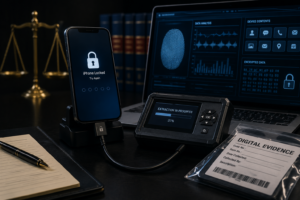
Can Police Get Into Your iPhone? How Apple’s New Security Is Reshaping Digital Evidence
By Douglas E. Huff | Partner, Deandra Grant Law | Dallas, Texas In March 2026, [...]

The Michael Morton Act, the Richard Miles Act and the Heath Opinion Now Under Fire
Most people who are not lawyers do not think much about criminal discovery. It sounds [...]

Pitchford v. Cain: What a Batson Challenge Is, and Why the Jury Is Often Decided Before the First Witness
By Deandra Grant | Deandra Grant Law | Dallas, Texas On May 28, 2026, the [...]

Probabilistic DNA Software in the Courtroom: What Defense Lawyers Need to Watch For
This month Cybergenetics (the company behind the TrueAllele probabilistic genotyping system) announced the launch of [...]

Texas SB 4 Goes Live May 15: What Defense Lawyers and Their Clients Need to Know Right Now
On April 24, 2026, the en banc Fifth Circuit vacated the preliminary injunction that had [...]

How Forensic Misconduct Can Unravel a Conviction: The Missy Woods Case and What It Means for Texas
For 29 years, Yvonne “Missy” Woods was a star analyst at the Colorado Bureau of [...]

Can the Algorithm Convict You? TrueAllele and a Defendant’s Right to Cross-Examine the Code
In March 2026, the U.S. Court of Appeals for the Third Circuit handed prosecutors a [...]

Can a Texas Warrant Expire or Does It Follow You Forever?
One of the most common misconceptions about warrants in Texas is that they eventually expire [...]
Client Reviews

“Deandra Grant Law – Criminal & DWI Defense handled my case with diligence and professionalism. Deandra Grant’s reputation is stellar and now I know why. She has a team of individuals who provide quality service.”
N. Coulter


(214) 225-7117
Experienced DWI Defense