
Home »


Do You Need Legal Help?

"Deandra Grant Law fights hard for their clients and is always willing to go above and beyond. They are the best firm for DWI cases in DFW and beyond. Definitely hire them to represent you in any pending cases."
- P. Williams
"Deandra Grant made a tough situation so much better. She listened to my concerns and helped me so much with my case. I would recommend her to anyone needing legal services."
- M. Haley
"Deandra Grant Law handled my case with diligence and professionalism. Deandra Grant's reputation is stellar and now I know why. She has a team of individuals who provide quality service."
- N. Coulter
As Seen On







Download Our Free Texas Federal Guide
Learn what you should and shouldn't be doing to help your federal defense case.
Federal Drug Trafficking Defense Lawyers in Texas
Federal drug trafficking is one of the most heavily prosecuted categories of federal crime in the Northern District of Texas. Dallas sits at the intersection of I-35 and I-45 (two of the primary trafficking corridors connecting Mexico to distribution networks throughout the United States) making the Northern District a high-priority enforcement jurisdiction for the DEA, FBI, Homeland Security Investigations, and the HIDTA task forces operating throughout North Texas.
By the time federal drug trafficking charges are filed, the government’s investigation is typically months or years old. Wiretap recordings, surveillance footage, controlled buy evidence, cooperating witness debriefs, and forensic laboratory results have already been assembled. The defendant is facing a case the government believes it can win with mandatory minimum sentences that limit the court’s discretion regardless of individual circumstances.
At Deandra Grant Law, Attorney James Lee Bright leads our federal drug trafficking defense with more than 25 years of experience in federal courts across Texas and the District of Columbia. Our firm also brings ACS-CHAL Forensic Lawyer-Scientist credentials (held by both Deandra Grant and Douglas Huff) giving us the ability to evaluate the government’s drug identification and quantification evidence at a scientific level. Deandra holds an M.S. in Pharmaceutical Science and a Graduate Certificate in Forensic Toxicology, and has undergone forensic chromatography training at Axion Analytical Laboratories. That training directly applies to the GC-MS and GC-FID methods federal laboratories use to identify controlled substances and report quantities that determine mandatory minimum sentences. No other firm in North Texas brings this combination of federal trial experience and forensic science credentials to drug trafficking defense.
Federal Drug Trafficking Statutes and Mandatory Minimums
Federal drug trafficking penalties under 21 U.S.C. §841 are determined primarily by drug type and quantity. The following thresholds trigger mandatory minimum sentences:
- Cocaine: 500 grams or more — 5-year mandatory minimum, 40-year maximum. 5 kilograms or more — 10-year mandatory minimum, life maximum.
- Methamphetamine: 5 grams or more (pure) or 50 grams or more (mixture) — 5-year mandatory minimum, 40-year maximum. 50 grams or more (pure) or 500 grams or more (mixture) — 10-year mandatory minimum, life maximum.
- Heroin: 100 grams or more — 5-year mandatory minimum, 40-year maximum. 1 kilogram or more — 10-year mandatory minimum, life maximum.
- Fentanyl: 400 grams or more (mixture) — 10-year mandatory minimum, life maximum. Fentanyl prosecutions are a stated enforcement priority in the Northern District of Texas, and the threshold quantities are substantially lower than for other Schedule II substances.
- Marijuana: 100 kilograms or more (or 100 plants) — 5-year mandatory minimum. 1,000 kilograms or more (or 1,000 plants) — 10-year mandatory minimum, life maximum.
A prior federal felony drug conviction doubles the applicable mandatory minimum and maximum under 21 U.S.C. §851. Two prior felony drug convictions can result in a mandatory life sentence for certain quantity thresholds. The government must file a formal §851 notice to trigger these enhancements and those notices can be challenged.
Because mandatory minimums are keyed to specific quantity thresholds, the government’s drug quantity evidence is the most consequential element of the prosecution. Laboratory analysis determines quantity and laboratory analysis can be wrong, incomplete, or conducted under conditions that do not meet validated standards.
Recent Blogs

Bite Marks, Hair Analysis, and the Science Courts Are Still Admitting
In 2016, the President’s Council of Advisors on Science and Technology (PCAST) published a detailed [...]
Cold Cases and the Fourth Amendment: What Genetic Genealogy Means for Defendants
Florida Attorney General James Uthmeier announced this week a $600,000 partnership with Othram (a Texas-based [...]
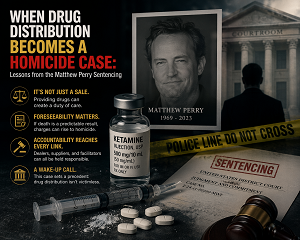
When Drug Distribution Becomes a Homicide Case: Lessons from the Matthew Perry Sentencing
On April 8, 2026, U.S. District Judge Sherilyn Peace Garnett sentenced Jasveen Sangha (the Los [...]
Criminal Justice Reform in 2026: What It Means for Texas Defendants
National headlines about criminal justice reform in 2026 tell a story of accelerating bipartisan progress [...]
How Do Police Track Your Online Activity And Can That Evidence Be Challenged?
Law enforcement agencies have increasingly sophisticated tools for monitoring and documenting internet activity. They can [...]

What to Do if You’re Falsely Accused of Sexual Assault in Texas
Few things are more terrifying than being accused of something you did not do and [...]

How Killing a Cop Went from Murder to Manslaughter
A New York jury recently acquitted Guy Rivera of first-degree murder in the 2024 shooting [...]

When Restraining a Student Becomes a Criminal Charge: What Texas Teachers Need to Know About Injury to a Child
A veteran teacher with twenty-something years in the classroom, no disciplinary history, no prior criminal [...]
How We Challenge the Government’s Evidence
Drug Identification and Quantification
The forensic laboratory report is the linchpin of most federal drug trafficking prosecutions. It identifies the controlled substance and reports the quantity that determines which mandatory minimum applies. That report is not self-executing evidence of accuracy. It reflects the work of a human analyst using instruments that require calibration, reference standards that must be validated, and methods that must be properly followed.
Our ACS-CHAL Forensic Lawyer-Scientist credentials allow us to evaluate the government’s laboratory evidence at the level it deserves. We review: whether the laboratory’s standard operating procedures were followed; whether instruments were properly calibrated using traceable reference standards; whether appropriate controls and blanks were included in the analytical run; whether chromatographic retention times and mass spectra actually support the reported identification; whether the internal standard response was within validated acceptance criteria; and whether chain of custody was maintained from seizure through analysis. An error in quantification can mean the difference between 5 years and 10 years. An error in identification can undermine the charge entirely.
We also evaluate the Confrontation Clause implications of how laboratory evidence is offered. Under Melendez-Diaz v. Massachusetts (2009) and Bullcoming v. New Mexico (2011), the certifying analyst must testify and be subject to cross-examination. A substitute analyst (a supervisor or coworker who did not personally perform the analysis) does not satisfy the defendant’s right of confrontation. Requiring the government to produce the actual certifying analyst opens the door to exactly the cross-examination that laboratory results most need.
Search and Seizure Challenges
Many federal drug trafficking cases originate with a traffic stop, a border crossing, a controlled delivery, or a premises search. The legality of those searches and the seizures that follow is subject to Fourth Amendment challenge. Lee evaluates every search and seizure in a trafficking case for potential suppression: the constitutional basis for the initial stop or search, the scope of any consent given, the adequacy of any warrant and the four corners of the supporting affidavit, and whether evidence discovered in plain view was actually in a lawful vantage point.
In cases involving extended surveillance, GPS tracking, cell site location data, or monitoring of electronic communications without a Title III wiretap order, additional Fourth Amendment and statutory issues arise. Following the Supreme Court’s decisions in
Carpenter v. United States (2018) and related cases, the government’s use of prolonged electronic surveillance without a warrant is subject to serious constitutional challenge. Evidence obtained through unlawful electronic surveillance can be suppressed.
Wiretap and Electronic Surveillance Evidence
Title III wiretap evidence is among the most powerful and most technically challengeable evidence in federal drug trafficking cases. Lee examines compliance at every stage: the necessity showing required before a wiretap order can issue (the government must demonstrate that conventional investigative techniques have been tried and failed or are unlikely to succeed); the scope of the order and whether agents intercepted communications outside its authorization; compliance with the 30-day maximum duration and renewal requirements; minimization which is the requirement that agents stop listening when conversations are not pertinent to the investigation; and the sealing requirements for intercepted communications. A successful suppression motion targeting wiretap evidence can eliminate the government’s most critical proof of the trafficking operation’s scope and the defendant’s participation in it.
Cooperating Witness Testimony
Cooperating witnesses in federal drug cases receive significant benefits in exchange for their testimony: reduced sentences, dropped charges, financial consideration, and relocation assistance in some cases. These incentives create powerful motivation to provide testimony that implicates others, and the reliability of cooperator testimony is directly tied to the scrutiny it receives on cross-examination.
Lee’s decades of federal trial experience make him exceptionally effective at cross-examining cooperators. The cross-examination examines the specific terms of the cooperation agreement and what the witness stands to gain, prior statements the witness made that are inconsistent with their trial testimony, the witness’s criminal history and demonstrated willingness to lie under oath, and the degree to which the cooperator’s account is corroborated by objective evidence as opposed to standing alone as uncorroborated assertion.
Quantity Attribution and Relevant Conduct
The drug quantity attributed to a defendant under the Sentencing Guidelines is driven by the relevant conduct rules: all quantities within the scope of the jointly undertaken criminal activity that were reasonably foreseeable to the defendant. This can produce sentences based on quantities that far exceed anything the defendant personally handled.
We challenge the quantity calculation at every level: the evidentiary basis for the government’s total quantity figure, the reliability of cooperator testimony used to establish quantities not captured in physical evidence, the foreseeability of quantities attributed to a defendant based on their specific role in the alleged conspiracy, and whether the government has improperly conflated the total drug quantity of a large operation with the quantities actually attributable to this defendant’s individual conduct. Because mandatory minimums are threshold-based, a successful quantity challenge can move a defendant below a threshold that carries years of additional mandatory prison time.
Sentencing in Federal Drug Trafficking Cases
Federal Safety Valve
The federal safety valve (18 U.S.C. §3553(f)) allows a judge to sentence below the applicable mandatory minimum if the defendant satisfies five criteria: criminal history that does not exceed four points under the Guidelines; no prior three-point offense; no prior two-point violent offense; no use of violence, threats, or a dangerous weapon in the offense and no serious bodily injury or death resulted; and the defendant was not an organizer, leader, manager, or supervisor. The defendant must also, before sentencing, truthfully provide the government with all information the defendant has about the offense and all related offenses.
The safety valve proffer (the meeting at which the defendant provides information to the government) must be carefully prepared with counsel. Incomplete disclosure disqualifies the defendant from safety valve relief. Inaccurate disclosure creates additional criminal exposure. Navigating the safety valve proffer requires knowing exactly what the government already knows, what the defendant can truthfully provide, and how to present it in a way that satisfies the statutory requirement without creating new problems.
Role Reduction
The Sentencing Guidelines provide for downward adjustments of two levels (minor role) or four levels (minimal role) for defendants who were substantially less culpable than the average participant in the criminal activity. In large trafficking operations involving multiple levels of distribution, lower-level participants (couriers, street-level distributors, peripheral logistics support) often qualify for role reductions that meaningfully reduce the guidelines range. Lee evaluates the role reduction argument in every trafficking case and presents it aggressively where the facts support it.
§851 Enhancement Challenges
When the government files a §851 notice to double the mandatory minimum based on a prior felony drug conviction, that enhancement can be challenged. The qualifying conviction must be a “felony drug offense” as defined under federal law, which is not the same as a state felony drug conviction. Some prior convictions that appear to qualify do not actually meet the statutory definition. Procedural requirements for §851 notices must also be met. A successful challenge to a §851 enhancement can halve the mandatory minimum and the potential maximum the defendant faces.
Substantial Assistance
A substantial assistance motion under U.S.S.G. §5K1.1 allows the court to sentence below the mandatory minimum based on the value of the defendant’s cooperation with the government’s investigation or prosecution of others. Whether cooperation is appropriate requires careful evaluation of the specific facts, the strength of the government’s case against the defendant, what the defendant actually knows, and the personal risks associated with cooperation in a drug trafficking context. This is a decision that must be made with full information and sound judgment and not under pressure and not without understanding the consequences.
Lead Attorney: James Lee Bright
James Lee Bright has spent more than 25 years defending clients against the most serious federal drug charges in courts across Texas and the country.
- Juris Doctor, University of Tennessee College of Law (1996)
- LL.M. in International Law, SMU Dedman School of Law (2003) — Phi Delta Phi honor fraternity
- Admitted to all four U.S. District Courts in Texas (Northern, Eastern, Southern, and Western Districts)
- Admitted to the U.S. District Court for the District of Columbia
- Admitted to the U.S. Court of Appeals for the Fifth Circuit
- Admitted to the United States Supreme Court
- Lead defense counsel in the Stewart Rhodes/Oath Keepers seditious conspiracy trial which was a three-month federal trial in Washington, D.C., among the most significant federal conspiracy prosecutions in recent history
- President, Dallas Criminal Defense Lawyers Association (2010–2011)
- Super Lawyers® (2021–2024)
- D Magazine Best Lawyers — multiple appearances
Facing Federal Drug Trafficking Charges? Act Immediately.
Federal drug trafficking cases move fast and the government’s advantage compounds with time. Every day that passes without legal representation is a day the defense is not reviewing discovery, not identifying suppression issues, not assessing sentencing alternatives, and not engaging with prosecutors at the pre-trial stage where the most leverage exists.
Contact Deandra Grant Law for a free, confidential consultation with Attorney James Lee Bright. We represent clients in federal courts throughout Texas and beyond.
Call (214) 949-4295 or schedule an appointment online.
Client Reviews

“Deandra Grant Law – Criminal & DWI Defense handled my case with diligence and professionalism. Deandra Grant’s reputation is stellar and now I know why. She has a team of individuals who provide quality service.”
N. Coulter


(214) 225-7117
Experienced DWI Defense