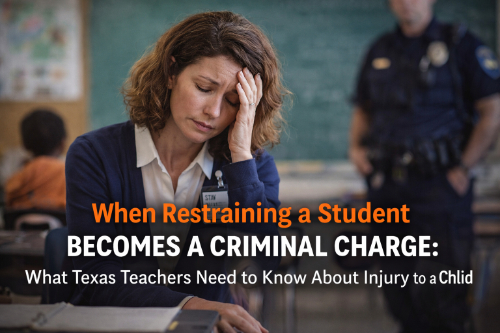
A veteran teacher with twenty-something years in the classroom, no disciplinary history, no prior criminal record. A student in crisis who is physically dangerous, injuring themselves or others and beyond the reach of verbal de-escalation. The teacher intervenes physically. Someone gets hurt. And then, weeks or months later, there is a criminal charge: injury to a child, a third-degree felony under Texas Penal Code §22.04.
This is not a hypothetical. It has happened to teachers in Texas and it is happening more frequently as special education classrooms grow larger, behavioral supports grow thinner, and school districts respond to liability by stepping back and letting the criminal justice system step forward.
If you are a teacher, a special education aide, or a school administrator in Texas, you need to understand what the law says, what the law permits, and what happens when a school district’s failures land in a prosecutor’s inbox with your name on it.
What Injury to a Child Actually Requires
 Texas Penal Code §22.04 defines injury to a child as intentionally, knowingly, recklessly, or with criminal negligence causing bodily injury, serious bodily injury, or serious mental deficiency to a child under 15 years of age. The offense level depends on the mental state and the severity of harm:
- Intentional or knowing serious bodily injury: First-degree felony — 5 to 99 years.
- Intentional or knowing bodily injury: Third-degree felony — 2 to 10 years.
- Reckless serious bodily injury: Second-degree felony — 2 to 20 years.
- Reckless bodily injury: State jail felony — 180 days to 2 years.
- Criminal negligence causing serious bodily injury: State jail felony.
The mental state is everything. A teacher who physically restrains a student is not acting with intent to injure. The question is whether their conduct was reckless (whether they consciously disregarded a substantial and unjustifiable risk of injury) or criminally negligent, meaning they should have been aware of that risk. These are factual determinations made by prosecutors, grand juries, and trial juries, often without any firsthand understanding of what it looks like to manage a student in a full behavioral crisis in an understaffed classroom.
What Texas Law Actually Permits: The Education Code and TEA Restraint Rules
Texas does not prohibit physical restraint of students. It regulates it. Texas Education Code §37.0021 and the Texas Education Agency’s restraint and seclusion rules (19 TAC §89.1053) establish a framework for when physical restraint is lawful in a school setting.
Physical restraint is permitted when:
- The student’s behavior poses a threat of imminent, serious physical harm to the student or others.
- Less restrictive interventions have been tried and failed or are clearly inadequate given the emergency.
- The restraint is the minimum force necessary to address the emergency.
- The restraint does not restrict the student’s ability to breathe.
Physical restraint is not permitted as:
- A form of discipline or punishment.
- A response to property destruction alone (without risk of physical harm to persons).
- A response to verbal behavior, refusal to comply, or non-dangerous behavior.
- A convenience measure when appropriate behavioral supports are not in place.
When a restraint occurs, TEA rules require that it be documented, that parents be notified, and that the school evaluate whether the student’s behavioral intervention plan (BIP) needs to be updated. These documentation requirements matter enormously in a criminal case, because they create a contemporaneous record of what happened, why, and whether the teacher followed protocol.
The IEP and BIP: What Schools Are Required to Have in Place
Every student receiving special education services in Texas is entitled to an Individualized Education Program (IEP) under the Individuals with Disabilities Education Act (IDEA). For students with behavioral challenges, the IEP should include a Behavioral Intervention Plan which is a document that identifies the student’s behavioral triggers, the specific interventions to be used, the sequence of responses to escalating behavior, and who is responsible for each step.
A well-developed BIP means that when a student begins to escalate, everyone in the room knows what to do. A missing or inadequate BIP means the teacher is improvising in a crisis with no roadmap, no trained support, and no institutional guidance. If something goes wrong, the teacher is the one who gets charged.
In the cases we have handled, the pattern is consistent: the district had failed to develop an adequate BIP, had failed to provide the training required to implement behavioral supports, had failed to ensure that adequate staff were present in the classroom, or had placed a student with serious behavioral needs in an environment that could not safely accommodate those needs. The teacher did not create that situation. The teacher inherited it and then faced a felony charge when it went wrong.
How a Criminal Investigation Typically Unfolds
Criminal investigations of teachers in these situations rarely begin with a police call from the teacher. They begin with a report from the student, from a parent, from another student, or from a colleague. The school district may or may not conduct its own investigation before law enforcement is involved. In some cases, the district’s internal investigation concludes before a teacher is aware that criminal charges are being considered.
From the moment a report is made, everything the teacher says (to administrators, to HR, to the school district’s investigator) can potentially be used in a criminal proceeding. Texas does not have a blanket teacher privilege that protects internal school communications from criminal discovery. If you are a teacher who has been asked to participate in an internal investigation following a physical restraint or intervention, you should speak with a criminal defense attorney before you make any written or recorded statement, regardless of whether you have been told that criminal charges are being considered.
The Defense in Teacher Injury to a Child Cases
These cases are defensible. The charge requires proof of a mental state (recklessness or criminal negligence at minimum) and the facts of most teacher-student physical intervention cases do not support that standard when fully developed. The key evidence in these cases includes:
The student’s IEP and BIP. What was the school required to have in place? What was actually in place? What did the behavioral intervention plan call for in exactly the situation that occurred? If the teacher followed the plan, that is a powerful defense. If there was no plan, or the plan was inadequate, that speaks to the district’s failure and not the teacher’s culpability.
Training records. Was the teacher trained in the de-escalation and restraint techniques required by TEA rules? Did the district provide that training? Training documentation that shows the teacher used the techniques they were taught significantly undermines a recklessness theory.
Classroom staffing. How many students were in the room? How many adults? What were the student’s known behavioral needs? A teacher alone in a classroom with multiple students with serious behavioral challenges who intervenes physically to prevent injury is not acting recklessly. They are doing what the district’s staffing decisions required them to do.
Prior behavioral incidents. What is the documented history of this student’s behavior? Prior incident reports, behavioral data, and documentation of previous interventions establish the context in which the teacher was operating. A student with a documented history of assaultive behavior toward staff and peers is a fundamentally different situation than an isolated incident.
Surveillance footage. Most Texas schools have camera systems. The footage, if it exists and is preserved, is often the most important evidence in these cases. It shows what actually happened and not what was reported, not what was alleged, not what was reconstructed from memory. Preservation of surveillance footage should be a priority from the moment a criminal investigation is underway.
The injury itself. Medical evidence of the nature and severity of the injury is relevant both to the charge level and to the question of whether it is consistent with the student’s own behavior during the incident. Students in behavioral crises frequently injure themselves (against walls, furniture, the floor, or through self-injurious behavior). Whether the injury was caused by the restraint or by the student’s own actions during the incident is a factual question the defense examines carefully.
The School District’s Role and Its Incentives
It is worth being direct about something: when a teacher faces a criminal charge arising from a school incident, the school district’s interests and the teacher’s interests are not the same.
The district has its own liability exposure to the student’s family under IDEA, under Section 504, and potentially in civil litigation. The district has an institutional interest in demonstrating that the teacher acted outside of policy, outside of training, and without authorization because that separates the district’s conduct from the teacher’s and limits the district’s exposure. The district’s lawyers work for the district. The district’s HR department works for the district. The district’s investigator works for the district.
None of them work for the teacher.
This is not an accusation of bad faith. It is a description of how institutional incentives work. Teachers who have been charged, or who are under investigation, should have their own legal representation and should understand that cooperation with a district investigation is a choice, not a legal requirement, and one with potential criminal consequences.
What Teachers Should Do Immediately
- Do not make any written or recorded statement to administrators, HR, or investigators without speaking to a criminal defense attorney first.
- Preserve any personal records you have: notes, emails, prior incident reports, communications with parents, documentation of your requests for behavioral support or additional staffing.
- Document your own account of what happened, in writing, as soon as possible after the incident for your attorney, not for the district.
- Contact a criminal defense attorney before the situation becomes a formal criminal investigation, if at all possible. Early intervention sometimes prevents charges from being filed.
- Understand that a TEA certification investigation and a criminal investigation are separate proceedings. A finding in the TEA proceeding does not determine the outcome of the criminal case, and vice versa. You may need separate representation for each.
A Note on Who These Cases Actually Involve
The teachers we have represented in these cases are not reckless people. They are experienced educators who have spent decades working with students with serious behavioral and developmental needs (i.e. students that many other adults are not equipped or willing to work with). They took jobs that are genuinely hard, in classrooms that are genuinely difficult, and they stayed.
The criminal justice system does not have a category for that context. Texas Penal Code §22.04 does not ask whether the defendant was a veteran teacher acting in good faith in an impossible situation created by institutional failures. It asks whether the defendant’s conduct was reckless or criminally negligent. The defense’s job is to make sure the jury understands the full context and to hold the prosecution to its burden of proving, beyond a reasonable doubt, that what happened in that classroom was a crime rather than the predictable consequence of an underfunded, understaffed, and underregulated system that puts impossible demands on the people closest to the students.
If you are a Texas teacher, school employee, or administrator facing a criminal investigation or charge arising from a student physical intervention, contact Deandra Grant Law for a free, confidential consultation. Call (214) 225-7117 or schedule online at texasdwisite.com.