On March 13, 2026, a federal jury in Fort Worth returned guilty verdicts against nine defendants connected to a July 4, 2025 incident outside the Prairieland ICE Detention Center in Alvarado, Texas. Eight were convicted of providing material support to terrorists. One (Benjamin Song, a former Marine Corps reservist) was convicted of attempted murder for shooting an Alvarado police officer in the neck. A ninth defendant, Daniel Sanchez Estrada, was convicted on two counts of corruptly concealing documents.
The Department of Justice called it the first terrorism conviction against individuals the government branded as ANTIFA. Attorney General Pam Bondi called it a landmark in the Trump administration’s effort to “systematically dismantle” ANTIFA. Song faces a minimum of 20 years and potentially life in federal prison. The other eight defendants face between 10 and 60 years. Sentencing is scheduled for June 2026.
This case deserves careful analysis from a criminal defense perspective, not because the conduct alleged was acceptable, but because the charging decisions made here will shape federal prosecution strategy for years, and because anyone who attends a political demonstration in Texas in 2026 should understand what those decisions mean.
What Actually Happened
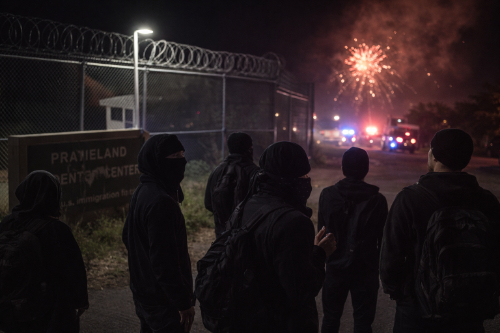 The facts, as established at trial, are these. On the evening of July 4, 2025, at least eleven people gathered near the Prairieland Detention Center in Alvarado, a facility housing immigration detainees. Several were dressed in black clothing with their faces covered. The group had brought fireworks, spray paint, and firearms. They set off fireworks toward the facility, vandalized vehicles in the parking lot, and spray painted a guard shack.
When Alvarado Police Lt. Thomas Gross responded to a 911 call from correctional officers, Benjamin Song (according to body camera footage) yelled “get to the rifles” and opened fire. Lt. Gross was shot in the neck. He has since fully recovered. Most defendants were arrested near the scene shortly after the shooting. Song fled and remained at large until July 15, 2025, when he was captured with help from other defendants who assisted his escape.
Pretrial, seven other individuals pleaded guilty to providing material support to terrorists and agreed to cooperate with the prosecution. Their testimony was central to the government’s case at trial.
What “Providing Material Support to Terrorists” Actually Requires
The material support statute, 18 U.S.C. §2339B, makes it a federal crime to knowingly provide “material support or resources” to a designated foreign terrorist organization. The maximum sentence is 15 years; up to life if the conduct results in death. For foreign terrorist organizations, the statutory framework is relatively clear: the State Department maintains an official list, and providing support to an organization on that list is the offense.
The Prairieland case did not involve a foreign terrorist organization. It involved a domestic designation which is legally and constitutionally different in ways that the verdict does not resolve.
In September 2025, President Trump signed an executive order directing federal agencies to prioritize investigating ANTIFA as a domestic terrorist organization. But there is no domestic equivalent to the State Department’s foreign terrorist organization list. Organizations operating within the United States are protected by broad First Amendment associational rights. The Supreme Court held in Holder v. Humanitarian Law Project, 561 U.S. 1 (2010), that material support prosecutions require proof that the defendant acted in coordination with, or under the direction of, a designated foreign terrorist organization. The Prairieland case applied that framework to a domestic context by arguing that ANTIFA itself is a terrorist organization which is a legal theory that has never been tested and affirmed by the Supreme Court in the domestic context.
What this means practically: the government did not have to prove that any defendant was a member of a formal ANTIFA organization, because ANTIFA is not a formal organization. It had to prove that defendants knew they were supporting terrorism. The jury accepted that argument. Defense attorneys argued they were attending a demonstration.
The Charging Decisions That Deserve Scrutiny
Understanding the Prairieland verdict requires looking carefully at who was charged with what and how.
Benjamin Song. Song is the person who shot a police officer. He fired a rifle at law enforcement. His convictions (attempted murder, discharging a firearm during a crime of violence) are straightforwardly supported by the facts as established at trial. Whatever else can be said about this case, the conduct that Song was convicted of is serious, and those convictions are legally grounded.
The eight material support defendants. This is where the legal questions become significant. These defendants were convicted for participating in the demonstration (i.e. bringing fireworks, spray painting, being present at the scene). The prosecution’s theory was that the shooting by Song was the “terrorist act,” and that the other defendants provided material support to it by being part of the group that carried it out.
Several of the defendants who pleaded guilty told a consistent story: they believed they were attending a noise demonstration, that they would set off fireworks near the facility in solidarity with detainees inside, and that they had no knowledge of any planned violence. Seth Sikes, for example, told investigators he saw a flyer on Discord, drove to Alvarado by himself, and only thought they would be shooting off fireworks. He was arrested with a handgun and a disassembled AR-15, and he pleaded guilty to providing material support to terrorists.
The prosecution countered with evidence of coordination: a Signal chat called “4th of July Party!” in which defendants allegedly discussed bringing fireworks, firearms, and medical kits; surveillance of the facility beforehand; black bloc clothing; and body armor. The jury found that evidence sufficient.
Daniel Sanchez Estrada. The ninth defendant was not convicted of material support. He was convicted of corruptly concealing documents. Specifically, it was transporting a box of what the government called “ANTIFA materials” including “insurrection planning, anti-law enforcement, anti-government, and anti-immigration enforcement documents and propaganda” from his residence to another location to conceal them from a federal grand jury. His attorney called the verdict unbelievable.
The Sanchez Estrada charge is worth pausing on. The criminal charge here is obstruction (concealing evidence from a grand jury) which is a legitimate offense. But the description of the concealed materials as “anti-government” and “anti-law enforcement” literature introduces political ideology as the content of the evidence being concealed. The government did not charge him for possessing those documents. It charged him for hiding them. But the framing of what was being hidden, and why it mattered, was explicitly ideological.
The Foreseeability Theory and Its Implications
The prosecution argued that for defendants who were present but did not shoot, it was “foreseeable” that violence could occur and that bringing firearms and body armor to a nighttime demonstration against a law enforcement facility created a foreseeable risk that someone in the group would use those weapons. The jury accepted this theory for most defendants.
The jury rejected it for some: defendants charged with attempted murder of the officers (a more serious charge than material support) were acquitted on those counts. The jury apparently drew a distinction between foreseeability of violence (sufficient for material support) and actual participation in the attempt to murder officers (a higher standard).
The foreseeability theory is legally significant beyond this case. It means that a person who attends a demonstration where another participant commits violence (and where the prosecution can argue the defendant should have foreseen that possibility) may face federal terrorism charges even if they personally committed no violence. The nature of the clothing worn, the items brought, and the communications beforehand all become evidence of what was foreseeable.
What This Means for Texas Defendants
The Prairieland verdict establishes several things that anyone navigating political demonstration activity in Texas should understand:
Political ideology is evidentiary. The government introduced what it characterized as ANTIFA materials, insurrection planning documents, and anti-law enforcement literature as evidence of criminal intent. Political belief is not a crime. But when the government charges terrorism, political belief becomes context for the jury’s evaluation of intent. Defense attorneys in this case argued that the prosecution introduced ideology rather than proof of a structured terrorist organization. The jury disagreed.
Group liability can attach from presence. The theory that being part of a group where violence was foreseeable is sufficient for material support convictions means that individual conduct matters less than group association when terrorism charges are in play. This is a significant departure from how most criminal liability is assessed.
Coordinated communications are high-risk. The Signal chat was central evidence. The reconnaissance visits to the facility were central evidence. Planning documents, weapons purchases, and medical kit procurement were central evidence. In the current federal prosecution environment, demonstrators who coordinate in advance (even for entirely lawful activities) create a documentary record that prosecutors can characterize as evidence of intent.
Guilty pleas in co-defendant cases create pressure. Seven co-defendants pleaded guilty before trial and cooperated with the prosecution. Their testimony was central to the government’s case. When federal charges carry 15-year caps for guilty pleas and potentially life sentences after trial, the structural pressure toward cooperation is intense. This is not unique to terrorism cases, but the consequences in terrorism cases are more severe than in almost any other context.
The “domestic terrorism” designation is legally untested. The government’s characterization of the defendants as a “North Texas ANTIFA Cell” and its claim that this is the first terrorism conviction against ANTIFA rests on an executive order, not on a statutory designation process with judicial review. The appeals courts have not yet evaluated whether applying the material support statute in this domestic context survives constitutional scrutiny. The convictions may or may not hold up on appeal.
The Unresolved Legal Questions
The Prairieland case will almost certainly be appealed. The legal questions that remain unresolved include:
- Whether the material support statute can constitutionally be applied to domestic political activity in the absence of a formally designated foreign terrorist organization.
- Whether the executive order designating ANTIFA as a domestic terrorist organization provides sufficient legal foundation for the terrorism charges, or whether that designation is itself constitutionally suspect under the First and Fifth Amendments.
- Whether introducing political literature and ideology as evidence of criminal intent (rather than as propensity evidence subject to Rule 404(b) analysis) violated the defendants’ constitutional rights.
- Whether the foreseeability theory applied to the material support charges is consistent with the Supreme Court’s holdings on what “knowingly” providing support requires.
These are not abstract academic questions. They are the questions that the appellate courts will be deciding and the answers will determine whether the Prairieland verdict becomes a template or an outlier.
A Note on What This Blog Is Not Saying
A police officer was shot in the neck. That is serious, and the person who shot him faces an appropriate consequence. Nothing in this analysis suggests otherwise.
What this analysis addresses is the broader charging framework: specifically, the decision to charge participants who brought spray paint and fireworks with federal terrorism offenses carrying 10-to-60 year sentences, the use of political literature and ideology as evidence of criminal intent and the application of a material support statute developed for foreign terrorist organizations to a domestic political context that the statute’s authors did not design it to cover.
Those are legitimate legal concerns regardless of the political valence of the defendants. The same framework, applied in a different political climate to a different group, would raise the same concerns. Criminal defense attorneys have an obligation to identify when prosecutorial overreach is occurring, and to say so clearly because the constitutional protections that are tested in unpopular cases are the ones that protect everyone.
If you are facing federal criminal charges in the Northern District of Texas (including charges arising from protest activity or political demonstrations) contact Deandra Grant Law for a free, confidential consultation. Call (214) 225-7117 or schedule online at texasdwisite.com.