By Douglas E. Huff | Partner, Deandra Grant Law | Dallas, Texas
On April 7, 2026, the United States Attorney for the Southern District of Ohio announced the first federal conviction under the Take It Down Act, the bipartisan federal statute signed by President Trump in May 2025 that criminalizes the non-consensual publication of intimate visual depictions, including AI-generated forgeries. The defendant, James Strahler II of Columbus, pleaded guilty to three federal charges: cyberstalking, producing obscene visual representations of child sexual abuse material under existing federal law, and publication of digital forgeries under the Take It Down Act. The publication-of-digital-forgeries count is the count that makes the case historic; it is the first time a federal court has accepted a conviction under that section of the new law.
The case has been reported in technical and legal press as a milestone for prosecution of AI-generated material generally. That framing is partly right and partly worth unpacking. The Strahler case actually surfaces three distinct legal regimes each addressing a different category of conduct, each with its own statutory text, its own evidentiary requirements, and its own defense issues. For the criminal defense bar, untangling those regimes is the first step. The technical forensic questions that will run alongside them (how synthetic media is identified, authenticated, and preserved as evidence) are the second.
This post walks through the legal framework, the constitutional backdrop, and the practical forensic questions emerging in this space. It treats a serious topic seriously. The underlying conduct (the use of artificial intelligence to harm real adults and to depict children sexually) causes real injury to real victims, and a defense-focused legal explainer is not a place to suggest otherwise. What follows is, instead, what a criminal defense lawyer needs to understand about how these cases will be charged, proved, and litigated.
What the Take It Down Act Actually Criminalizes
The Take It Down Act (formally, the Tools to Address Known Exploitation by Immobilizing Technological Deepfakes on Websites and Networks Act) was authored by Senators Ted Cruz (R-TX) and Amy Klobuchar (D-MN) and passed both chambers of Congress in 2025 with rare unanimity (unanimous consent in the Senate; 409–2 in the House). President Trump signed it into law on May 19, 2025. The Act has two main operative pieces.
First, a criminal prohibition on the non-consensual publication of intimate visual depictions. The Act creates federal criminal liability for knowingly publishing intimate visual depictions of an identifiable individual without the depicted individual’s consent. The Act’s reach includes both authentic intimate imagery and “digital forgeries” which is the statutory term for AI-generated, computer-manipulated, or otherwise synthetic intimate imagery that depicts an identifiable real person. The penalty structure tracks the nature of the depiction (adult victim, minor victim, threat-to-harm context). The Strahler conviction is, specifically, a conviction under the digital-forgeries provision.
Second, a notice-and-takedown regime for covered platforms. The Act requires online platforms that allow user-uploaded content to establish a process for identifiable individuals to request removal of non-consensual intimate visual depictions, and to act on those requests within 48 hours. This is administrative (not criminal) and is enforced primarily by the Federal Trade Commission.
What the Take It Down Act does not do is criminalize all AI-generated sexual content, all synthetic media generally, or all CSAM in synthetic form. Each of those areas is governed by different (and in some cases older) statutes. Conflating the Act with the broader synthetic-media regulatory landscape is one of the more common errors in the press coverage and in the lay legal commentary that has followed the Strahler plea.
The Other Statute in the Strahler Case: 18 U.S.C. § 1466A
Of the three charges Strahler pleaded guilty to, the most legally consequential for the wider defense bar may not be the Take It Down Act count. It is the second one: producing obscene visual representations of child sexual abuse under 18 U.S.C. § 1466A.
Section 1466A is a federal statute enacted in 2003 as part of the PROTECT Act. It criminalizes the production, distribution, receipt, and possession of obscene visual representations of the sexual abuse of children including representations created without the use of any real child, such as drawings, cartoons, paintings, sculptures, and, of particular contemporary relevance, computer-generated and AI-generated material. The statute applies whether the visual representation depicts an identifiable real minor or a wholly synthetic minor. The mens rea is knowledge.
Section 1466A exists because of a constitutional decision the United States Supreme Court reached in 2002. In Ashcroft v. Free Speech Coalition, 535 U.S. 234 (2002), the Court struck down portions of the Child Pornography Prevention Act of 1996 that had criminalized purely virtual child-pornography material (imagery that appeared to depict minors engaged in sexual conduct but that had been created without the use of any actual minor). The Court held that the statutory prohibition swept too broadly into protected speech and could not be sustained on the theory that the material itself was (by definition) unprotected child pornography, because the constitutional basis for the categorical exclusion (the harm to real children in the production of the material) was absent in cases involving purely virtual content.
Congress’s response was § 1466A, which uses a different constitutional theory: obscenity. Under longstanding First Amendment doctrine, obscene material is not constitutionally protected. The PROTECT Act’s drafters concluded that visual representations of the sexual abuse of children (even where no real child was involved in production) could be prosecuted under obscenity principles. Lower federal courts have generally upheld § 1466A against constitutional challenge, applying the three-part obscenity test articulated in Miller v. California, 413 U.S. 15 (1973). The leading appellate decision is United States v. Whorley, 550 F.3d 326 (4th Cir. 2008), in which the Fourth Circuit affirmed a § 1466A conviction involving obscene Japanese animation depictions of minors and held that obscenity is unprotected speech regardless of whether real children were involved in production. The Supreme Court denied certiorari in Whorley and has not, in the years since, squarely revisited the Ashcroft holding in the AI-generation era.
The Strahler plea involved both real and synthetic depictions of minors. As reported by the Department of Justice, the AI-generated CSAM in the case involved morphed imagery meaning the faces of known minor children placed on bodies in sexual contexts. That fact pattern is harder, doctrinally, than a purely synthetic case: it involves identifiable real children whose likenesses were used. A purely synthetic case (imagery generated by AI that does not depict any identifiable real child) would raise the Ashcroft questions in cleaner form. That case has not yet reached the Supreme Court.
And the Third Charge: Federal Cyberstalking
The third charge in the Strahler case (cyberstalking under 18 U.S.C. § 2261A) is an older federal statute and does not require any AI element. Section 2261A prohibits using an interactive computer service or electronic communications system to engage in a course of conduct that places a person in reasonable fear of death or serious bodily injury, or that causes substantial emotional distress, where the conduct involves multiple states or jurisdictions. It is the statute the Justice Department often uses as the criminal backbone for cyberstalking and harassment cases that cross state lines.
Strahler’s cyberstalking count is not legally novel. What makes it relevant in a synthetic-media case is the way AI-generated material can supply the underlying course of conduct (i.e. the harassing communications, the threats, the publication of fabricated imagery directed at the victim, her family, her employer). The synthetic media is not, in that posture, the offense element itself. It is the instrumentality of an older offense.
The Defense Issues This New Landscape Surfaces
For criminal defense lawyers, the synthetic-media era raises a small set of issues that recur across these cases, regardless of which charging statute the government has chosen. Five are worth attention now.
- Authentication of the imagery itself. Under Federal Rule of Evidence 901 (and Texas Rule of Evidence 901), the proponent of a piece of evidence must produce evidence sufficient to support a finding that the item is what the proponent claims it is. For a digital image alleged to be an AI-generated forgery of a real person, the State must establish both that the image exists and that it is, in fact, AI-generated. For a digital image alleged to be authentic CSAM, the State must establish that it depicts a real minor. The two questions look superficially similar but require very different evidentiary showings, and the consequences of mistakes run in both directions.
- Chain of custody for generative-AI outputs. Synthetic media has a forensic property traditional evidence does not: the same input prompt produces different outputs each time it is run, and most consumer-facing generative-AI systems do not retain the precise model weights, parameters, or random seeds that produced any given output. Reconstructing the production process from the output alone is, in many cases, technically impossible. That asymmetry between the certainty of the final image and the uncertainty of how it was produced is a real evidentiary problem the State will need to address in some cases.
- Mens rea — specifically, knowledge of the AI nature of the content. The Take It Down Act’s criminal provisions are knowledge-based. The statute reaches knowing publication of non-consensual intimate visual depictions, including knowing publication of digital forgeries. A defendant who actually believed the material was authentic, or who actually believed the depicted person had consented, raises a knowledge defense that is conceptually clean and factually complicated. Section 1466A similarly requires knowing conduct. The contours of “knowing” in a synthetic-media context are not yet well developed in the case law.
- Statutory construction. The Take It Down Act is months old. Its key terms (“intimate visual depiction,” “digital forgery,” “identifiable individual,” “publishing”) are defined in the Act, but the application of those defined terms to specific fact patterns will be litigated for years. Defense lawyers handling early cases under the Act will be doing first-impression statutory construction, and the early appellate decisions will shape how the statute is read for the next generation of cases.
- The constitutional questions. Ashcroft v. Free Speech Coalition is still the controlling Supreme Court authority on purely synthetic depictions of minors. Section 1466A relies on obscenity doctrine to avoid the Ashcroft problem, and lower courts have generally accepted that theory. But the doctrine has not been tested at the Supreme Court level in the modern generative-AI era, where the realism of synthetic imagery and the volume that can be produced are categorically different from anything in the case law. Constitutional challenges to specific applications of § 1466A (particularly applications to purely synthetic content not depicting any identifiable real minor) are likely, and they are an open area of doctrine.
None of these defense issues is a shortcut around the underlying offense. None is a strategy for evading prosecution in cases where the conduct is what the State says it is. They are the ordinary work of testing the government’s proof on every element the statute requires which is the work the Sixth Amendment guarantees. That work is harder, not easier, in a synthetic-media case, because the technology is newer than the precedent.
What the Digital Forensics Community Is Working On
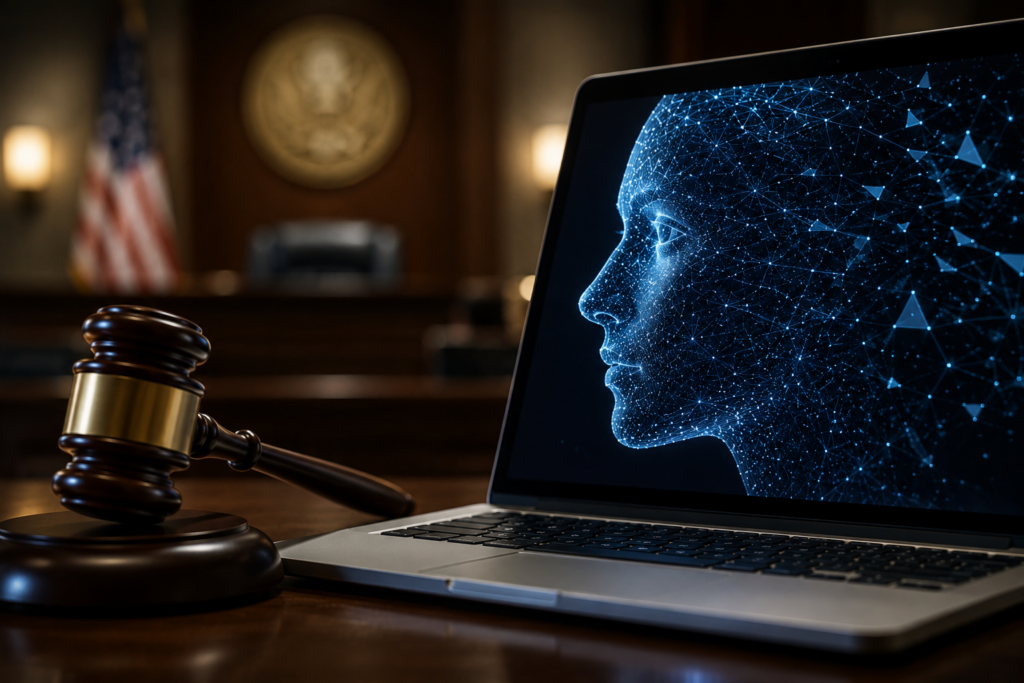
Synthetic-media identification is an active research area in academic computer science, federal law enforcement, and private digital-forensics practice. The tools developed in those settings are the tools that will, increasingly, be offered as expert evidence in criminal cases.
Several techniques are in use or under development:
- Provenance metadata and watermarking. Some generative-AI systems embed metadata or invisible watermarks in their outputs that identify the producing system. Industry standards organizations have proposed standardized provenance metadata frameworks. The existence (or absence) of expected provenance markers in a piece of evidence is a fact a forensic examiner can speak to.
- Statistical artifact analysis. AI-generated imagery often contains subtle statistical artifacts (ex. patterns in pixel-level noise, frequency-domain signatures, anatomical or geometric inconsistencies)mthat distinguish it from camera-captured imagery. These signatures vary by generation model and have been the subject of substantial published research. They are also a moving target as the technology improves.
- Reverse-image and source-image matching. Where a synthetic image has been derived from a real source image (a common pattern in face-morphing cases), the source can sometimes be identified through reverse-image-search tools and similarity-matching algorithms. The link between the synthetic output and the real source is itself a fact, and a forensically demonstrable link can be both inculpatory and (in the right case) exculpatory.
- Device and platform forensics. Many AI-generation cases are not actually built on analysis of the imagery itself. They are built on analysis of the defendant’s devices including installed applications, browser history, model files, prompt logs, generation histories, and the kinds of indicia of intentional use that have been the bread and butter of digital forensics for two decades. The Strahler case, per the Justice Department’s public statements, involved evidence of more than two dozen AI platforms installed on the defendant’s phone and more than 100 web-based models accessed from it.
Each of these is also a defense issue. Expert testimony based on emerging detection techniques is subject to admissibility scrutiny under Federal Rule of Evidence 702 (and Texas Rule of Evidence 702, with the Texas Court of Criminal Appeals’ Kelly framework). The validation of the technique, the error rate, the qualifications of the examiner, the chain from the device to the analysis, and the limits of the conclusion the examiner is willing to draw are all properly tested on cross-examination and, where appropriate, in pretrial motions.
Texas Law and the State-Court Picture
Federal law is not the whole story. Texas has its own statutes that intersect with the synthetic-media space, and most prosecutions of conduct involving Texas victims, Texas defendants, or Texas-based platforms will involve some combination of state and federal exposure.
Three Texas statutes are particularly important. Penal Code § 21.16 criminalizes the unlawful disclosure or promotion of intimate visual material. This is the Texas analog to the federal Take It Down Act’s non-consensual-publication provisions, predating the federal Act and covering conduct involving Texas victims even where the federal jurisdictional hook is missing. Penal Code § 21.165 criminalizes the production or distribution of certain types of synthetic sexual visual material. It’s essentially the Texas “deepfake” statute, addressing AI-generated intimate imagery of identifiable persons. Penal Code § 43.26 criminalizes possession or promotion of child sexual abuse material (CSAM); the statute’s reach in synthetic-media cases involving real-minor likenesses, including morphed imagery, is being developed in Texas appellate decisions.
For Texas defendants, the practical reality is that conduct of the kind alleged in the Strahler case would, in most circumstances, expose the defendant to both federal charges under the statutes discussed above and state charges under §§ 21.16, 21.165, and 43.26. Which sovereign actually charges, and in which order, depends on the facts. Federal indictments tend to follow cross-jurisdictional conduct, large volumes of material, and use of interstate communications systems. State indictments tend to follow conduct with primarily local effects and identifiable Texas victims. The dual-sovereignty exposure is real and is, in many cases, the most important strategic feature of the case for the defense to understand at the front end.
The Takeaway
The Strahler case is the first conviction under a new federal statute and an early data point on how synthetic-media prosecutions will be charged, defended, and proved. It is not the last. The defense bar is going to be confronted with these cases in growing numbers over the coming years, and the lawyers handling them will need to be conversant in three things: the statutory architecture (the Take It Down Act, § 1466A, the cyberstalking provisions, the Texas analogs), the constitutional doctrine that has governed depictions of minors since Ashcroft and the obscenity doctrine that has filled the gap, and the digital-forensics methods that are increasingly the spine of the State’s evidentiary case.
None of that work is easy. None of it is a substitute for the careful, methodical, fact-specific defense any serious criminal case requires. But understanding the framework is the foundation. Cases of this kind are going to keep coming, and the early cases will set the precedent that governs later ones.
If you or someone you know is under investigation or facing charges involving synthetic media, AI-generated content, or the federal or Texas statutes discussed above, the right time to retain counsel familiar with both the digital-forensics evidence and the underlying statutory framework is at the front end of the case, not after the indictment lands.
Douglas E. Huff is a partner at Deandra Grant Law, an ACS-CHAL Forensic Lawyer-Scientist, past president of the Dallas Criminal Defense Lawyers Association, and a defense lawyer with substantial training in digital forensics. The firm handles criminal cases involving digital evidence, computer forensics, and online conduct throughout North and Central Texas. To discuss a pending investigation or charge in confidence, call (214) 225-7117.