By Deandra Grant & Griffin Grant
Welcome to The Defense File, where we examine the criminal cases of public figures through the lens of Texas criminal law. Each entry looks at what happened in court, what the defense argued, and what a defendant would have faced (and how they might have been defended) if the same facts had occurred in Texas.
The Pattern
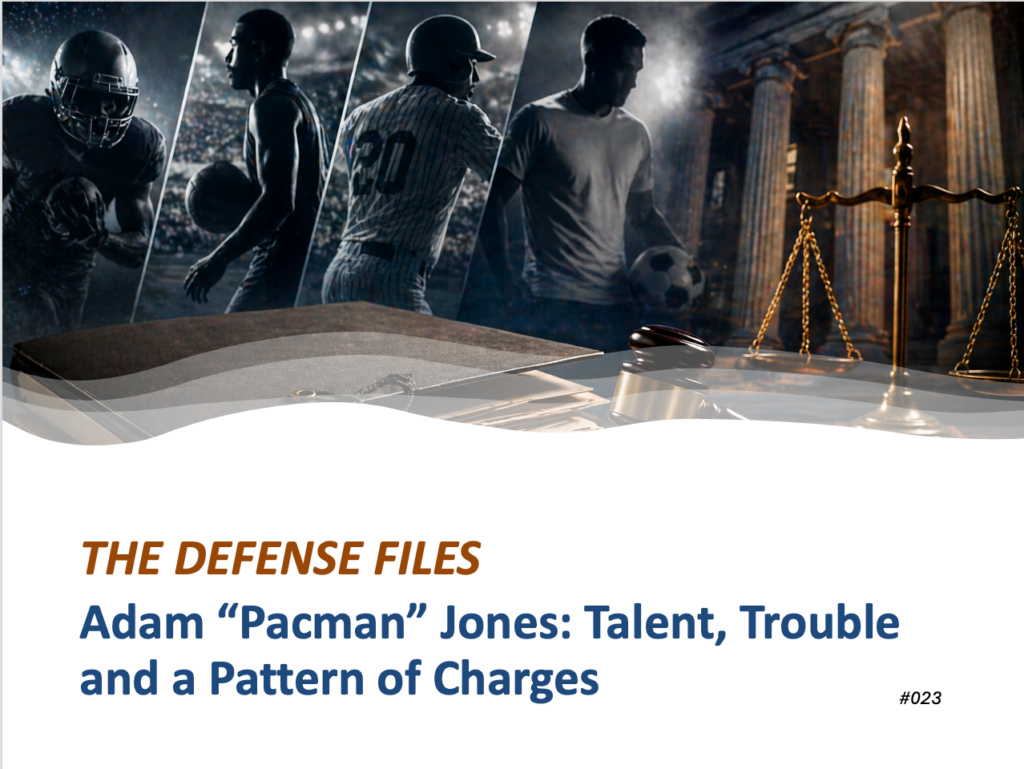
Few players have a record as long as Adam “Pacman” Jones’s. A West Virginia standout drafted sixth overall by the Tennessee Titans in 2005, Jones paired real talent (First-Team All-Pro as a returner in 2014, a Pro Bowl selection in 2015) with a recurring habit of ending up in handcuffs. Across roughly two decades he was arrested in at least six states, and the charges form a recognizable pattern: alcohol, a public place, an altercation, and a confrontation with police.
The pattern set in early. In July 2005, weeks into his rookie year, Jones was arrested in Nashville for assault and felony vandalism after a nightclub altercation; the charges were dismissed within a year. In February 2006 he faced marijuana-possession and obstruction charges in Fayetteville, Georgia, after an encounter with an officer. The drug charge was later dropped. That August, in Murfreesboro, Tennessee, he drew disorderly-conduct and public-intoxication charges after spitting on a woman at a club, resolved with six months’ probation.
The most serious chapter came in February 2007, when Jones was connected to a Las Vegas strip-club shooting that injured three people. He was never charged in the shooting itself, but the NFL suspended him for the entire 2007 season based on a pattern of off-field conduct. (More on why he was never charged and what Texas’s law of parties would and would not reach below.)
The incidents continued well past his playing days. In 2021 he pleaded no contest to two counts of misdemeanor assault following a Cincinnati bar altercation and served 18 days in jail. On November 15, 2024, after attending the Jake Paul–Mike Tyson event, he was arrested at AT&T Stadium in Arlington, Texas, on charges of public intoxication, assault on a peace officer, resisting arrest, and evading arrest. And on June 7, 2025, he was arrested in Covington, Kentucky, on charges of public intoxication, disorderly conduct, and assaulting a police officer after a disturbance at a bar; he was booked into the Kenton County Jail and later released on a $10,000 bond.
The Charges and What Happened in Court
The dispositions track the pattern as much as the arrests do with many charges dismissed, reduced, or resolved with probation and short jail stints. The 2021 Cincinnati matter ended with the no-contest plea and 18 days served. The November 2024 Arlington case was, as of this writing, still pending, with limited public detail on its progress. In the June 2025 Kentucky case, Jones pleaded not guilty; his attorney, Pete Schaefer, characterized the charges as the product of overzealous policing, arguing that the allegations shifted from assault toward public intoxication and disorderly conduct, and that the media had leveraged Jones’s history to cast him as a villain. That case remained pending with no trial date set.
The Texas Analysis
Most of these arrests happened somewhere other than Texas. But one of them (the November 2024 arrest at AT&T Stadium in Arlington) happened here, so for this entry the Texas analysis is not entirely hypothetical. And two features of Jones’s record draw Texas law’s harshest treatment: an assault on a peace officer, which is a second-degree felony, and the sheer accumulation of offenses, which Texas’s enhancement statutes are built to punish.
Public Intoxication: Texas Penal Code §49.02
The single most common thread in Jones’ record is alcohol in a public place. In Texas, that is public intoxication under §49.02 which is committed when a person appears in a public place intoxicated to a degree that may endanger themselves or another. It is a Class C misdemeanor, fine-only (up to $500), and the statute expressly treats a licensed or permitted bar as a public place, so an arrest inside a club counts. Standing alone, a single PI is among the least serious offenses on the books.
The problem is that Jones’s record is not a single PI. Under §12.43, a defendant with two prior public-intoxication convictions can have a third PI enhanced to a Class B misdemeanor thereby moving a fine-only ticket into jail-eligible territory, up to 180 days in county jail and a $2,000 fine. For a defendant whose history shows the same charge again and again, the third and later arrests are no longer trivial.
Assault on a Peace Officer: Texas Penal Code §22.01(b-2)
This is where Texas exposure is most severe. Both the 2024 Arlington arrest and the 2025 Kentucky arrest included allegations of assaulting an officer. In Texas, an assault that causes bodily injury is ordinarily a Class A misdemeanor under §22.01(a)(1). But §22.01(b-2) elevates that offense to a second-degree felony (punishable by 2 to 20 years in prison and a fine up to $10,000) when the person injured is a peace officer the defendant knows is lawfully discharging an official duty.
The elevation turns on two things the defense would scrutinize: whether the contact caused bodily injury at all (offensive or provocative contact without injury is a far lesser, Class C offense), and whether the officer was lawfully discharging an official duty when the contact occurred. Because the AT&T Stadium incident arose in Arlington, an assault-on-an-officer charge there would be prosecuted by the Tarrant County Criminal District Attorney’s Office and, as a felony, heard in one of Tarrant County’s felony district courts which is a different forum, and a different sentence range, than the misdemeanor county criminal courts that would handle the PI and resisting counts.
Resisting and Evading: §38.03 and §38.04
The 2024 Arlington charges also included resisting arrest and evading arrest. Resisting under §38.03 requires using force against an officer to prevent an arrest or search; it is a Class A misdemeanor (up to a year in county jail and a $4,000 fine), rising to a third-degree felony only if a deadly weapon is used. Evading under §38.04 is a Class A misdemeanor when a person flees on foot for a first offense but it becomes a third degree felony if the person uses a vehicle. On the facts reported (a bar disturbance and a struggle with police rather than a vehicle pursuit) both would most likely sit at the Class A misdemeanor level: serious, but not felonies.
The Early Offenses: Marijuana, Disorderly Conduct, Criminal Mischief
The 2005–2006 charges map cleanly onto Texas misdemeanors. Possession of two ounces or less of marijuana is a Class B misdemeanor under Health & Safety Code §481.121. Disorderly conduct (the Murfreesboro spitting incident, for example) is generally a Class C misdemeanor under §42.01, and the spitting itself could alternatively be charged as assault by offensive contact, also a Class C. The Nashville “felony vandalism” allegation would be analyzed in Texas as criminal mischief under §28.03, where the offense level rises with the dollar amount of the damage from a Class C for minor damage up through felony grades for higher losses.
The Las Vegas Shooting: Why He Was Never Charged and the Texas Law of Parties
It is worth being precise here, because the distinction matters legally. Jones was never charged in connection with the 2007 Las Vegas shooting. His NFL suspension was a league disciplinary decision based on a pattern of conduct, not a criminal conviction, and the two should not be conflated.
Texas law would not change that without evidence the case never produced. Under the law of parties, §7.02, a person can be held criminally responsible for another’s conduct only if, acting with intent to promote or assist the offense, they solicit, encourage, aid, or direct it or, under the conspiracy branch, if the offense was committed in furtherance of a conspiracy they joined and should have anticipated. Discharging a firearm in the direction of people is itself deadly conduct under §22.05, a third-degree felony. But none of that attaches to a person merely present when violence erupts. Mere presence at the scene (or even association with the people involved) is not enough to make someone a party. The absence of charges in Las Vegas reflects exactly that line, and it is the same line a Texas prosecutor would have to cross with real evidence rather than inference.
The Enhancement Machinery: Why a Pattern Costs More in Texas
The throughline of Jones’s record is repetition, and Texas criminal law is built to make repetition expensive. Beyond the public-intoxication enhancement already described, §12.43 escalates penalties for repeat misdemeanants generally, and the felony habitual-offender provisions in §12.42 sharply raise sentencing ranges for defendants with prior felony convictions. A defendant who collects misdemeanor after misdemeanor in Texas does not reset to zero each time; prior convictions become the State’s leverage in every later negotiation and the foundation for enhanced punishment. The lesson the enhancement statutes teach is that the cheapest time to fight a minor charge is the first time because in Texas, the second and third are never priced like the first.
How Would the Defense Approach This in Texas?
- The “may endanger” element of public intoxication. A PI conviction is not automatic just because someone had been drinking. The State must prove intoxication to a degree that may endanger the defendant or another. A defendant who was intoxicated but seated, cooperative, and a danger to no one has a genuine factual defense.
- Bodily injury versus offensive contact on the officer-assault count. Because the second-degree felony turns on bodily injury to an officer, the defense would test that element hard: what injury, documented how, caused by what contact. If the contact was offensive rather than injurious, the charge belongs at the Class C level, not as a felony.
- Was the officer “lawfully discharging an official duty”? The §22.01(b-2) elevation requires it. If the underlying detention or arrest was itself unlawful, the legal foundation for the felony enhancement (and for the resisting and evading counts) comes under pressure.
- Article 38.23 and the lawfulness of the stop. Texas’ exclusionary rule reaches evidence obtained through an unlawful detention or arrest. In a bar-altercation case, the defense begins with what justified the officers’ approach and whether each escalation was constitutionally sound.
- Keeping convictions off the record to stop the enhancement clock. For a defendant with a pattern, the most valuable outcome is often not just avoiding jail today but avoiding a conviction that fuels tomorrow’s enhancement. Deferred dispositions, dismissals, and pleas to non-enhancing offenses are as much about the next case as the present one.
- Mitigation and the accountability narrative. A long record is a sentencing liability, but the drivers behind it (alcohol, impulse control, the pressures of public life) are also the material of a credible treatment-and-accountability mitigation case. A Texas defense team would build that record early, before the prosecution’s “repeat offender” framing hardens.
What This Case Illustrates
The Pacman Jones file is not a single dramatic crime; it is a pattern. And patterns are exactly what Texas’s penalty structure is engineered to punish. A first public intoxication is a fine. A third can be jail. An assault becomes a felony when the person on the other end is a police officer. None of these individual charges is extraordinary (Texas defense lawyers see each of them every week) but stacked over time, with priors feeding enhancements, they compound into real exposure.
And this entry carries a reminder the others do not: one of these arrests actually happened in Texas. The November 2024 case at AT&T Stadium is not a thought experiment. It is a live application of the same statutes analyzed here: a second-degree felony assault-on-an-officer allegation, prosecuted in Tarrant County, alongside misdemeanor public intoxication, resisting, and evading counts. Whatever its outcome, it is the clearest illustration of the point: in Texas, the cost of a pattern is paid in the enhancement column.
Related Reading on Deandra Grant Law
- DWI and Intoxication Offenses in Texas — Public intoxication, the “may endanger” element, and how alcohol-related charges are defended.
- Assault and Assault on a Public Servant — Why an assault on a peace officer is a second-degree felony and how the bodily-injury element is contested.
Sources
- ESPN — Adam Jones arrest history and career timeline: com
- Associated Press — Jones 2024 Arlington and 2025 Covington arrests: com
- Texas Penal Code §49.02 (Public Intoxication): capitol.texas.gov
- Texas Penal Code §22.01 (Assault): capitol.texas.gov
- Texas Penal Code §§38.03, 38.04 (Resisting / Evading): capitol.texas.gov
- Texas Penal Code §12.43 (Penalties for Repeat and Habitual Misdemeanor Offenders): capitol.texas.gov
The Defense File is an educational series. All Texas analysis is hypothetical and does not constitute legal advice about any specific case.
If you are facing public intoxication, assault, resisting, or evading charges in Texas, call (214) 225-7117 for a free, confidential consultation. Or schedule online at texasdwisite.com.