Most people who are not lawyers do not think much about criminal discovery. It sounds like procedure which is the dry, technical part of how a case moves through the system. But discovery is the work of getting the truth into the courtroom, and the rules that govern what each side is required to turn over to the other are some of the most important in Texas criminal law. They are also, for two of the last fifteen years, the rules a Texas defendant’s freedom most often turns on.
Two of those rules are named after men who lost decades of their lives because the rules did not exist. A third is a 2024 Texas Court of Criminal Appeals decision that gave both of those reforms real enforcement power. And the 2025 Texas Legislature spent a session trying to take that power away.
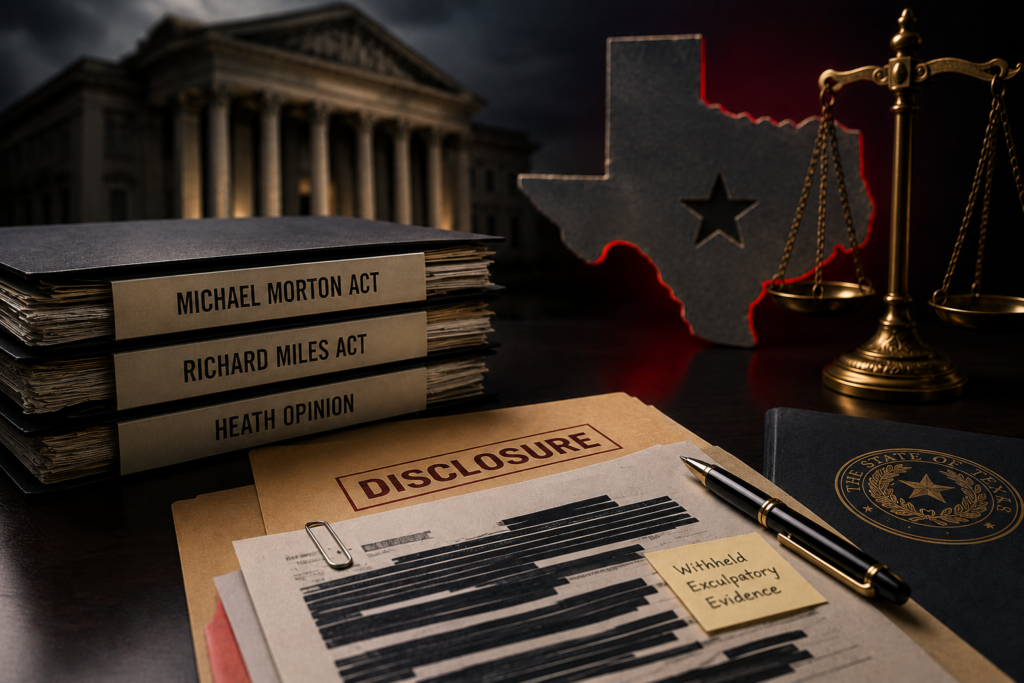
Here is what the Michael Morton Act and the Richard Miles Act actually do, how they came to be, why State v. Heath matters, and why the same fight is going to be back in front of the Legislature again.
The Way It Was Before
Before 2014, criminal discovery in Texas was a much narrower business than people imagined. The U.S. Supreme Court’s 1963 decision in Brady v. Maryland required prosecutors to turn over evidence “material either to guilt or to punishment” (a federal constitutional floor). But Brady put the prosecutor in charge of deciding what was material. If a prosecutor decided a particular piece of evidence was not significant enough to be “Brady material,” it stayed in their file.
Texas’s state-law discovery rule (the original version of Article 39.14 of the Texas Code of Criminal Procedure, enacted in 1965) was narrower still. The defense had to file a written motion identifying specific items. The trial court had discretion over whether to order production. And large categories of material, including witness statements, were not subject to disclosure at all.
What that looked like in practice was a system in which a defendant’s lawyer could go to trial without ever seeing the offense reports, witness statements, photographs, or recordings the State had built its case around. Many counties operated open-file policies as a matter of professional courtesy. Many counties did not. The result was a discovery system that depended on which county you were charged in and which prosecutor you drew. That is not a system. That is a lottery.
Michael Morton
On August 13, 1986, Christine Morton was beaten to death in the bed she shared with her husband, Michael Morton, at the couple’s home in Williamson County, Texas. The Mortons’ three-year-old son was in the house at the time. Michael Morton, a 32-year-old supermarket manager with no criminal history, was arrested, charged, and tried for the murder. He was convicted in 1987 and sentenced to life in prison.
Michael Morton spent nearly 25 years in the Texas Department of Criminal Justice for a crime he did not commit. He missed his son’s childhood. His parents grew old without him. He maintained his innocence the entire time.
What the trial jury never heard (because the prosecutor, Ken Anderson, never disclosed it) was a body of evidence pointing somewhere else entirely:
- A transcript of an interview in which the Mortons’ three-year-old son described the man who killed his mother and made clear it was not his father.
- A neighbor’s report of a suspicious man parked behind the Mortons’ house in a green van in the days before the murder.
- A check, written in Christine Morton’s name, that had been cashed with her forged signature days after her death.
- A credit card used in San Antonio after she was killed.
In 2011, after years of post-conviction litigation by the Innocence Project, DNA testing was performed on a bloody bandana found near the Morton home. The DNA on the bandana belonged to Mark Norwood, a man already linked to a similar killing two years after Christine Morton’s murder. Michael Morton was exonerated. Mark Norwood was tried and convicted of Christine Morton’s murder.
Ken Anderson (by then a sitting district judge) was the subject of a court of inquiry. He pleaded no contest to criminal contempt of court for his conduct in concealing evidence, served ten days in jail, was disbarred, and resigned from the bench.
The Michael Morton Act
In the 2013 legislative session, the Texas Legislature passed Senate Bill 1611, the Michael Morton Act, which rewrote Article 39.14 of the Code of Criminal Procedure. Governor Rick Perry signed it on May 16, 2013. It took effect January 1, 2014.
The Act is the most significant change to Texas criminal procedure in a generation. In broad strokes, it does five things:
- Broad mandatory disclosure. On a timely request from the defendant, the State must produce, as soon as practicable, any “offense reports, designated documents, papers, written or recorded statements of the defendant or a witness, including witness statements of law enforcement officers but not including the work product of counsel for the state in the case and their investigators and their notes or report, or any designated books, accounts, letters, photographs, or objects or other tangible things not otherwise privileged that constitute or contain evidence material to any matter involved in the action and that are in the possession, custody, or control of the state or any person under contract with the state.” That language is in the statute. Read it carefully. It is intentionally sweeping.
- Continuing duty. The State’s obligation does not end when initial discovery is provided. If the State later comes into possession of material evidence, it must turn that evidence over.
- Disclosure of exculpatory, mitigating, and impeachment evidence. The Act expressly codifies and expands the Brady obligation in state-law terms.
- The State must keep a record of what it discloses and when. That record is itself part of the case file.
- A prohibition on prior-act “surprise” evidence. The Act sharply limits the State’s ability to use evidence at trial that it has not disclosed in discovery.
The simplest way to describe what the Michael Morton Act changed: it took the prosecutor’s discretion to decide what the defense “needed” to see and replaced it with a statutory duty to turn over the file. That is not a small change. It is the foundation of how every Texas criminal case has been litigated since 2014.
The Gap the Morton Act Left
The Michael Morton Act regulates the relationship between the State and the defense. It assumes that what the prosecutor has, the prosecutor must turn over. What it does not directly address is the upstream problem: what happens to evidence that never makes it from the police to the prosecutor in the first place?
That gap is not theoretical. It is the gap that put Richard Miles in prison for fifteen years.
Richard Miles
On the night of May 15, 1994, a man was shot and killed and another was severely wounded at a Texaco gas station on Northwest Highway in the Bachman Lake area of Dallas. A 19-year-old Richard Miles was walking home through the neighborhood. A bystander told police that the shooter had fled on foot. Officers detained Miles and placed him in the back of a squad car. They drove him to the scene. An eyewitness identified him as the shooter.
Richard Miles did not match the description of the shooter the eyewitness had originally given dispatch. He had no criminal history. He told the officers where he had been that night. The State’s physical evidence consisted primarily of trace material on his right hand that the State characterized as gunshot residue. Miles told the jury he had been smoking and that the matches he used could have produced similar trace chemicals.
Miles was convicted in 1995 of murder and attempted murder. He was sentenced to 60 years in prison. He was 19 years old.
Inside the Dallas Police Department’s homicide file on the case were two memorandums that the trial jury, the defense, and the prosecution never saw. Those memorandums identified other potential suspects in the shooting including one man who had allegedly confessed to it. The memorandums sat in the police file. They did not go to the District Attorney’s office. They did not go to Miles’s defense lawyer. Richard Miles went to prison.
The Centurion innocence organization took on Miles’s case in 2007. After post-conviction investigation produced the suppressed police memorandums, Miles was released from prison on October 12, 2009. On February 15, 2012, the Texas Court of Criminal Appeals granted Miles relief on actual innocence grounds in Ex Parte Miles, 359 S.W.3d 647 which was the first non-DNA, non-confession actual innocence exoneration in Texas history. Miles was awarded compensation under the Tim Cole Act and, with that compensation, founded Miles of Freedom, a Dallas nonprofit that helps people leaving prison rebuild their lives.
The Richard Miles Act
In the 2021 legislative session, the Texas Legislature passed Senate Bill 111, the Richard Miles Act. Governor Greg Abbott signed it on June 14, 2021. It took effect September 1, 2021.
The Act’s sponsorship is itself part of the story. The legislation was championed at the Capitol by Dallas County Criminal District Attorney John Creuzot who was the elected prosecutor in the county where Miles was wrongfully convicted nearly three decades earlier. The Act reflects a recognition by the prosecution side of the bar that the gap between police and prosecutor was a structural problem that no amount of good-faith prosecution could fix on its own.
The Richard Miles Act does what the Michael Morton Act did not: it places a duty on law enforcement. Specifically, it requires law enforcement agencies to provide a written statement that all documents, items, and information required to be disclosed have been transmitted to the prosecutor. It applies both at the time charges are filed and on a continuing basis as new evidence is developed. Officers who fail to comply can face disciplinary action.
In effect, the two Acts together close a loop. The Richard Miles Act requires police to turn everything over to the prosecutor. The Michael Morton Act requires the prosecutor to turn everything over to the defense. Both Acts together require a paper trail.
State v. Heath: The Decision That Gave the Acts Teeth
Discovery statutes are only as strong as the consequences for violating them. For a decade after the Michael Morton Act took effect, courts and lawyers worked through what the consequences should be when the State (either by oversight, sloppiness, or design) turned over evidence late. Did exclusion of the evidence require a finding of bad faith by the prosecutor? Was the prosecutor responsible for what the police had in their files? What did “as soon as practicable” mean?
On June 12, 2024, the Texas Court of Criminal Appeals answered those questions in State v. Heath, 696 S.W.3d 677 (Tex. Crim. App. 2024).
Dwayne Robert Heath was indicted in 2016 in McLennan County for injury to a child. His appointed counsel sent the District Attorney’s office an email request for discovery. Discovery was provided. The case was set for trial four times; three times, it was bumped by another case. About a week before the fourth setting (fourteen months after the original discovery request) the trial prosecutor met with the child’s mother and learned for the first time that she had placed a 911 call on the date of the offense. The prosecutor requested the recording from law enforcement and turned it over to defense counsel as soon as she received it.
Defense counsel moved to suppress the recording under Article 39.14, arguing that the call had been in the possession of law enforcement (and therefore in the possession of the State) since the date of the offense, and that the 14-month delay was not “as soon as practicable.” The trial court agreed and excluded the 911 call. The State appealed, arguing that exclusion required a finding of willful violation by the prosecutor, and that the prosecutor here had acted in good faith and turned over the recording within days of learning it existed.
After a lengthy procedural path, the Court of Criminal Appeals affirmed the exclusion. The holding is the part that matters:
- “The State” includes law enforcement. For purposes of Article 39.14(a), “the State” is the State of Texas as a whole including prosecutors and the law enforcement agencies investigating the case. Evidence in the possession of law enforcement is in the possession of the State even if no prosecutor has ever seen it.
- “As soon as practicable” has no knowledge requirement. The statute does not measure timeliness from the day the prosecutor personally learned of the evidence. It measures it from the day the State, broadly defined, came into possession of it.
- Exclusion does not require bad faith. A trial court does not abuse its discretion by excluding untimely-disclosed evidence even where the prosecutor acted in good faith and had no personal knowledge of the evidence.
Heath did not invent any of these propositions. It applied the plain text of the statute the Legislature passed in 2013. But by stating those propositions clearly and authoritatively, the Court of Criminal Appeals gave Texas trial courts a usable enforcement mechanism: if the State fails to put a system in place to find out what law enforcement has, the State bears the consequences.
That is what discovery rules are supposed to do. That is also, depending on the audience, why Heath has become controversial.
Heath Under Fire: HB 3330 and SB 1124
In the 89th Texas Legislative Session, which ran in 2025, two companion bills sought to roll back the Heath decision and, with it, key portions of the Michael Morton Act’s enforcement structure. House Bill 3330 was filed in the House. Its identical Senate companion, SB 1124, was filed in the Senate.
As filed, the bills would have done three principal things:
- Narrow the definition of “the State.” The bills would limit “the State” under Article 39.14 to the prosecuting attorney’s office and the specific law enforcement agency that filed the charges, excluding other agencies, dispatch centers, and other governmental units that might possess relevant evidence.
- Raise the bar for exclusion. The bills would prohibit a trial court from excluding evidence for a discovery violation unless the State acted in bad faith and the defendant suffered irreparable harm which is a standard so demanding it would functionally eliminate exclusion as a remedy.
- Expand prosecutorial discretion to redact and withhold. The bills would allow prosecutors to unilaterally redact or withhold portions of disclosed materials and shift the burden to defendants to justify discovery requests.
On April 15, 2025, SB 1124 passed the Texas Senate by a vote of 25-6. On April 16, 2025, it was received in the House and referred to the Criminal Jurisprudence Committee. On April 22, 2025, HB 3330 was left pending in committee. The 89th regular session adjourned sine die in June 2025 without either bill becoming law.
But pending is not dead. The same Senate vote total that approved SB 1124 in 2025 will be available in 2027. And this is not the first effort to scale back the Michael Morton Act’s enforcement structure. In 2019, Senate Bill 2136 (introduced by Senator Joan Huffman) attempted to impose the same bad-faith-plus-irreparable-harm standard. It also failed. The strategy did not. It returned in 2025, and there is no reason to assume it will not return in the next session.
Michael Morton himself (the man for whom the original Act is named) wrote an opinion piece in the Houston Chronicle in 2025 denouncing these rollback efforts. He spent twenty-five years in prison because the system that produced his conviction did not require the prosecutor to give his lawyer the evidence that would have set him free. He is, perhaps, the most credible voice in Texas on what is at stake.
What This Means for Texas Defendants
For a person under investigation or charged with a criminal offense in Texas, the Michael Morton Act and the Richard Miles Act are not abstractions. They are the rules that govern whether a defense lawyer will see the offense report, the body-camera footage, the dispatch tapes, the witness statements, the lab notes, the calibration records, the chain-of-custody documentation, and everything else the State has built its case around. Without those rules, an honest defense is harder and sometimes impossible.
Three practical observations are worth making:
- Make the discovery request and make it well. Both Acts are request-driven. The State’s obligation to disclose is triggered by a request from the defense. A well-drafted, comprehensive request (not a casual “can I get discovery on this case” email) is the foundation of the entire framework. Heath itself spent years on the question of whether a one-line email was an adequate request. The lesson is that discovery requests are themselves legal documents and should be drafted as such.
- Track what comes in, and when. The State must document its disclosures. The defense should do the same. Knowing exactly when each piece of evidence was produced (and which pieces of evidence the defense expected to receive but did not) is the predicate for any motion to compel, motion to exclude, or motion for sanctions.
- Pay attention to what is missing. Both the Richard Miles Act and the Heath decision were responses to the same recurring problem: critical evidence sitting in a police file that no one outside that file knows exists. A defense lawyer who treats the prosecutor’s production as the complete record of the State’s case is missing the most important question: What does the police file actually contain, and has it actually been transmitted? The Richard Miles Act’s written-statement requirement is a tool for asking that question.
Two Names, One System
Michael Morton was wrongfully convicted in 1987. Richard Miles was wrongfully convicted in 1995. Between them they spent forty years in prison for crimes they did not commit, in two different cities, with two different sets of withheld evidence, prosecuted by two different offices. The pattern was the same. Information that would have helped clear them existed. The system did not require anyone to give it to them.
The two Acts that bear their names (the Michael Morton Act of 2013 and the Richard Miles Act of 2021) are part of a generation of Texas wrongful-conviction reforms that include the Tim Cole Act on compensation, the eyewitness identification reforms, the recorded interrogation requirements, and the Forensic Science Commission. None of those reforms is perfect. None of them prevents every wrongful conviction. But together they represent a state-level recognition, hard-won and case by case, that the system can fail and that the rules of evidence and disclosure are the place where the system either catches its failures or repeats them.
State v. Heath is a 2024 reminder that the rules still mean something. The 2025 legislative effort to undo Heath is a reminder that the rules will keep being contested. Both are part of why having a defense lawyer who knows the current state of the law (and the direction it is moving) matters in any criminal case in Texas.
Deandra Grant Law handles criminal defense cases throughout North and Central Texas, including matters in which discovery practice and disclosure obligations are central. To discuss a pending case, call (214) 225-7117 for a free, confidential consultation.