In late April 2026, The Appeal reported on the appeal of Maria Montalvo, a New Jersey woman convicted in 1996 of murdering her two young children in a car fire and sentenced to 100 years in prison. Her attorneys at the New Jersey Office of the Public Defender argue that every forensic indicator the State’s experts used to characterize the fire as arson has, in the decades since the trial, been scientifically dismantled. In February 2026, a New Jersey trial court denied her petition for a new trial, ruling that the evolution of fire science over the past thirty years did not amount to “new evidence” for purposes of New Jersey post-conviction procedure. The appeal of that ruling is pending.
There is a second development worth noting in the same matter. On January 20, 2026, in one of his final acts as Governor of New Jersey, Phil Murphy commuted Ms. Montalvo’s sentence, making her immediately eligible for parole consideration. She remains, as a matter of New Jersey court record, a convicted murderer. Her appeal seeks to change that. Through counsel, she has said she will continue to pursue the new-trial litigation regardless of the parole outcome. People who believe they are innocent generally do.
The Montalvo case is one of the cleanest current illustrations of a problem that has dogged American criminal law for the last twenty years: what happens when the science a jury was told to rely on turns out, on later scrutiny, to have been wrong. The forensic discipline most often associated with that problem is arson investigation. And the state that has done the most to give defendants a tool for reopening these cases is Texas.
How Arson Investigation Was Done and Where the Science Went
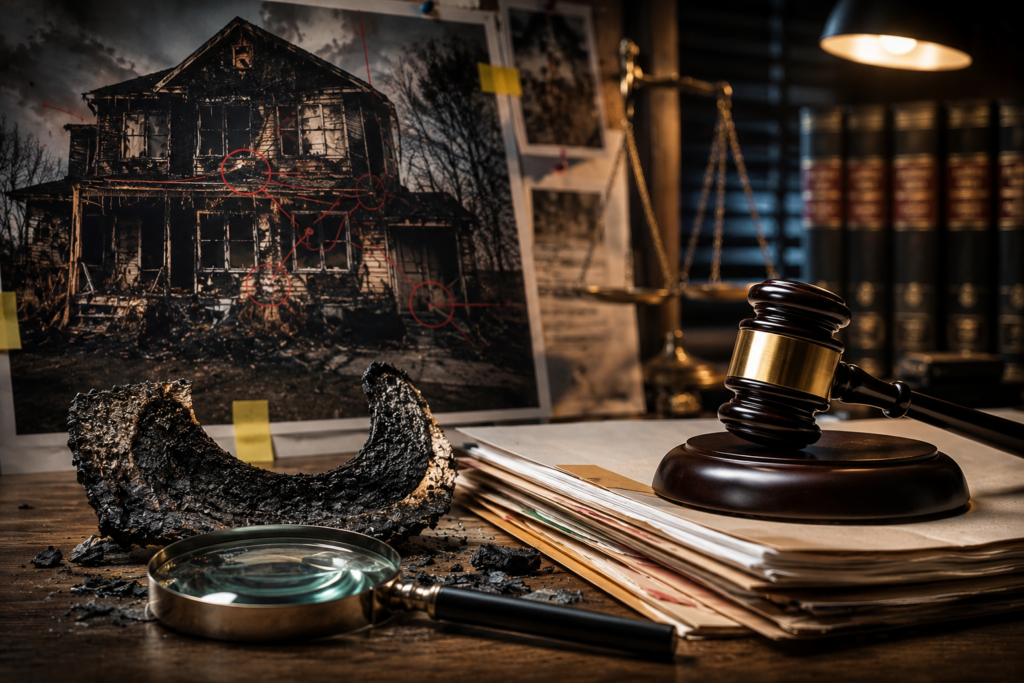
From roughly the mid-twentieth century until the early 1990s, arson investigation in the United States was largely a craft-based discipline, learned in the field and passed down from senior investigators to junior ones through experience, training manuals, and conventional wisdom. A set of recurring visual indicators (patterns in the burned debris that supposedly distinguished an intentionally set fire from an accidental one) formed the working vocabulary of investigators across the country. Those indicators included:
- “Alligator charring” — a pattern of large, shiny, blistered char on burned wood, said to indicate an accelerant-fueled fast-burning fire.
- “Crazed glass” — fine fracture patterns in window glass, said to indicate rapid heating from an intense, accelerant-driven fire.
- Low burn patterns and floor-level burning — scorched flooring under furniture and at floor level, said to indicate a liquid accelerant poured on the floor.
- “Pour patterns” — irregular burn shapes on a floor, said to trace the path of a poured ignitable liquid.
- Multiple points of origin — the conclusion that a fire started in more than one place, said to indicate intentional setting.
- Depth-of-char measurements — the idea that the depth to which wood had been burned could be used to determine how long the fire had burned at any given point, and therefore where it started.
Each of those indicators was treated, in the investigative culture of the 1970s and 1980s and into the 1990s, as essentially diagnostic. A fire scene with several of them present was an arson, and an investigator who said so on the stand could expect to be believed.
Beginning in the late 1980s and accelerating through the 1990s, controlled fire research by the National Institute of Standards and Technology and others began to dismantle those assumptions one by one. The single most important phenomenon the new research surfaced was “flashover” which is the moment when a compartment fire reaches a temperature at which everything in the room that can burn ignites essentially simultaneously. After flashover, a room previously consumed by a fire that started in one place looks, to an investigator searching for points of origin, like a fire that started in several places. Pour patterns appear on a floor that never saw an ounce of accelerant. Low burn patterns appear under furniture that never had liquid spilled on it. The visual indicators that had been treated as evidence of arson turn out to be the ordinary result of a sufficiently hot accidental fire.
In 1992, the National Fire Protection Association published the first edition of NFPA 921, Guide for Fire and Explosion Investigations. The document has been revised many times since and is now the recognized methodological standard for fire-cause-and-origin investigations in the United States. NFPA 921 specifically and explicitly identifies most of the indicators listed above as having no reliable diagnostic value for distinguishing arson from accidental fires. By the early 2000s, every major fire-investigation organization in the country had accepted the new science. By the mid-2010s, the old indicators were no longer defensible expert testimony.
The problem is that thousands of arson convictions had already been obtained, in courtrooms around the country, on the strength of those indicators. And the science of how to undo a conviction lags well behind the science of how it was obtained.
Cameron Todd Willingham
No American case has done more to push the arson-conviction problem into public view than the case of Cameron Todd Willingham of Corsicana, Texas.
On the morning of December 23, 1991, a fire broke out in the small frame house Mr. Willingham shared with his wife Stacy and their three young daughters (two-year-old Amber and one-year-old twins Karmon and Kameron). Mr. Willingham survived. His daughters did not. The Corsicana fire department and the Texas State Fire Marshal’s Office investigated the scene. Their investigators concluded that the fire had been intentionally set with a liquid accelerant poured along the floor. They based that conclusion on the indicators that the investigative culture of the era treated as diagnostic: pour patterns on the floor; multiple apparent points of origin; alligator charring; crazed window glass; burn marks under doorways.
Mr. Willingham was charged with the capital murder of his three daughters. At trial in August 1992, the State’s case rested heavily on the arson finding. He was convicted and sentenced to death. He maintained his innocence through twelve years on death row.
In the final weeks before his scheduled execution, Mr. Willingham’s lawyers obtained a report from Dr. Gerald Hurst, a Cambridge-trained chemist and one of the country’s leading independent fire scientists. Dr. Hurst reviewed the case file and concluded that every one of the indicators the original investigators had relied on was either consistent with an accidental fire or affirmatively contraindicated arson. The report was submitted to the trial court, to the Texas Court of Criminal Appeals, to the Board of Pardons and Paroles, and to Governor Rick Perry. Each declined to act. Mr. Willingham was executed by lethal injection at the Huntsville Unit on February 17, 2004.
In the years after the execution, additional independent fire-science reviews (by Dr. John DeHaan, by Dr. John Lentini, and by a panel commissioned by the Innocence Project) reached the same conclusion as Dr. Hurst. In 2008, the Texas Forensic Science Commission, a state body created by the Legislature to evaluate forensic-science practice in Texas, opened an inquiry into the Willingham case. In 2011, after years of internal dispute, the Commission issued its report. While the Commission, by statute, could not declare a specific defendant innocent, the report found that the investigators in the Willingham case had used flawed science and that the State Fire Marshal’s methodology had not kept pace with the developing field.
Mr. Willingham was never formally exonerated. He was, however, executed. He is the most concrete example available, in any American jurisdiction, of what is at stake when a conviction is built on forensic indicators the relevant scientific community no longer accepts.
The Legal Obstacle: “Evolving Science Isn’t New Evidence”
The Montalvo trial court’s ruling (that thirty years of fire-science evolution did not constitute “new evidence” under New Jersey post-conviction procedure) is the doctrinal core of the problem in most states. Traditional post-conviction relief rules are built around the model of a particular new fact: a witness recants, a previously unknown document surfaces, DNA testing produces a new result. “Evolving scientific understanding” does not fit that model neatly. The scientific community has changed its mind, but no particular new fact about the defendant’s case has been discovered.
The result, in most states, has been that defendants seeking to reopen convictions based on discredited forensic science have to litigate uphill. They have to identify a particular new piece of evidence that did not exist at trial; characterize the shift in scientific consensus as that piece of evidence; and persuade a court that the consensus shift would probably have changed the outcome. Each of those steps is contested. Each is decided judge by judge and state by state. The result has been wildly inconsistent decisions across jurisdictions on factually similar cases.
Texas, partly because of the Willingham case and partly because of broader reform pressure that built through the 2000s, took a different path.
Texas’s Junk Science Writ: Article 11.073
In 2013, the Texas Legislature passed Senate Bill 344, which added a new provision (Article 11.073) to the Texas Code of Criminal Procedure. The bill was signed by Governor Rick Perry on June 14, 2013, and took effect September 1, 2013. Texas was the first state in the country to enact a statute of this kind. Several other states have since followed in some form, but Texas remains the leading jurisdiction. The statute was further refined in 2015, with amendments that broadened access.
Article 11.073 (commonly called the “junk science writ”) authorizes a Texas court to grant habeas corpus relief based on a change in scientific evidence. Specifically, the statute provides that a court may grant relief if the convicted person establishes the following:
- Relevant scientific evidence is currently available that was not available at trial, because the evidence was not ascertainable through the exercise of reasonable diligence by the convicted person before the date of trial; or
- Relevant scientific evidence contradicts scientific evidence relied on by the State at trial; and
- The new scientific evidence would more likely than not have led to the convicted person’s acquittal had it been presented at trial.
The first two prongs are the structural innovation. The statute expressly contemplates that the “new evidence” can be a change in the scientific knowledge or technique itself and not just a new fact about the defendant’s case. The reasoning the New Jersey trial court used to reject Ms. Montalvo’s petition (that an evolution in fire science is not new evidence) is foreclosed by the plain text of Article 11.073 in Texas.
Article 11.073 has been used to reopen Texas convictions across a range of forensic disciplines:
- Bite mark testimony — once treated as forensic identification evidence; now widely recognized as scientifically unreliable for individual identification. The Texas Court of Criminal Appeals granted relief in cases involving discredited bite-mark testimony.
- Shaken-baby syndrome and abusive-head-trauma testimony — subject to continuing scientific debate and significant revision of the triad-based diagnostic model. Article 11.073 cases have addressed convictions resting on that older model.
- Hair-microscopy comparison testimony — the FBI’s 2015 acknowledgment of widespread overstatement by its own examiners in hair-comparison testimony opened the door to relief in cases that had relied on such testimony at trial.
- Fire and arson cases — the discipline this post has discussed. The Texas Forensic Science Commission has worked through the case files of pre-NFPA 921 arson convictions in Texas; some have been the subject of Article 11.073 litigation.
- Other forensic disciplines — including blood-spatter analysis, certain DNA-mixture interpretations, and toolmark identification have been subjects of relief claims under the statute.
Not every Article 11.073 application succeeds. The statute requires a showing that the new science would more likely than not have changed the outcome at trial, and that is a contested standard in many cases. But the door the statute opens is real, and it is open further in Texas than in most other states.
How the Writ Is Actually Used
In practical terms, an Article 11.073 application is filed as part of a writ of habeas corpus under Article 11.07 of the Code of Criminal Procedure (for non-capital cases). The convicted person files an application in the convicting court, raising one or more grounds for relief under Article 11.073. The State responds. The trial court holds an evidentiary hearing if material disputed facts require one, and issues findings of fact and conclusions of law. The application is then transmitted to the Texas Court of Criminal Appeals, which is the court that ultimately grants or denies relief.
Two practical considerations matter to potential applicants. First, the new-science showing has to be specific and concrete. A general statement that “arson investigation has changed” is not enough. The application has to identify the particular indicators the State’s experts relied on at the original trial, the particular scientific developments that contradict that reliance, and the particular reason a properly instructed jury would more likely than not have reached a different result if the State’s evidence had been evaluated under the newer standards.
Second, the work is heavy. An Article 11.073 application typically requires retained or pro-bono fire-science experts, careful review of the original trial record (often decades old), and supporting affidavits or testimony from professionals who can speak to the development of the relevant discipline. The convicted person’s lawyer has to be able to read the science alongside the law. That is the kind of work this firm built its reputation doing in DWI cases involving forensic toxicology, and the analytical framework transfers.
Why This Matters in Texas and Outside It
The Willingham case ended in 2004 with an execution. Article 11.073 was enacted nine years later. The statute is not a memorial. It is a working procedural tool that, properly used, can reach cases that earlier procedural rules could not.
The Montalvo case ended at the New Jersey trial-court level in February 2026 with a ruling that evolving fire science does not count as new evidence. Whether the New Jersey appellate courts will agree remains to be seen. But the New Jersey ruling illustrates the gap between the Texas statutory framework and the framework most other states still operate under. A Texas defendant convicted of arson on the strength of discredited fire-science testimony has a procedural mechanism specifically designed for that situation. A New Jersey defendant in the same situation does not.
For Texas defendants and their families, the practical question is whether a case is the kind of case Article 11.073 was built to reach. A few general indicators that a case may warrant a closer look:
- The conviction was obtained before the relevant forensic discipline’s revision. For arson, this generally means pre-2000, and often pre-1992. For other disciplines, the dividing line is different: hair-microscopy testimony from before 2015; certain bite-mark cases from any era; older shaken-baby cases.
- The State’s expert testimony at trial relied on indicators or methodologies the field has since formally moved away from. If the trial transcript reads like a list of the discredited indicators above (alligator char, pour patterns, multiple points of origin, depth-of-char measurements) the case is, on its face, a candidate.
- There is meaningful reason to believe a jury hearing the current state of the science would have reached a different result. This is the prong that does the most work. Not every conviction with weak science would have been an acquittal with better science. The relief is for the cases where the science was load-bearing.
A Final Thought
Forensic science changes. Sometimes it changes because something better is invented; sometimes it changes because someone finally tested the underlying assumption and found it could not be sustained. Either way, what was taught in police academies and accepted in courtrooms in 1992 is not what is taught and accepted today. That is a feature of science working as intended.
The challenge for the criminal justice system has been figuring out what to do with the convictions obtained between then and now. New Jersey, this April, gave one answer. Texas, in 2013, gave a different one. The Texas answer is harder for the State and easier for the convicted person who is right about what happened. That is exactly the direction a justice system is supposed to lean when the evidence it once used has been shown not to support what it once claimed.
If you or a family member was convicted of a Texas offense on the strength of forensic evidence the relevant scientific community no longer accepts, the cases are decided one by one and the work is significant but the procedural door exists. The right time to start asking whether it applies is now, not later.
Deandra Grant holds a Master of Science in Pharmaceutical Science, a Graduate Certificate in Forensic Toxicology, and the ACS-CHAL Forensic Lawyer-Scientist designation — the first attorney in Texas to earn it. The firm handles forensic-evidence challenges in pending criminal cases on a confidential basis. Call (214) 225-7117 to discuss whether a case may warrant a closer look.