Florida Attorney General James Uthmeier announced this week a $600,000 partnership with Othram (a Texas-based forensic biotechnology company) to deploy investigative genetic genealogy against Florida’s backlog of more than 21,000 unsolved homicides, some dating back to the 1960s. The initiative begins with three cold cases from the 1970s and 1980s in Broward County, Miami-Dade, and Central Florida, with plans to expand statewide and eventually into unsolved sexual battery cases.
Florida is not alone. The technology has been used to solve more than 600 cold cases nationally since the Golden State Killer investigation put it on the map in 2018. Texas law enforcement agencies have used investigative genetic genealogy in their own cold case efforts. The question that prosecutors and press releases consistently underemphasize is the one defense attorneys have to answer: what does any of this mean for a defendant?
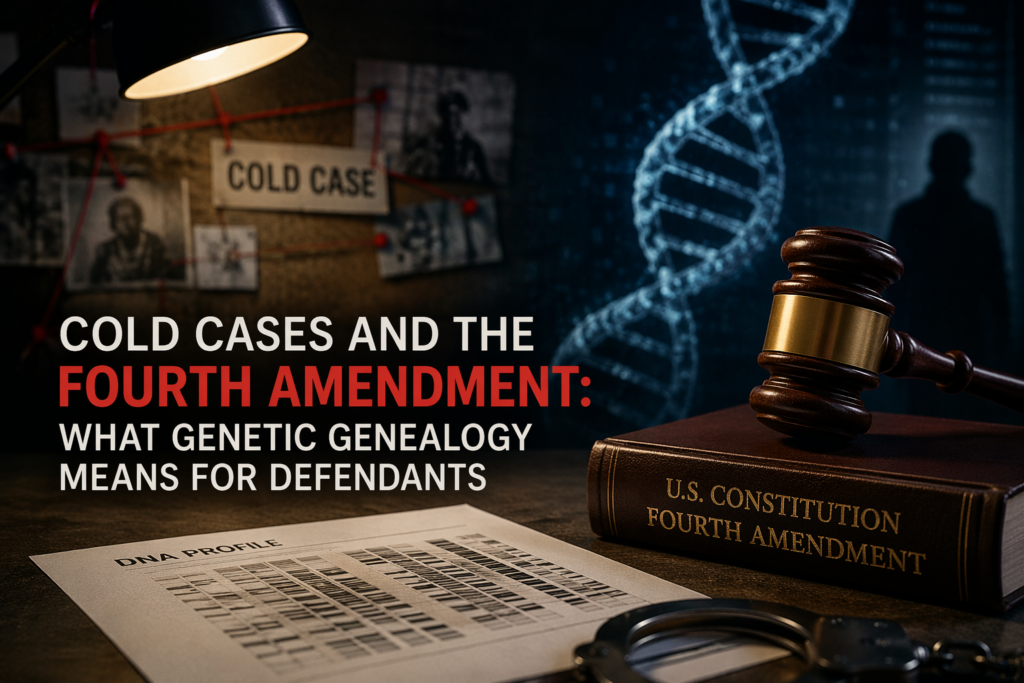
The constitutional framework governing investigative genetic genealogy is unsettled, the practical defense challenges are significant, and the technology is advancing faster than the law governing it. This is what you need to understand.
How Investigative Genetic Genealogy Actually Works
Investigative genetic genealogy (sometimes called forensic genetic genealogy searching, or FGGS) is not the same as the CODIS DNA database law enforcement has used for decades. CODIS stores short tandem repeat (STR) profiles from convicted offenders, arrestees in some jurisdictions, and crime scene samples, and matches are identified when a crime scene profile exactly matches a profile in the database. If a suspect’s DNA is not in CODIS, CODIS cannot help.
Investigative genetic genealogy operates differently. Using a crime scene sample (often degraded, partial, or decades old) a laboratory like Othram performs whole-genome sequencing or single nucleotide polymorphism (SNP) analysis to generate a genetic profile far more detailed than what CODIS uses. That profile is then uploaded to a consumer genealogy database (historically GEDmatch, which is now owned by Verogen; FamilyTreeDNA; or in some cases multiple platforms) where it is compared against the millions of profiles uploaded by ordinary people curious about their ancestry.
The goal is not an exact match. The goal is a partial match to a distant relative such as a second or third cousin, a half-sibling, anyone who shares enough DNA to suggest a common ancestor. Once a partial match is identified, investigators build a family tree backward from the common ancestor, then forward through every descendant line, using publicly available genealogical records, obituaries, social media, and other open-source research to narrow the field to a candidate pool. Physical surveillance, discarded DNA (ex. from a cup, a cigarette, a door handle) and traditional investigation then confirm or eliminate candidates.
This is the technology that identified the Golden State Killer, Joseph DeAngelo, in 2018. It identified the Zodiac Killer’s suspected accomplice in some investigations. Othram specifically touts its ability to work with degraded and mixed samples that standard STR testing cannot analyze which is precisely the condition of evidence in many decades-old cold cases.
The Third-Party Doctrine Problem
The Fourth Amendment protects against unreasonable searches and seizures. Under the Katz framework, a person has a reasonable expectation of privacy in information they have not voluntarily exposed to the public. The third-party doctrine, established in Smith v. Maryland (1979) and Miller (1976), holds that when a person voluntarily shares information with a third party (a bank, a telephone company, a business) they assume the risk that the third party will share that information with the government, and they lose any Fourth Amendment protection in it.
Applied to investigative genetic genealogy, the argument goes: the people whose DNA profiles are in GEDmatch or FamilyTreeDNA voluntarily uploaded those profiles. They shared their genetic information with a third party. Under classic third-party doctrine, the government can access that information without a warrant, and the people whose profiles were uploaded have no Fourth Amendment claim.
Courts have largely accepted this reasoning when applied to investigative genetic genealogy. In State v. Hartman (Washington, 2023), the first published court decision to address the Fourth Amendment implications of FGGS directly, the court held that law enforcement’s use of GEDmatch did not constitute a Fourth Amendment search requiring a warrant. The court found that the third-party doctrine applied because database users had voluntarily uploaded their profiles, and it rejected the argument that Carpenter v. United States (2018) (which recognized a narrow exception to the third-party doctrine for cell site location information) extended to consumer genetic databases.
But Hartman is a single California appellate decision, not binding on Texas courts, and the constitutional question remains genuinely open at the federal level. There are serious arguments that Carpenter’s reasoning (which asked whether the government was accessing information of a “comprehensive” and “invasive” nature that revealed far more than traditional third-party doctrine contemplated) should extend to genetic data. The Supreme Court in Carpenter identified three key factors: whether the data was deeply revealing, whether it had “depth, breadth, and comprehensive reach,” and whether the person had any meaningful ability to avoid its collection. Genetic data is deeply revealing. A person’s genome discloses not just their identity but their health conditions, predispositions, and (most relevantly) the identity of their relatives, who made no choice to share their genetic information with anyone. Whether the third-party doctrine’s assumption of risk can apply to information that implicates people who made no voluntary choice is an unresolved question.
The Standing Problem: You Cannot Assert Someone Else’s Rights
Here is the hardest practical reality for defense attorneys confronting a genetic genealogy case: even if the law eventually establishes that law enforcement’s access to consumer genealogy databases requires a warrant, the defendant identified through that process may have no standing to challenge it.
Fourth Amendment rights are personal. A defendant challenging a search must establish that their own reasonable expectation of privacy was violated and not someone else’s. When law enforcement accesses GEDmatch and finds a partial match to the defendant through the profile of the defendant’s second cousin (who voluntarily uploaded their DNA) the defendant did not upload anything. The defendant made no disclosure to any third party. The defendant’s own DNA was not in the database. The constitutional violation, if any, belongs to the cousin whose profile was searched, not to the defendant who was identified through it.
This is the standing gap that makes investigative genetic genealogy particularly resistant to Fourth Amendment challenge. The person who has the best claim (the relative whose DNA was used to generate the lead) typically has no interest in bringing it. The defendant who has the strongest interest because they are now facing prosecution may have no Fourth Amendment standing at all. Federal courts have so far accepted this reasoning, though as one commentator observed, the argument that a criminal defendant “has no standing to assert the privacy rights of their relatives” produces the counterintuitive result that the government can effectively search everyone’s genome by searching the portion of the population that chooses to upload to consumer databases.
The DOJ Policy and What It Actually Requires
The Department of Justice issued interim guidelines for forensic genetic genealogy searching in 2019, updated since. The guidelines require: that investigative agencies identify themselves as law enforcement to consumer DNA services when uploading; that FGGS be used only for violent crimes or cases of unidentified human remains; that no suspect be charged based solely on a genetic genealogy lead without independent confirmation; and that investigators attempt to limit searches to databases that “provide explicit notice to their service users and the public that law enforcement may use their service sites.”
The DOJ policy is an administrative requirement, not a constitutional one. Violation of the DOJ guidelines does not necessarily make the resulting evidence inadmissible. Courts have held that evidence obtained in violation of DOJ policy may be admissible unless an independent constitutional violation can be established. The guidelines create accountability within the executive branch; they do not create suppression rights for defendants.
GEDmatch, following public outcry after the Golden State Killer case, shifted to an opt-in model where users must affirmatively consent to having their profiles available for law enforcement searches. FamilyTreeDNA uses an opt-out model and has historically been more cooperative with law enforcement. Neither policy change has been found to create Fourth Amendment rights for defendants, though Orin Kerr and other Fourth Amendment scholars have argued persuasively that terms of service between private parties cannot define constitutional protections between citizens and the government.
Decades-Old Evidence: The Chain-of-Custody Challenge
Florida’s initiative targets cases from the 1960s through the 2000s. Texas cold case investigations using similar technology involve evidence of comparable age. For the defense, the age of the evidence creates independent challenges that exist entirely separately from the Fourth Amendment questions.
Sample integrity. Biological evidence stored for decades degrades. Improper storage conditions — temperature fluctuations, humidity, contamination — affect both the quality of the sample and the reliability of any analysis performed on it. Othram’s whole-genome sequencing and SNP analysis are more sensitive than STR testing, but sensitivity works in both directions: a more sensitive technique applied to a degraded sample can amplify artifacts and contaminants alongside the target DNA, producing profiles that may not accurately reflect the original sample.
Chain of custody across decades and agencies. Evidence in a cold case from 1975 may have passed through multiple agencies, evidence rooms, and storage facilities over 50 years. Each transfer, each storage location, and each person who had access to the sample is part of a chain of custody that the prosecution must establish. Gaps in that chain (i.e. periods where the sample’s location is undocumented, agencies that have been reorganized or closed, evidence room records that have not been preserved) create legitimate challenges to whether the sample analyzed today is the same sample collected at the original crime scene.
The Othram process itself. Othram’s laboratory work is proprietary. Its Forensic-Grade Genome Sequencing methods, its genealogy database search protocols, and its family tree construction methodology are not published in peer-reviewed literature in the same way that CODIS STR methodology is. The validation of Othram’s specific methods (the accuracy and error rates, the conditions under which the method produces reliable results versus artifacts, the bioinformatic pipelines used to call variants from raw sequencing data) are subject to Confrontation Clause challenge just as any other forensic methodology is. The certifying analysts whose work produces the genetic profile and the genealogical conclusion are witnesses whose testimony can be demanded under Melendez-Diaz and Bullcoming. The match is not self-proving.
The Confirmatory Evidence Problem
Both the DOJ guidelines and sound investigative practice require independent confirmation before a prosecution proceeds. Typically, investigators who have identified a candidate through genealogical research obtain a DNA sample from that person through one of two methods: a court-authorized DNA collection, or collection of “abandoned DNA” (ex. a discarded cup, a cigarette butt, a swab from a doorknob or steering wheel) without the person’s knowledge or a warrant.
Abandoned DNA collection sits in a different constitutional space from genealogy database searching. Under California v. Greenwood (1988), a person who places trash at the curb for collection has abandoned it and has no reasonable expectation of privacy in it. Courts have generally extended this reasoning to other discarded biological material. But “abandoned” is not always as clear as discarding a coffee cup. Investigators have collected DNA from shared surfaces, from objects taken without the person’s awareness, and from samples collected under circumstances where the voluntariness of the “abandonment” is genuinely contestable.
What This Means for Texas Defendants
The Florida initiative will accelerate adoption of investigative genetic genealogy in Texas, where Othram (a Texas company, based in The Woodlands) already has relationships with state law enforcement. Texas has used FGGS in cold case investigations, and the trend is toward broader and faster deployment as the technology becomes cheaper and the databases grow.
For defendants identified through FGGS, the practical landscape is challenging but not hopeless. The constitutional challenges are real, if not yet resolved in defendants’ favor. The chain-of-custody challenges for decades-old evidence are substantial. The confrontation clause rights applicable to the laboratory analysts are enforceable. And the gap between a genealogical lead and a confirmatory DNA match, which is the evidentiary gap that must be closed before prosecution can proceed, involves investigative steps that are themselves subject to legal scrutiny.
What is not realistic is the assumption that FGGS evidence will be treated the same as traditional DNA matches by courts. The legal framework is developing, the constitutional questions are genuinely open at levels above the trial court, and the forensic science underlying both the genealogical identification and the confirmatory analysis is challengeable by attorneys with the training to challenge it. Deandra Grant holds a Master of Science in Pharmaceutical Science, a Graduate Certificate in Forensic Toxicology, and the ACS-CHAL Forensic Lawyer-Scientist designation which are the analytical chemistry and forensic methodology credentials directly applicable to evaluating the laboratory work underlying any genetic evidence, old or new.
Florida’s announcement this week is a signal about where this technology is going. Texas is already there. Defense attorneys who have not yet dealt with FGGS evidence in a cold case will.
Deandra Grant Law handles DNA and forensic evidence challenges in criminal cases throughout North Texas. Call (214) 225-7117 for a free, confidential consultation.