In 2016, the President’s Council of Advisors on Science and Technology (PCAST) published a detailed scientific assessment of forensic feature-comparison methods used in criminal courts. Feature-comparison methods are those that attempt to determine whether a crime scene sample came from a specific source (a person, a weapon, a shoe) by comparing patterns or features. Bite marks, hair, fingerprints, firearms, footwear impressions, and DNA mixtures were all evaluated.
The findings were stark. PCAST concluded that several of these methods lack what it called “foundational validity” meaning there are no adequate empirical studies establishing that the method produces reliable and accurate results. Despite these findings, some of these methods continue to be admitted in criminal courts, including in Texas. Understanding what PCAST found and how to deploy it in defense is essential for any defense attorney whose client faces prosecution based on pattern evidence.
What PCAST Found About Specific Disciplines
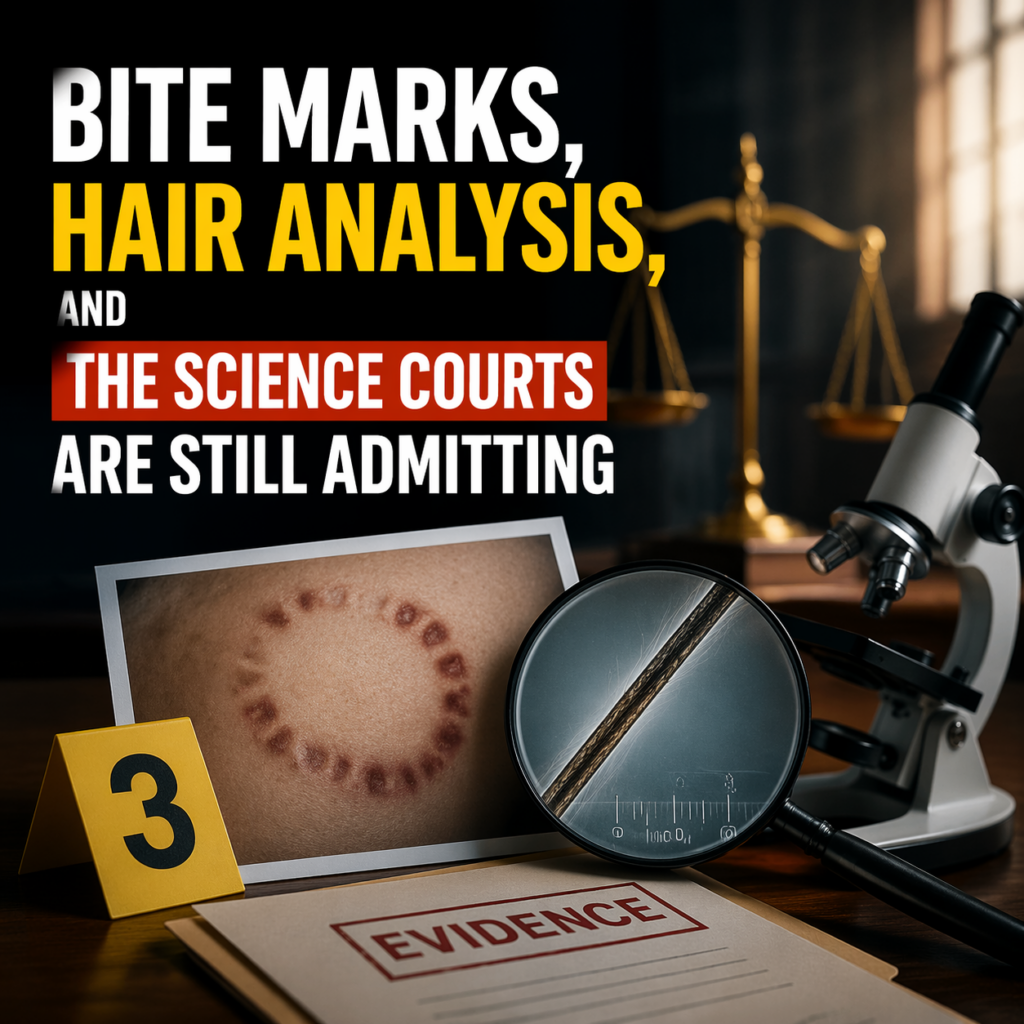
Bite mark analysis. “PCAST finds that bitemark analysis does not meet the scientific standards for foundational validity, and is far from meeting such standards.” The report found no empirical studies establishing that human dentition is sufficiently unique to allow identification from bite marks, and no studies establishing that bite marks in skin or other substrates reliably capture dental features. It found considerable literature demonstrating that examiners regularly disagree about whether injuries are bite marks and cannot reliably identify suspects from bite marks. The false positive rate (i.e. incorrectly identifying someone as the source of a bite mark) is unknown because it has never been measured.
Microscopic hair analysis. While PCAST did not conduct a comprehensive evaluation of hair analysis, it reviewed the Department of Justice’s own proposed standards and found that those standards (which claimed that hair comparison “has been demonstrated to be a valid and reliable scientific methodology”) were not supported by available studies. A 2002 FBI study comparing microscopic hair analysis to DNA analysis in 170 samples found an 11 percent false positive rate. Subsequent FBI review of cases where hair analysis was used to convict has resulted in acknowledgment that the method contributed to wrongful convictions.
Firearms and tool mark identification. PCAST found that foundational validity had not been established. The one empirical study that met criteria for evaluating accuracy found a false positive rate of 1 in 66 examinations (with the upper 95 percent confidence limit at 1 in 46). Despite this, firearms examiners continue to testify to a “match” between bullet or cartridge evidence and a specific weapon without quantifying the uncertainty of that conclusion.
Footwear analysis. Foundational validity not established. No properly designed empirical studies exist to evaluate the accuracy of associating a shoeprint with a specific shoe.
Latent fingerprint analysis. PCAST found latent fingerprint analysis foundationally valid but identified a substantial false positive rate in testing (in one study, 1 in 18). The report recommended that jurors be informed of this error rate, which is rarely done in practice.
DNA — complex mixtures. Single-source and simple two-person mixture DNA analysis was found foundationally valid. Complex mixture analysis (DNA from three or more individuals) was found to have significant validity concerns, with high variability among examiners in interpreting complex mixture profiles.
How Courts Have Responded
The PCAST report has had a measured impact on courts. The National Institute of Justice has tracked post-PCAST court decisions and found that courts have responded variably: some have excluded bite mark testimony entirely, many more have admitted it with varying limitations, and a substantial number have continued to admit it without any PCAST-based restriction.
The persistence of bite mark evidence in courts despite PCAST’s findings reflects a tension between scientific assessment and legal precedent. Courts in many jurisdictions had admitted bite mark testimony for decades before PCAST, and overcoming that precedent requires presenting PCAST’s findings persuasively at admissibility hearings. In Texas, the Robinson/Kelly framework provides the mechanism for doing so: at a Daubert hearing, defense counsel can present the PCAST report and supporting literature to the court as scientific authority for the proposition that bite mark analysis does not satisfy the requirements for reliable expert testimony.
Using PCAST in Texas Defense Practice
In any case where the prosecution proposes to offer bite mark, hair, firearms, or footwear analysis evidence, defense counsel should file a motion in limine or motion to suppress challenging admissibility under Texas Rule of Evidence 702 and request a Kelly/Robinson admissibility hearing. At the hearing, the PCAST report should be offered alongside the NAS report, expert testimony from a forensic scientist familiar with the literature, and the peer-reviewed research cited in the PCAST report.
Even where bite mark or hair evidence is ultimately admitted over objection, preserving the record of the challenge establishes the basis for appeal and ensures that the jury can be informed of the limitations of the evidence through cross-examination and potentially through defense expert testimony.
If forensic science evidence is central to your case, contact Deandra Grant Law for a free, confidential consultation. Managing Partner Deandra Grant and Partner Douglas Huff both hold the ACS-CHAL Forensic Lawyer-Scientist designation and Deandra has a Master’s Degree in Pharmaceutical Science and a Graduate Certificate in Forensic Toxicology. Call (214) 225-7117 or visit deandragrantlaw.com.