Federal Fraud & Financial Crimes
Federal fraud prosecutions cover wire, mail, and many financial schemes.
Learn More
Defense for federal investigations and charges in TX, from white collar cases to drug offenses.







A federal criminal investigation is a different experience from a state arrest. Federal agencies (the FBI, DEA, ATF, HSI, IRS Criminal Investigation) investigate for months or years before charges are filed. They build detailed evidentiary records through wiretaps, informants, financial analysis, and digital forensics before a single warrant is executed. By the time federal agents knock on your door, they have often already gathered substantial evidence. The U.S. Attorney’s office that prosecutes your case operates with resources and institutional depth that far exceed what most state prosecutors bring to a case.
Federal defense requires attorneys who know the federal system from the inside. Of Counsel James Lee Bright has more than 25 years of federal criminal trial experience and has appeared in all four Texas federal districts: the Northern, Eastern, Southern, and Western Districts of Texas. He has defended clients against the full range of federal charges, from drug trafficking and conspiracy to firearms offenses, fraud, and RICO.
Explore the federal charges our attorneys defend in courts across Texas.
Federal fraud prosecutions cover wire, mail, and many financial schemes.
Learn MoreFederal sex offense charges carry severe penalties and mandatory minimums.
Learn MoreFederal drug charges carry mandatory minimum sentences measured in years or decades.
Learn MoreFederal weapons charges carry mandatory minimums and ACCA sentencing enhancements.
Learn MoreRICO charges target ongoing criminal enterprises and carry severe federal penalties.
Learn MoreFederal conspiracy charges can apply even without completing the underlying crime.
Learn MoreFederal court runs on different rules, a different sentencing structure, and different leverage points than state court, and Of Counsel James Lee Bright has tried federal criminal cases across all four federal districts of Texas for more than 25 years.
James Lee Bright has tried federal cases for 25+ years and is admitted in all four Texas districts, the Fifth Circuit, and the U.S. Supreme Court. Prosecutors know who will try a case.
We challenge the government's evidence at the technical and scientific level, a combination of federal trial experience and forensic credentials no North and Central Texas firm can match.
On-Guidelines versus a below-Guidelines variance can mean years. We work the Guidelines, mandatory minimums, safety valve, and §3553(a) variance arguments.





The Federal Sentencing Guidelines. Unlike Texas state court, where judges have broad sentencing discretion, federal sentences are calculated through the U.S. Sentencing Guidelines which is a complex scoring system that produces an advisory Guidelines range based on offense level, criminal history, and specific offense characteristics. The difference between an on-Guidelines sentence and a below-Guidelines variance can be years of incarceration, and achieving that variance requires a mitigation presentation that addresses the specific Guidelines calculation and the factors under 18 U.S.C. §3553(a) that argue for a reduced sentence.
Mandatory minimums. Many federal offenses carry mandatory minimum sentences that eliminate judicial discretion entirely. Federal drug trafficking under 21 U.S.C. §841 carries mandatory minimums of 5 years for certain drug types and quantities, 10 years for larger quantities, and 20 years where death or serious injury results. These minimums cannot be waived by the judge. The safety valve provision (18 U.S.C. §3553(f)) allows a limited category of first-time, non-violent drug offenders to be sentenced below the mandatory minimum but only if specific criteria are met and only if argued effectively.
Grand jury proceedings. Federal charges are typically initiated through a grand jury indictment. The grand jury process is conducted in secret, and the target of an investigation generally has no right to appear or present evidence. If you learn you are the target of a federal grand jury investigation (through a target letter, a subpoena to someone you know, or a visit from federal agents) you should retain federal counsel immediately, before charges are filed.
Cooperation and plea dynamics. The federal system resolves the vast majority of cases through plea agreements. Cooperation with the government (i.e. providing information or testimony that assists other prosecutions) is one of the few mechanisms available to obtain a sentence below the applicable Guidelines range or mandatory minimum. The decision whether to cooperate, when to approach the government, and what cooperation is worth involves strategic calculations that require experienced federal defense counsel.
Federal and state crimes are similar in that they occur when someone has broken the law. A federal crime is when someone violates federal law, which Congress enacts. Federal laws generally prohibit illegal conduct that affects interstate or foreign commerce (essentially that it crosses state lines or country borders) or that occurs on federal property such as the Post Office or a national park.
In contrast, a state crime is one where someone violates a state law enacted by state legislators. State laws concern acts confined to the state.
Sometimes, a person may be accused of violating both state and federal laws. If this happens, they may be prosecuted by the state government, the federal government, or both. Although the U.S. has a law prohibiting Double Jeopardy (no person can be tried for the same crime twice) that protection does not apply when conduct falls under both state and federal jurisdiction. Double Jeopardy forbids prosecution by the same sovereign, but state and federal governments are considered separate sovereigns.
Federal crimes are investigated by agents from federal law enforcement agencies. Multiple agencies may work together on a single case depending on the alleged conduct.
An investigation begins when someone reports an alleged violation of federal law. Agents are dispatched to determine whether an offense has been committed and whether the accused committed it, using sophisticated investigative techniques to gather evidence. Depending on the outcome, agents arrest a suspect and hand their file to a federal prosecutor who determines whether sufficient evidence exists to pursue charges.
During a federal investigation, you have the right to remain silent and the right to an attorney. Exercise these rights, even at the earliest stages, because what you say at the beginning can affect the outcome of the entire case.
Bank fraud cases usually involve allegations of false statements, forged documents, misrepresentations, or unauthorized transactions involving a financial institution. The government often builds these cases using account records, applications, email trails, and testimony from bank employees, then argues intent based on patterns rather than a single event.
Wire fraud charges typically arise from alleged schemes using emails, texts, phone calls, online platforms, or electronic transfers to obtain money or property. Prosecutors often focus on what was communicated, when it was sent, and whether the government can prove a deliberate plan to deceive.
Money laundering allegations center on financial transactions the government claims were designed to conceal, move, or disguise funds tied to criminal activity. These cases often involve deposits, transfers, business revenue, cryptocurrency activity, asset purchases, or layering transactions that investigators interpret as concealment.
Federal loan fraud cases often involve allegations tied to loan applications, certifications, eligibility, use-of-funds rules, or supporting documentation. The government may claim omissions or inaccuracies were intentional, even when the defense is that the application process was confusing, delegated, or based on incomplete information.
Tax fraud allegations can involve claims of underreporting income, overstating deductions, payroll tax issues, false filings, or unreported accounts. These cases often hinge on intent, recordkeeping, and whether errors were willful or the result of mistakes, misunderstanding, or reliance on others.
Conspiracy charges allow prosecutors to claim someone is responsible for an entire alleged agreement, not just one act. The government usually tries to prove knowledge and participation through communications, financial links, travel, and association, even when the defense is that there was no true agreement or shared criminal intent.
Drug conspiracy charges are commonly used in federal court to expand exposure by alleging an agreement to manufacture, distribute, or traffic controlled substances. The government often relies on informants, wiretaps, coded language interpretations, and network theories that can overstate a person’s role.
Drug trafficking cases generally involve allegations of manufacturing, transporting, distributing, or possessing with intent to distribute controlled substances. Penalties are tied to the type and quantity involved, and prosecutors may seek enhancements if they claim leadership, weapons involvement, or conduct near protected locations.
RICO cases allege involvement in an enterprise that engaged in a pattern of racketeering activity. These prosecutions can combine multiple allegations (fraud, drugs, money laundering, weapons) then attempt to connect them under one theory. Defense often focuses on challenging the claimed enterprise structure, the pattern requirement, intent, and the reliability of cooperating witnesses.
Federal DWI charges apply when an arrest occurs on federal property or within federal jurisdiction, such as certain parks, military areas, or federal enclaves. These cases carry serious consequences and often involve challenges to traffic stops, field testing, breath or blood procedures, and constitutional issues.
Federal firearms cases can involve allegations of unlawful possession, prohibited person status, straw purchasing, trafficking, transport, or possession in connection with another offense. The government frequently ties firearms allegations to drug or conspiracy investigations, which can significantly increase sentencing exposure.
Federal fraud is a broad category covering allegations of deception for financial gain, often proved through records, emails, and transaction histories. These investigations can involve business practices, contracts, invoices, applications, or benefit programs. Defenses often focus on intent, knowledge, reliance, and whether the conduct was actually unlawful.
Healthcare fraud cases often involve allegations tied to billing, coding, referrals, documentation, medical necessity, or reimbursement claims. Prosecutors typically build these cases with audits, billing data, patient files, and investigator interpretations, then argue that patterns prove intent.
Identity theft charges may involve allegations of using another person’s information to obtain credit, money, services, or access. These cases often turn on attribution, device and account evidence, and whether the government can prove knowledge and intent beyond a reasonable doubt.
Federal sex crime investigations often involve allegations tied to interstate conduct, electronic communications, travel, or federal jurisdiction triggers. These cases move quickly, frequently involve search warrants and digital forensics, and demand aggressive defense focused on constitutional challenges and evidence reliability.
Sexual exploitation allegations can involve claims of coercion, manipulation, production of explicit material, or conduct involving minors under federal statutes. Evidence often includes device data, communications, images, account activity, and witness statements that must be carefully tested for context and authenticity.
Child sexual assault cases charged federally are among the most serious matters in the system, often involving extensive forensic interviews, medical examinations, and digital evidence. Defense frequently requires close review of interviewing methodology, forensic evidence reliability, and any factors that could influence the accusations.
Human trafficking cases can involve allegations of force, fraud, or coercion, or trafficking involving minors. Prosecutors may rely on communications, financial records, travel data, and witness testimony. These cases raise high-stakes issues involving credibility, consent, and the interpretation of relationships and financial arrangements.
Federal weapons charges can include allegations involving possession, trafficking, transport, use during another alleged crime, or possession of prohibited weapons. These cases often involve searches, stops, or warrant execution, making Fourth Amendment challenges and evidence handling a major defense focus.
Being convicted of a federal crime can result in serious sanctions. Penalties vary based on the offense and other factors.
In addition to incarceration and fines, a federal conviction carries collateral consequences under local, state, and federal law: denial of professional licenses, disqualification from federal benefits, loss of firearm rights, and immigration consequences. These collateral effects can continue long after a sentence is served.
If you are facing federal criminal charges in Texas, the federal system moves quickly and strategically from the moment an investigation begins. Retaining experienced federal defense counsel early (before charges are filed, if possible) gives the defense the maximum opportunity to evaluate the government’s evidence, challenge the investigative methodology, and position the case for the best available outcome.
Deandra Grant Law’s federal defense practice is led by Of Counsel James Lee Bright, with more than 25 years of federal trial experience across all four Texas federal districts. Call (214) 225-7117 for a free, confidential consultation, or schedule online at texasdwisite.com.
Meet the federal defense attorney who will personally handle your case.


Visit one of our Texas offices to discuss your federal case.






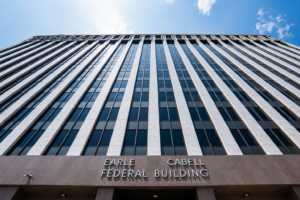
Deandra Grant Law defends federal criminal cases across all four federal districts in Texas, the District of Columbia,…
View Courthouse InfoBooks and guides explaining how federal criminal cases are defended.

Clear articles on federal law, investigations, charges, and the court process.

Watch our attorney explain federal charges, penalties, and how defenses work.






Straight answers to the questions people ask most after a federal charge or investigation in Texas, from how federal court differs from state court to what the sentencing process looks like.
Federal cases are investigated by federal agencies, prosecuted by United States Attorneys, and sentenced under the federal guidelines. They tend to involve longer investigations, more resources, and harsher sentencing exposure, including mandatory minimums. The procedures and strategy differ significantly from state court.
Contact a federal defense lawyer immediately and do not speak with agents on your own. Do not alter or destroy any records or devices. The period before charges are filed is often when a defense can do the most good, so early representation matters.
The United States Sentencing Guidelines calculate an advisory range based on the offense and the defendant's criminal history. Judges weigh that range along with other factors. Effective advocacy can argue for a sentence below the range through variances and departures.
Sometimes, but federal release works differently from state bond. A judge decides release based on flight risk and danger to the community, and some charges carry a presumption of detention. Having a lawyer at the detention hearing is critical.
We defend clients in the federal district courts that serve Texas. Federal practice is demanding and procedure-heavy, and we prepare each case accordingly.
Federal cases generally require more investigation and preparation than state cases, and fees reflect that. We discuss fees openly at the consultation and explain what your case is likely to involve so you can plan.
Every case starts with a conversation. Reach out today and put an experienced, trial-tested team in your corner. We’re available 24/7 across all six Texas offices.
Tell us what happened. We’ll respond within one business hour.
Submitting this form does not create an attorney-client relationship. All communications are confidential.