
Your smartphone contains more personal information about you than any other object you own including your text messages, emails, photos, browsing history, GPS location data, financial accounts, medical information, and social media activity. When law enforcement seizes and searches a phone during a criminal investigation, they gain access to an extraordinary volume of private data.
The question of whether that search is legal is one of the most important issues in modern criminal defense.

"Deandra Grant Law – Criminal & DWI Defense handled my case with diligence and professionalism. Deandra Grant's reputation is stellar and now I know why. She has a team of individuals who provide quality service."
- N. Coulter
"Deandra Grant Law – Criminal & DWI Defense fights hard for their clients and is always willing to go above and beyond. They are the best firm for DWI cases in DFW and beyond. Definitely hire them to represent you in any pending cases."
- P. Williams
"Deandra Grant made a tough situation so much better. She listened to my concerns and helped me so much with my case. I would recommend her to anyone needing legal services."
- M. Haley
The Riley Decision: Warrants Are Required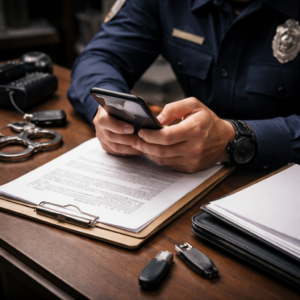
In Riley v. California (2014), the United States Supreme Court held unanimously that the police generally cannot search the contents of a cell phone without a warrant, even when the phone is seized during a lawful arrest. The Court recognized that cell phones contain vast quantities of personal information that are qualitatively different from the physical items a person might carry in their pockets.
Before Riley, law enforcement routinely searched phones incident to arrest under the same authority that allowed them to search a suspect’s pockets or bag. The Supreme Court rejected that reasoning, holding that the privacy interests at stake with cell phone data are far greater than with physical items and require a warrant supported by probable cause.
Exceptions to the Warrant Requirement
While Riley established the general rule, there are exceptions that law enforcement may rely on:
Consent
If you voluntarily consent to a search of your phone, the police do not need a warrant. This is the most common exception and the easiest to avoid. You have the right to refuse consent. If law enforcement asks to look through your phone, you can say no. You should say no.
Exigent Circumstances
If the police have reason to believe that evidence on the phone will be destroyed imminently, or that the phone contains information needed to prevent an imminent threat to life, they may search without a warrant. However, this exception is narrow, and the government bears the burden of proving that true exigency existed.
Search Incident to Arrest (Limited)
While Riley eliminated the phone search incident to arrest, officers may still physically secure the phone to prevent evidence destruction while they obtain a warrant. They may also document the phone’s exterior and identifying information without accessing its contents.
What About Passcode and Biometric Access?
A significant area of ongoing litigation involves whether law enforcement can compel a suspect to unlock their phone using a passcode, fingerprint, or facial recognition. The legal landscape is evolving, but the general principles are:
- Passcodes are generally protected by the Fifth Amendment’s privilege against self-incrimination because providing a passcode is a testimonial act that reveals the contents of your mind
- Biometric access (fingerprint, face recognition) has been treated differently by courts, with some jurisdictions holding that compelling a fingerprint or face scan is not “testimonial” and therefore not protected by the Fifth Amendment
This area of law is unsettled and continues to develop. Doug stays current on the latest case law and raises appropriate constitutional challenges in every case.
How Doug Challenges Unlawful Phone Searches
Doug’s digital forensics training allows him to evaluate not just whether a warrant was obtained, but how the search was actually conducted:
- Was the scope of the search limited to what the warrant authorized, or did law enforcement exceed the warrant by searching categories of data not specified?
- Was the forensic imaging of the phone conducted using accepted protocols that preserved the integrity of the data?
- Were proper chain of custody procedures maintained from seizure through analysis?
- Did law enforcement use the phone’s data to obtain additional warrants, and were those subsequent warrants based on lawfully obtained information?
When a phone search violates the Fourth Amendment, the remedy is suppression of the evidence through a motion to suppress. If the phone data is the foundation of the prosecution’s case, suppression can result in dismissal of the charges.
Case Results
Talk to a Defense Team That Understands Digital Evidence
At Deandra Grant Law, Attorney Douglas Huff is our Partner and Criminal Division Chief — a senior trial attorney who has completed advanced training in digital forensics with Garrett Discovery, one of the nation’s leading digital forensics firms. Doug doesn’t just read the prosecution’s forensic reports. He has the training to understand the tools, challenge the methods, and expose the weaknesses in digital evidence.
If you are facing criminal charges involving digital evidence of any kind, contact Deandra Grant Law for a free, confidential consultation.
Call (214) 225-7117 or schedule an appointment online at texasdwisite.com.
Firm Accolades

Better Business Bureaus

D Magazine