
Home »
Do You Need Legal Help?
ARVE error: <a href="https://nextgenthemes.com/plugins/arve/documentation/installation/">ARVE Pro</a> license not activated or valid

"Deandra Grant Law fights hard for their clients and is always willing to go above and beyond. They are the best firm for DWI cases in DFW and beyond. Definitely hire them to represent you in any pending cases."
- P. Williams
"Deandra Grant made a tough situation so much better. She listened to my concerns and helped me so much with my case. I would recommend her to anyone needing legal services."
- M. Haley
"Deandra Grant Law handled my case with diligence and professionalism. Deandra Grant's reputation is stellar and now I know why. She has a team of individuals who provide quality service."
- N. Coulter
As Seen On






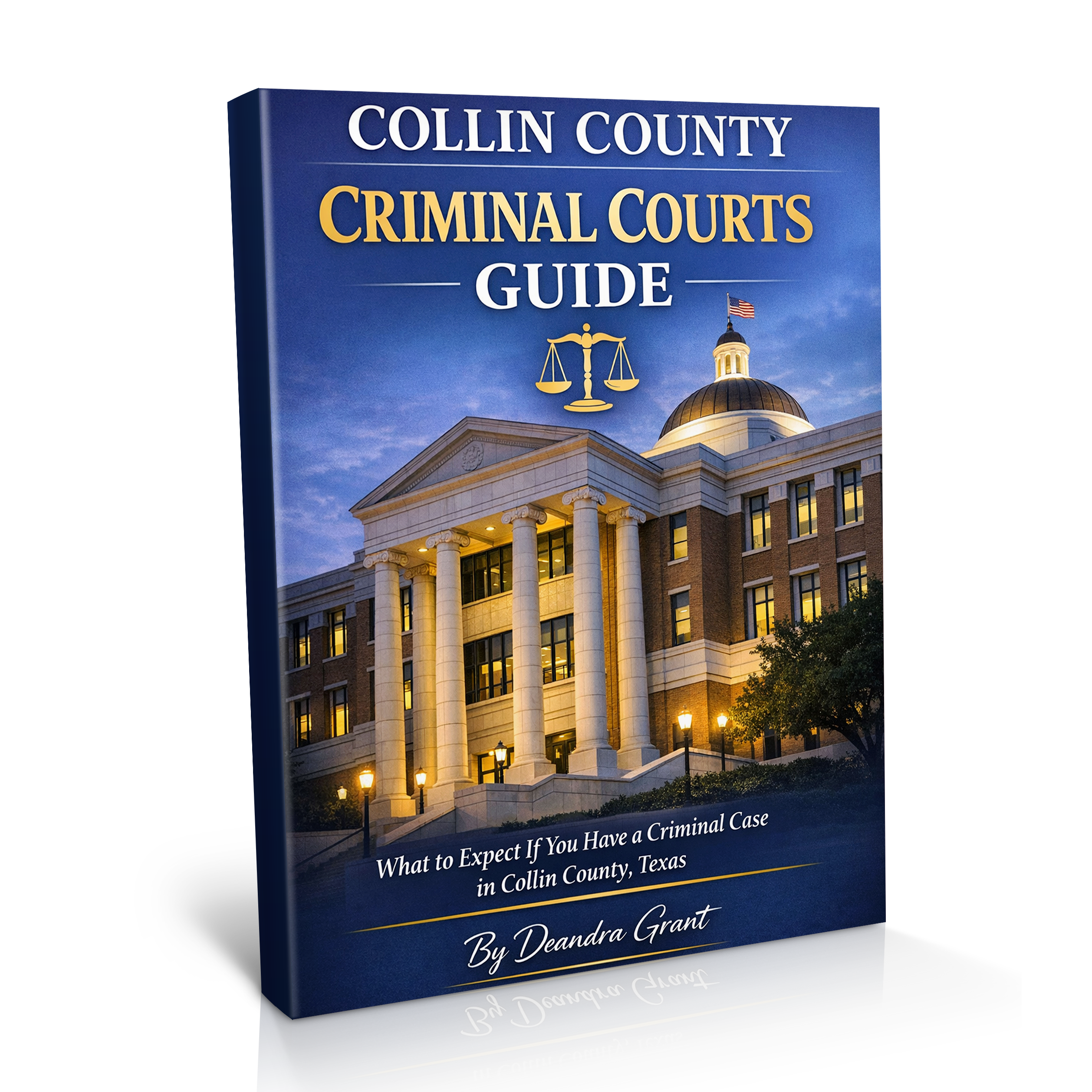
Collin County Criminal Courts Guide
By Attorney Deandra Grant
If you’re facing a criminal charge in Collin County, understanding how the local courts work can make the process far less confusing. This guide explains where cases are heard, what each court handles, and what you can expect as your case moves through the system.
Read NowCollin County Criminal Defense Lawyers
Collin County is one of the most active prosecution jurisdictions in North Texas. The District Attorney’s office handles cases from agencies across a large and growing county: McKinney PD, Allen PD, Plano PD, Frisco PD, the Collin County Sheriff’s Office, DPS troopers, and the departments serving Fairview, Princeton, Wylie, Murphy, Sachse, Celina, and every other city in the county. Every felony and misdemeanor case, regardless of which agency made the arrest, is prosecuted by the Collin County DA’s office and heard at the Russell A. Steindam Courts Building in McKinney.
Deandra Grant Law’s Allen office is at 1333 W. McDermott Drive, Suite 180 which is minutes from the Russell A. Steindam Courts Building at 2100 Bloomdale Rd., McKinney, TX 75071, where your case will be heard.
Managing Partner Deandra Grant holds a Master’s Degree in Pharmaceutical Science, a Graduate Certificate in Forensic Toxicology, and the ACS-CHAL Forensic Lawyer-Scientist designation. Partner Douglas Huff holds the same ACS-CHAL designation and has completed advanced digital forensics training. For federal matters in the Northern District of Texas, Of Counsel James Lee Bright brings more than 25 years of federal trial experience.
What Makes Collin County Criminal Defense Different
Collin County is a well-resourced, aggressive prosecution jurisdiction. Understanding what that means in practice:
A large, organized DA’s office. The Collin County DA’s office has specialized prosecution units for DWI, family violence, sexual assault, and major crimes. These units are staffed by experienced prosecutors who handle high volumes of the same offense types. The defense has to match that specialization.
Collin County juries. Collin County is known for juries that hold defendants to a high standard. Jurors in this county are educated, engaged, and attentive to scientific evidence. That cuts both ways: a technically weak prosecution case can be exposed, but a defense that relies on legal argument alone without scientific foundation is vulnerable.
The forensic science gap. Most Collin County defense attorneys challenge evidence through legal arguments about procedure and admissibility. Deandra Grant Law challenges it through the science itself: the GC-FID methodology the DPS Garland lab used, the THCA conversion chemistry in drug cases, the partition ratio in breath testing, the chain of custody gap that created fermentation conditions in blood storage. That depth is what the ACS-CHAL Forensic Lawyer-Scientist designation exists to provide.
Related Videos
The Science Behind the Evidence
- Blood alcohol testing: Collin County alcohol DWI blood draws typically go to the Texas DPS Crime Lab in Garland. GC-FID methodology, in vitro fermentation, sodium fluoride preservative adequacy, chain of custody, and analyst qualifications are all subject to independent forensic examination.
- Drug evidence: Drug specimens route to DPS Austin, Armstrong Forensic Laboratory, or NMS. Weight, identification methodology, and quantitation accuracy are challenged using the same analytical chemistry training that drives DWI blood evidence defense.
- Digital evidence: Fraud, cybercrime, online solicitation, sex offenses, theft — any case where the prosecution’s evidence is electronic. Doug Huff’s advanced digital forensics training means metadata, chain of custody, account authentication, and the completeness of records are better evaluated.
- Forensic pathology and injury evidence: In assault, aggravated assault, and homicide cases, whether an injury meets the legal definition of “serious bodily injury” is a medical and forensic question that the defense evaluates independently.
- DNA and biological evidence: SANE exam findings, touch DNA, and biological evidence are evaluated with the same forensic science foundation.
The Constitutional Foundation: Article 38.23
Every Collin County criminal defense begins with Texas Code of Criminal Procedure Article 38.23 which is the exclusionary rule with no good faith exception. An unlawful traffic stop on US-75, a defective search warrant, a consent search that exceeded its scope, a blood draw without proper authority: any of these suppresses the evidence derived from it. Suppression frequently ends the prosecution’s case.
Criminal Charges We Handle in Collin County
- Assault and Family Violence — from Class A misdemeanor bodily injury assault to first-degree felony aggravated assault, including the permanent consequences of the family violence affirmative finding: federal firearms prohibition, future enhancement, expunction bar, and child custody implications.
- Drug Possession and Delivery — all penalty groups, all quantities, including federal drug charges when DEA or HSI involvement elevates the case to the Eastern District.
- Theft, Robbery, and Fraud — shoplifting through first-degree robbery, organized retail theft, white-collar offenses, identity theft, and fraud cases where digital evidence is the prosecution’s foundation.
- Gun Crimes — UCW, felon in possession, weapons in prohibited places, NFA violations, and federal firearms charges.
- Sex Crimes — sexual assault, aggravated sexual assault, indecency with a child, online solicitation of a minor, CSAM, and sex offender registration consequences. The category where forensic evidence and digital evidence challenges are most decisive.
- Murder and Homicide — capital murder, murder, manslaughter, criminally negligent homicide, including cases where forensic pathology, blood evidence, and accident reconstruction are central to the prosecution’s theory.
- Federal Criminal Defense — any offense charged in the Eastern District of Texas, including drug trafficking, firearms, fraud, money laundering, and conspiracy. James Lee Bright handles federal defense.
Collin County Courts and Enforcement
Courthouse: Russell A. Steindam Courts Building, 2100 Bloomdale Rd., McKinney, TX 75071. Misdemeanor cases are heard in the County Courts at Law. Felony cases go to the District Courts.
Federal district: Collin County is in the Eastern District of Texas.
Enforcement Agencies in Collin County
- McKinney PD, Allen PD, Plano PD, Frisco PD
- Collin County Sheriff’s Office
- Texas DPS Troopers (US-75, US-380, Dallas North Tollway, Preston Road corridor)
- Fairview PD, Princeton PD, Wylie PD, Murphy PD, Sachse PD, Celina PD, and other municipal departments
Related Blogs
Can Police Get Into Your iPhone? How Apple’s New Security Is Reshaping Digital Evidence
By Douglas E. Huff | Partner, Deandra Grant Law | Dallas, Texas In March 2026, [...]
The Michael Morton Act, the Richard Miles Act and the Heath Opinion Now Under Fire
Most people who are not lawyers do not think much about criminal discovery. It sounds [...]
Pitchford v. Cain: What a Batson Challenge Is, and Why the Jury Is Often Decided Before the First Witness
By Deandra Grant | Deandra Grant Law | Dallas, Texas On May 28, 2026, the [...]

Probabilistic DNA Software in the Courtroom: What Defense Lawyers Need to Watch For
This month Cybergenetics (the company behind the TrueAllele probabilistic genotyping system) announced the launch of [...]

Texas SB 4 Goes Live May 15: What Defense Lawyers and Their Clients Need to Know Right Now
On April 24, 2026, the en banc Fifth Circuit vacated the preliminary injunction that had [...]
How Forensic Misconduct Can Unravel a Conviction: The Missy Woods Case and What It Means for Texas
For 29 years, Yvonne “Missy” Woods was a star analyst at the Colorado Bureau of [...]

Can the Algorithm Convict You? TrueAllele and a Defendant’s Right to Cross-Examine the Code
In March 2026, the U.S. Court of Appeals for the Third Circuit handed prosecutors a [...]

Can a Texas Warrant Expire or Does It Follow You Forever?
One of the most common misconceptions about warrants in Texas is that they eventually expire [...]
Why Choose Deandra Grant Law for Collin County Criminal Defense
- Allen office minutes from the McKinney courthouse. 1333 W. McDermott Drive, Suite 180.
- 30+ years in Collin County courts. 500+ trials to verdict statewide.
- ACS-CHAL Forensic Lawyer-Scientist — both Deandra Grant and Douglas Huff.
- Master’s Degree in Pharmaceutical Science + Graduate Certificate in Forensic Toxicology. Science-based challenges to blood, breath, and drug evidence that go beyond legal argument.
- Trained SFST Instructor.
- 17 published law books. Including The Texas DWI Manual.
- Texas Super Lawyer since 2011. AV® Preeminent rated by Martindale-Hubbell®.
- Federal defense. James Lee Bright — Northern District of Texas.
If you or someone you love is facing criminal charges in Collin County, call (214) 225-7117 for a free, confidential consultation. Or schedule online at texasdwisite.com.
Frequently Asked Questions: Arrests in Collin County, TX
What should I do immediately after being arrested in Collin County?
After an arrest in Collin County, your immediate steps are crucial. First and foremost, remain calm and respectful towards law enforcement. Do not make any statements beyond providing your identification and basic information. Exercise your right to remain silent and request an attorney. This will help ensure that your rights are protected from the outset. Next, you will likely be booked at the Collin County Jail or a local law enforcement facility. During booking, the police will take your fingerprints and photograph you, and you will be informed of the charges against you. Your priority should be to contact a knowledgeable criminal defense attorney who can guide you through the legal process and advocate on your behalf.
How can I get out of jail after an arrest?
Post-arrest, you have the option to secure your release through bail. Bail is a financial guarantee to the court that you will return for your scheduled court appearances. In Collin County, a bail amount is typically set based on the nature of the charges and other factors. You can post bail by paying the amount in full or through a bail bondsman, who will charge a non-refundable fee to cover the bail. If you cannot afford the bail amount, a bail bondsman can assist with the process, but be aware that their fees can be significant. An experienced attorney can also help you explore alternatives to bail or seek a reduction in the bail amount if necessary.
What are my rights during an arrest in Collin County?
During an arrest in Collin County, you retain several important rights. These include the right to remain silent, the right to an attorney, and the right to be informed of the charges against you. It is crucial to understand that anything you say can potentially be used against you in court, so it’s wise to avoid making statements until you have legal representation. Additionally, you have the right to a fair trial and to challenge any evidence the prosecution presents. Your lawyer will play a key role in ensuring these rights are upheld throughout the legal process.
How can a lawyer help if I’ve been arrested?
A lawyer can be instrumental in navigating the complexities of the criminal justice system following an arrest. They will assess the evidence against you, investigate the circumstances of your arrest, and develop a defense strategy tailored to your case. A skilled attorney will handle interactions with the prosecution and court, work to negotiate favorable plea deals if applicable, and represent you in court proceedings. Their experience can also help in reducing or dismissing charges and minimizing potential penalties.
What are the potential consequences if I’m convicted of a crime in Collin County?
The consequences of a criminal conviction in Collin County depend on the severity of the offense and your criminal history. Potential penalties include fines, probation, community service, and imprisonment. Additionally, a conviction can have long-lasting effects on your personal and professional life, including difficulties in securing employment, housing, or professional licenses. An experienced criminal defense attorney will work to mitigate these consequences by seeking reduced charges, negotiating plea deals, or fighting for acquittal.
Can I expunge my criminal record in Collin County?
Expungement in Collin County allows for the removal of certain criminal records from public view. Eligibility for expungement depends on various factors, including the nature of the offense and whether you were acquitted or the charges were dismissed. Expungement is typically available for cases where charges were dropped or you were found not guilty, but not for all offenses. Your attorney can help determine your eligibility and guide you through the expungement process to clear your record.
How long does it take to resolve a criminal case in Collin County?
The duration of a criminal case in Collin County can vary widely depending on several factors, including the complexity of the case, the severity of the charges, and the court’s schedule. Simple cases might be resolved in a matter of months, while more complex cases could take a year or more. Your attorney will provide a more accurate estimate based on the specifics of your case and will keep you informed throughout the process.
Talk to a Collin County Criminal Defense Attorney Before You Do Anything Else
The decisions made in the first hours after an arrest (what to say to law enforcement, whether to cooperate with investigators, what to do about bond conditions) can shape the entire trajectory of the case. Before any of those decisions are made, speak with an attorney.
Deandra Grant Law’s Allen office at 1333 W. McDermott Drive, Suite 180 is minutes from the Collin County Courthouse in McKinney. We have appeared in Collin County courts for more than 30 years, across more than 500 trials to verdict.
Call (214) 225-7117 for a confidential consultation.
Client Reviews

“Deandra Grant Law – Criminal & DWI Defense handled my case with diligence and professionalism. Deandra Grant’s reputation is stellar and now I know why. She has a team of individuals who provide quality service.”