By Deandra Grant | Deandra Grant Law | Dallas, Texas
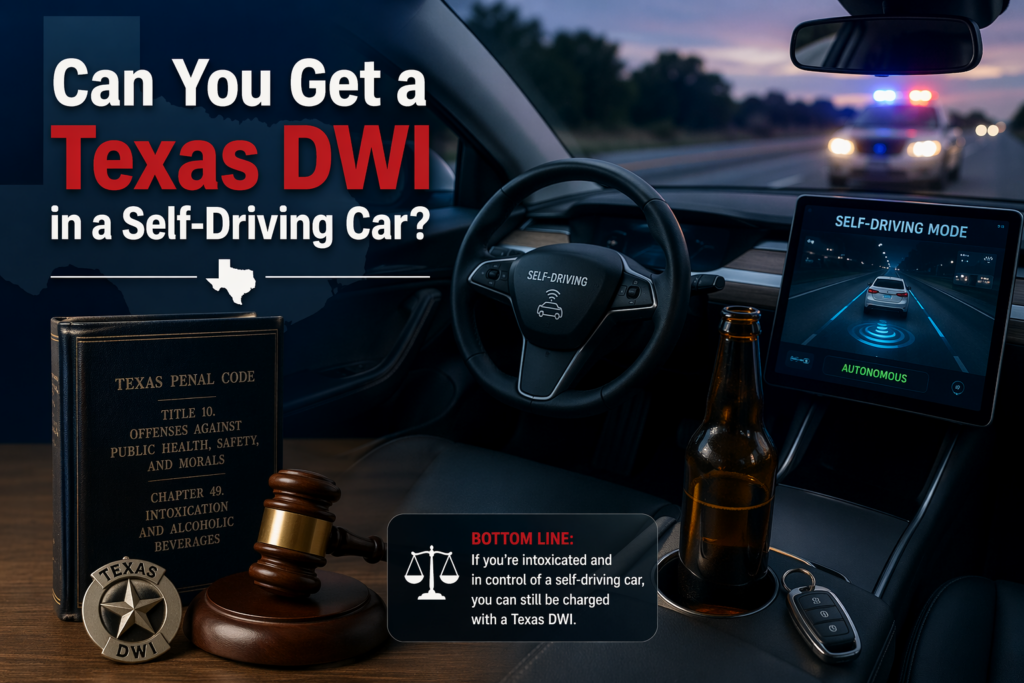
The short answer is yes and for most vehicles currently on Texas roads marketed as “self-driving,” the legal analysis is straightforward. What makes the question more interesting is understanding exactly why, what Texas law says about automated vehicles, and where the defense questions actually arise when a DWI case involves autonomous or semi-autonomous technology.
What “Self-Driving” Actually Means Today
The Society of Automotive Engineers defines six levels of vehicle automation (SAE J3016), ranging from Level 0 (no automation) to Level 5 (full automation in all conditions with no need for human intervention). The critical line for legal purposes runs between Level 2 and Level 3.
Levels 0, 1, and 2 all require the human driver to remain in control and monitor driving conditions at all times. Level 2 vehicles (which include Tesla’s Autopilot and Full Self-Driving (FSD) suite, GM’s Super Cruise, Ford’s BlueCruise, and similar systems) can handle both steering and speed simultaneously under certain conditions. But the driver must remain attentive and able to take control at any moment. Hands-off for stretches does not mean eyes-off or mind-off.
Level 3 vehicles allow the driver to disengage from active monitoring under defined conditions (the vehicle alerts the human when takeover is needed). Truly Level 3 vehicles have only recently begun limited deployment on public roads. No current production vehicle sold to consumers operates at Level 4 or 5.
The legal consequence: virtually every “self-driving” vehicle in Texas today is a Level 2 system. The human occupant in the driver’s seat remains legally responsible for the vehicle’s operation.
What Texas Law Says About “Operating” a Vehicle
Texas’s DWI statute (Penal Code §49.04) prohibits a person from operating a motor vehicle in a public place while intoxicated. The Legislature chose “operating” rather than “driving” deliberately, and the Texas Court of Criminal Appeals has given that word significant scope.
In Denton v. State (1995), the Court of Criminal Appeals established that “operating” a vehicle does not require the vehicle to be in motion. A person “operates” a vehicle when they take action to affect the functioning of the vehicle in a manner that would enable its use. Starting the engine, engaging the transmission, adjusting controls can all constitute operating. Courts have extended this reasoning across a range of factual scenarios involving parked vehicles, vehicles pulled to the side of the road, and vehicles with keys in the ignition.
The Transportation Code’s definition of “operator” as “a person who drives or has physical control of a vehicle” (§541.001(1-a)) informs but does not limit the Penal Code analysis. Texas courts have interpreted physical control broadly (i.e. a person in the driver’s seat with the ability to take control of the vehicle’s functions is exercising physical control, whether or not they are actively doing so).
For a Level 2 vehicle with Autopilot engaged, this analysis resolves clearly: the person in the driver’s seat has physical control of the vehicle and is required by both the technology’s design and Texas law to maintain that control. They are operating the vehicle.
Texas’s Automated Vehicle Statute: An Additional Layer
In 2017, Texas amended the Transportation Code to add provisions specifically addressing automated motor vehicles (Chapter 545, Subchapter H). These provisions are significant for DWI purposes in two ways.
First, Texas Transportation Code §545.453 provides that the owner of an automated vehicle is the operator for purposes of compliance with traffic and motor vehicle laws even when the automated driving system is engaged and even if the owner was not in the vehicle at the time. This provision was written primarily for fleet and commercial applications, but its implications for DWI exposure are real: being the owner of an automated vehicle that is operating in automated mode does not eliminate your status as the responsible operator.
Second, §545.454 requires automated vehicles to have a recording device installed by the manufacturer and to maintain a record of data relevant to the vehicle’s operation. This statutory requirement has direct implications for discovery in any DWI case involving an automated or semi-automated vehicle.
The Tesla FSD Case: What Actually Happens
The most common real-world scenario in North Texas involves Tesla vehicles operating in Autopilot or FSD mode. Here is what law enforcement and prosecutors encounter:
The stop. An officer observes driving behavior that suggests impairment (weaving, inappropriate speed, delayed response to traffic signals). In a vehicle operating in Autopilot mode, some of these behaviors may be caused by the system rather than the human occupant. Whether the driving behavior was generated by the human or the automation is a factual question that dashcam footage, the officer’s observations, and Tesla’s own data logs bear on.
The field sobriety tests. If the driver is contacted and appears impaired, field sobriety tests are administered. Drowsiness from inattention while trusting Autopilot to drive, disorientation from being roused from a semi-attentive state, and the physical effects of the stop itself can all produce results on SFSTs that suggest impairment without actually reflecting alcohol or drug intoxication. Deandra Grant is a trained SFST instructor and evaluates every administration against the NHTSA protocol the officer was trained to follow.
The vehicle data. This is where autonomous vehicle DWI cases diverge from traditional cases in an important way. Tesla vehicles generate substantial event data: speed, steering input, accelerator and brake position, whether Autopilot was engaged, whether the driver’s hands were detected on the wheel, and collision or near-collision events. This data can contradict the officer’s account of the driving or support it. It is also subject to the same chain-of-custody and authentication requirements as any other digital evidence.
Vehicle Event Data: Discovery and Defense
Event data recorders (EDRs) and advanced driver assistance system (ADAS) logs are increasingly significant evidence in DWI cases involving modern vehicles. Douglas Huff’s digital forensics training is directly applicable to this evidence.
Key discovery requests in any DWI case involving autonomous or semi-autonomous vehicle technology:
- Tesla EDR/Autopilot logs. Can be requested directly from Tesla with proper legal process or extracted from the vehicle itself by a qualified forensic examiner. These logs record whether Autopilot was active, the level of driver engagement detected, and the vehicle’s behavior in the minutes before the stop.
- Dashcam footage from the vehicle itself. Many modern vehicles record their own outward-facing and sometimes cabin-facing video. In Tesla vehicles, Sentry Mode and dashcam recordings may capture the driving behavior the officer described and may show something different.
- Authentication of the data. Vehicle data logs must be properly authenticated to be admissible. The chain of custody from vehicle to extraction to report, the qualifications of the person who extracted the data, and the methodology used to interpret it are all subject to challenge.
- Prosecution use of the data. If the prosecution intends to use vehicle data as evidence, all of the confrontation clause principles from Melendez-Diaz and Bullcoming The analyst who interpreted the data is a witness whose testimony can be demanded and whose methodology can be challenged.
What About Future Level 3, 4, and 5 Vehicles?
The legal framework for truly autonomous vehicles (Level 3 and above) is genuinely unsettled, and not just in Texas. The core question is whether a human who is not required to monitor or control the vehicle’s operation can be said to be “operating” it in a DWI sense.
Texas’s Transportation Code §545.453 provides a partial answer for the civil compliance framework: the owner is the operator. Whether that statutory designation translates to criminal liability under Penal Code §49.04 is a question courts have not yet answered definitively for truly autonomous operation because truly autonomous vehicles are not yet widely deployed on public roads.
What can be said with confidence: as Level 3 vehicles begin appearing in Texas (and as manufacturers and prosecutors attempt to apply existing DWI law to genuinely novel factual scenarios) the “operating” element of the DWI statute will be litigated in ways that current case law does not fully address. The defense arguments that will matter most are not new ones. They are the same ones that have always mattered: whether the stop was lawful, whether the evidence of intoxication is reliable, and whether the government can prove every element of the offense beyond a reasonable doubt with competent evidence.
The Bottom Line for Current Texas Drivers
If you are in the driver’s seat of a vehicle with Autopilot, FSD, Super Cruise, BlueCruise, or any similar system engaged, you are legally operating that vehicle under Texas law. The automation does not transfer the legal responsibility for the vehicle’s operation to the manufacturer. You remain subject to DWI laws.
If a DWI stop involves a vehicle with autonomous or semi-autonomous features, the vehicle’s own data becomes evidence and that is evidence that should be requested immediately before it is overwritten and evaluated by someone with the forensic training to understand what it actually shows.
Deandra Grant Law handles DWI defense in Dallas County and throughout North Texas, including cases involving advanced vehicle technology. Call (214) 225-7117 for a free, confidential consultation.