
A DWI traffic stop in Texas is not a single event. It is a sequence of stages, each with its own legal framework and its own decision points. The decisions made in the first few minutes (before an arrest, before a test, before a word is spoken into a recording) shape the evidence that exists afterward. Here is what the law actually requires at each stage, and what it does not.
Block "blog-reviews" not found
Stage 1: The Stop Itself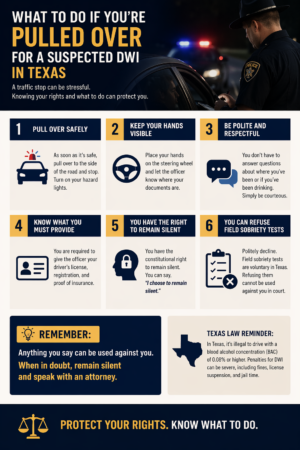
Pull over promptly and safely when you see emergency lights behind you. Move to the right, come to a complete stop, turn off the engine. Keep your hands visible on the steering wheel. This is not the moment for argument or explanation.
The officer approached your vehicle with a reason such as a traffic violation, a equipment issue, or observed driving behavior. Whatever that reason was, it is already in their notes. Nothing you say at this stage changes what the officer observed before the stop. What you say can, however, add to what they document.
Provide your license, registration, and proof of insurance when asked. These are required by law. Everything else is optional.
Stage 2: The Officer’s Questions
After the initial document check, the officer will likely begin asking questions: Where are you coming from? Where are you going? Have you had anything to drink tonight? How much?
You are not required to answer these questions. The Fifth Amendment right to remain silent applies at a traffic stop. You can say, politely and without elaboration, that you prefer not to answer questions. “I’d rather not say” or “I’m choosing to remain silent” is a complete answer. You do not need to explain why, argue about it, or justify the decision.
This is not a hostile act. It is a constitutional right that exists precisely for this situation. An officer who asks whether you’ve been drinking is not asking out of curiosity. They are building the probable cause record for the arrest. Your answer, whatever it is, goes into that record. Declining to contribute to it is not suspicious; it is the exercise of a right.
Do not lie. Lying to a law enforcement officer is a separate criminal offense. If you choose not to answer, say so. Do not provide a false account.
Stage 3: Field Sobriety Tests
If the officer suspects intoxication, they will likely ask you to step out of the vehicle and perform Standardized Field Sobriety Tests (typically the Horizontal Gaze Nystagmus (HGN) test, the walk-and-turn, and the one-leg-stand). These tests were developed by NHTSA and have specific administration protocols that officers are trained to follow.
You are not legally required to perform field sobriety tests in Texas. There is no statute obligating you to do them, and there is no ALR license suspension for declining. You can say, without further explanation, that you prefer not to perform the tests.
It is worth understanding what these tests are designed to do before deciding. They are not pass/fail in the way most people imagine. The HGN test looks for involuntary eye movement that correlates with alcohol impairment. The walk-and-turn and one-leg-stand are divided attention tests that assess coordination and ability to follow instructions under stress. The officer is not merely watching whether you fall down. They are documenting specific clues. Each deviation from the protocol counts as a clue and clues are aggregated into a conclusion about impairment.
These tests are administered roadside, at night, in traffic, often on uneven pavement, by a person who has already formed a suspicion that you are intoxicated. Deandra Grant is a trained SFST instructor. The administration errors she finds in case after case include: incorrect stimulus speed on the HGN, improper starting position, failure to screen for medical conditions that affect nystagmus, insufficient instruction time on the divided attention tests, and scoring errors. The tests are only as valid as the administration, and the administration is frequently imperfect.
Whether declining SFSTs is the right decision in your specific situation depends on factors that are impossible to assess in general terms. What is universally true is that you have the right to decline, and that the decision should be made with an understanding of what the tests actually measure and how they are actually used.
Stage 4: The Preliminary Breath Test
The officer may ask you to blow into a handheld device at the roadside. This is a Preliminary Breath Test (PBT) which is a portable screening device and not the evidentiary Intoxilyzer 9000 administered at the station after arrest. The PBT result is used to establish probable cause for arrest; it is not admissible in Texas as substantive evidence of BAC at trial.
You are not required to submit to the PBT. Like field sobriety tests, there is no ALR suspension for declining the roadside device. The officer may note your refusal, and refusal may factor into the probable cause determination. But the PBT is not the implied consent test. That comes after arrest.
Stage 5: Arrest
If the officer concludes there is probable cause to believe you were operating a motor vehicle while intoxicated, you will be placed under arrest. At this point your obligations under Texas’s implied consent law attach.
Do not resist arrest. Do not argue about whether the arrest is lawful at the scene. The place to contest an unlawful arrest is in court, not on the side of the road. Any physical resistance creates a separate criminal exposure and does not help the legal challenge that follows.
Continue to say nothing beyond what is required. You have been arrested. You have the right to an attorney. You do not have to explain yourself, describe the evening, or engage in conversation with officers at any point after the arrest.
Stage 6: The Post-Arrest Chemical Test
After a lawful DWI arrest, Texas’s implied consent law under Transportation Code §724.011 requires you to provide a specimen of breath or blood when properly requested. Before making that request, the officer must administer the DIC-24 statutory warning advising you of the consequences of refusing and the consequences of providing a specimen. This warning is a legal prerequisite. If it is not given properly, that failure is a defense to the administrative license suspension.
The choice between breath and blood is the most consequential decision at this stage, and it is not as simple as people assume. Breath test results from the Intoxilyzer 9000 have documented vulnerabilities (partition ratio variability, mouth alcohol contamination, calibration and observation period requirements) that experienced DWI defense counsel can challenge. A properly collected blood specimen, by contrast, typically produces a more accurate and more resistant result. In counties where no-refusal programs operate, a refusal often results in a blood draw by warrant anyway with the additional consequence of a longer ALR suspension and an admissible refusal at trial.
There is no universal answer to the breath-or-blood question. The right answer depends on the specific facts, the specific county, and what the chemical evidence is likely to show. What matters is understanding that the decision has consequences in both directions.
The 15-Day Deadline: Do Not Miss This
From the date of notice of suspension you have 15 days to request an ALR hearing with Texas DPS. If you provided a specimen that showed a BAC of 0.08 percent or higher, or if you refused a specimen, an Administrative License Revocation proceeding has been initiated against your license. Requesting the hearing within 15 days stays the suspension while the case is pending. Missing the deadline means the suspension takes effect automatically, with no further opportunity to contest it.
The ALR clock runs from the notice of suspension date, not from the date you receive paperwork, not from the date you hire an attorney. If you were arrested for DWI in Texas, this deadline may already be running. Call a lawyer the same day.
After the Stop: What to Do
Write down everything you remember. The sequence of the stop, what the officer said, the conditions (lighting, road surface, weather), how the field sobriety tests were administered, what you were asked and what you said. Memory fades quickly. A detailed written account made within hours of the stop is useful to your attorney in ways a vague recollection weeks later is not.
Do not post about it. Nothing about the stop, the arrest, or the night in question should appear on any social media platform. Social media content is routinely reviewed in DWI prosecutions. Post-arrest statements (even casual ones, even in private messages) can become evidence.
Call a DWI defense attorney immediately. Not after you see how things develop. Not after you talk to a friend who knows someone. Immediately. The 15-day ALR deadline may be running. The decisions that happen in the first days after an arrest have consequences that run the length of the case.
If you were arrested for DWI in Dallas County or North Texas, call Deandra Grant Law at (214) 225-7117 for a free, confidential consultation. We will request the ALR hearing, begin reviewing the evidence, and tell you exactly where your case stands.
Block "blog-awards" not found