

Knowledge Vault Blog

The Knowledge Vault Blog

Forensic Science. Criminal Defense Strategy. The Law Behind the Law.

View Blog Posts

Welcome to the Knowledge Vault Blog — where the attorneys, scientists, and forensic experts at Deandra Grant Law share what we know. This is not a typical law firm blog. It is a research library built by practitioners who teach forensic science courses, grade certification exams, and testify as experts in courtrooms across Texas.

Our Managing Partner, Deandra Grant, holds a Master’s Degree in Pharmaceutical Science, teaches the ACS-CHAL Forensic Lawyer-Scientist courses at Axion Analytical Labs, serves on the faculty of the Borkenstein Drug Course at Indiana University, and chairs the DUI Defense Lawyers Association’s national Board Certification program. She is a member of the American Academy of Forensic Sciences, the American Chemical Society, the Society of Toxicology, and the International Association of Forensic Science Consultants. Partner Douglas Huff brings ACS-CHAL credentials and Garrett Discovery digital forensics training. Federal Defense Attorney James Lee Bright contributes decades of experience in federal criminal practice.

Inside the Knowledge Vault you will find:

Hot Takes – The latest on high profile trials, changes to the law, rulings by the Supreme Court and forensic science news.

Forensic Science & DWI Defense — Deep analyses of blood and breath testing science, GC-FID instrument calibration, partition ratio variability, in vitro fermentation, retrograde extrapolation, and the pharmacokinetics of drug impairment. Written by attorneys who don’t just challenge the science — they teach it.

Field Sobriety Test Analysis — The history, validation research, and scientific limitations of the NHTSA Standardized Field Sobriety Tests, written by a certified SFST Instructor who was the first attorney in Texas to pass the Forensic Sobriety Assessment Certification exam.

Federal Criminal Defense — Guides to federal conspiracy, sentencing guidelines, proffer sessions, grand jury investigations, asset forfeiture, and the critical differences between state and federal prosecution. Written by attorneys who practice in federal courts across Texas.

Digital Forensics & Electronic Evidence — How cell phone location data, social media records, body cameras, call detail records, and computer forensics affect criminal cases — and how to challenge them.

Sex Crime Defense — Outcry witnesses, SANE exams, DNA evidence challenges, false accusations, registry implications, and defense strategies for the most serious allegations.

Emerging Science & Policy — Roadside cannabis testing technology, marijuana rescheduling and federal sentencing, Canadian travel after DWI, and the evolving intersection of science, law, and public policy.

Texas Criminal Courts & Local Practice — County-by-county courts guides, DA office profiles, courthouse walkthroughs, and city-specific enforcement patterns across Dallas, Collin, Denton, Tarrant, Rockwall, and McLennan counties.

Every article in the Knowledge Vault is written or reviewed by the attorneys at Deandra Grant Law.

We don’t publish filler. We publish the analysis we wish existed when we were building our own expertise and the information our clients deserve to have access to before they walk into a courtroom.

If you are facing criminal charges or a DWI in Texas and want to speak with the attorneys behind this work, call (214) 225-7117 or visit our Schedule an Appointment page for a free, confidential consultation.

Knowledge Vault Blog

Thirty Years on Death Row for Something You Didn’t Do: Why Wrongful Convictions Make the Death Penalty Irreversible

Thirty Years on Death Row for Something You Didn’t Do Why Wrongful Convictions Make the Death Penalty Irreversible

This week, Notre Dame Law School is hosting its second annual Death Penalty Abolition Week. Among the speakers are two men who, between them, spent nearly 60 years on death row for crimes they did not commit. Elwood Jones was convicted of aggravated murder in Ohio in 1996 and sentenced to death. He spent 27 […]

Indecency With a Child in Texas: Understanding the Charge, the Penalties, and What the Defense Examines

Indecency With a Child in Texas Understanding the Charge, the Penalties, and What the Defense Examines

Indecency with a child is one of the most frequently charged sex offenses in Texas and one of the most misunderstood. Many people facing this charge (and their families) conflate it with sexual assault, assume it requires physical penetration, or don’t understand how the two separate offense types within the statute carry fundamentally different penalties […]

Smarter Sentencing: Why Mandatory Minimums in Federal Drug Cases Are Back in the National Spotlight

Smarter Sentencing Why Mandatory Minimums in Federal Drug Cases Are Back in the National Spotlight

In early March 2026, Senators Dick Durbin (D-IL) and Mike Lee (R-UT) reintroduced two pieces of bipartisan criminal justice legislation: the Smarter Sentencing Act and its companion, the Smarter Pretrial Detention for Drug Charges Act. The fact that a Democratic Senate whip and one of the Senate’s most conservative members keep reintroducing this bill together […]
How to Challenge a Forensic Expert Witness in Texas

How to Challenge a Forensic Expert Witness in Texas

Forensic expert witnesses carry unusual authority in criminal trials. A jury that might skeptically evaluate an eyewitness’s account often defers to a laboratory analyst who presents technical findings in confident, technical language. The perception that science is objective (that a GC-MS result or a DNA match speaks for itself) can overwhelm the jury’s usual critical […]
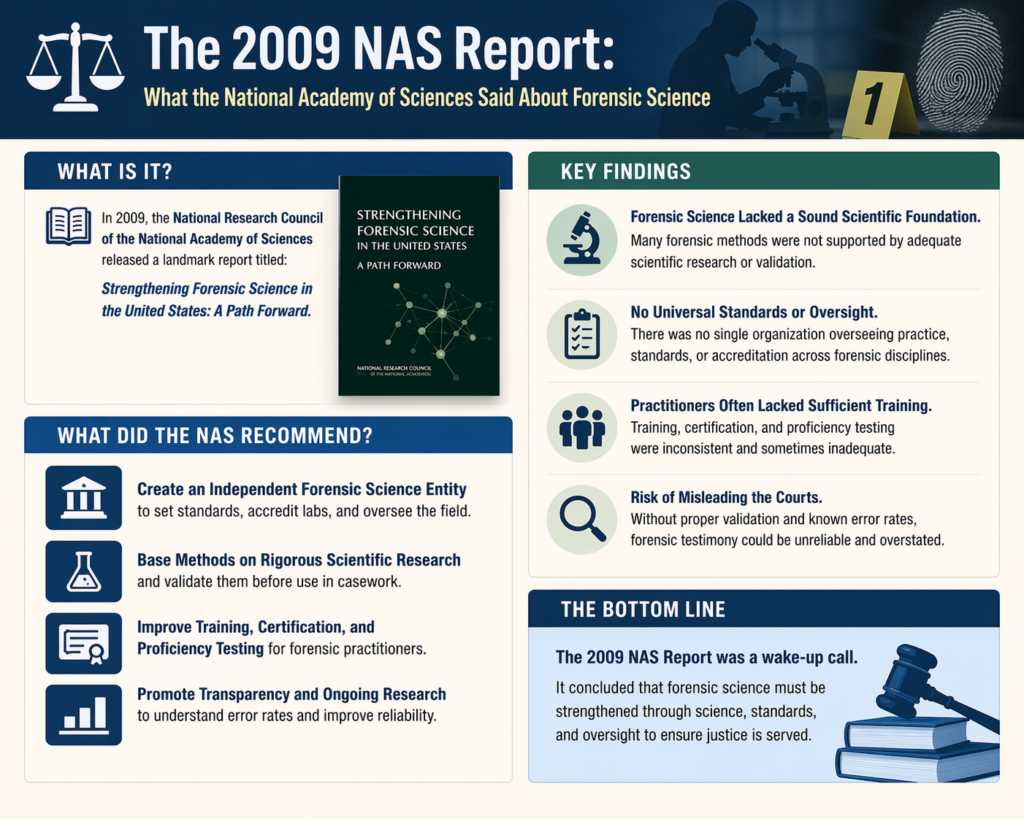
The 2009 NAS Report: What the National Academy of Sciences Said About Forensic Science

The 2009 NAS Report What the National Academy of Sciences Said About Forensic Science

In February 2009, the National Research Council of the National Academies published a report that fundamentally changed how forensic science evidence is understood in the American legal system. Titled “Strengthening Forensic Science in the United States: A Path Forward,” the report was the product of a congressionally mandated study examining the state of forensic science […]

How Federal Judges Decide Sentences: A Guide to the U.S. Sentencing Guidelines

How Federal Judges Decide Sentences A Guide to the U.S. Sentencing Guidelines

Federal sentencing is fundamentally different from state sentencing. In Texas state courts, judges and juries impose sentences within a statutory range (for example, 2 to 20 years for a second-degree felony), and the decision is driven primarily by the facts of the offense and the defendant’s criminal history. In federal court, the sentencing process is […]
What Turns a DWI Accident into Intoxication Assault or Manslaughter in Texas?

What Turns a DWI Accident into Intoxication Assault or Manslaughter in Texas

A DWI arrest is a Class B misdemeanor. The moment someone is seriously injured in the same accident, it becomes a third-degree felony. The moment someone dies, it becomes a second-degree felony. That escalation (from misdemeanor to felony, from probation-eligible to mandatory minimum) happens because of two words in the statute: serious bodily injury, and […]
Caught with a THC Vape Cartridge at DFW Airport? What Happens Next and What It Means

Caught with a THC Vape Cartridge at DFW Airport What Happens Next and What It Means

The THC vape cartridge in your carry-on bag just cost you a felony charge. That sentence captures what tens of thousands of travelers who pass through Dallas-Fort Worth International Airport every year do not know until it is too late. A THC vape cartridge that is entirely legal where you purchased it, that you have […]
Ghost Guns and NFA Firearms in Texas: What’s Legal, What’s Not, and What Changed in 2025

Few areas of firearms law have changed as rapidly as the rules governing homemade firearms and NFA-regulated weapons. A Supreme Court decision in March 2025 settled one major dispute about ghost gun regulations. A new federal law in July 2025 eliminated the $200 NFA tax stamp fee that had been in place since 1934. Texas’s […]
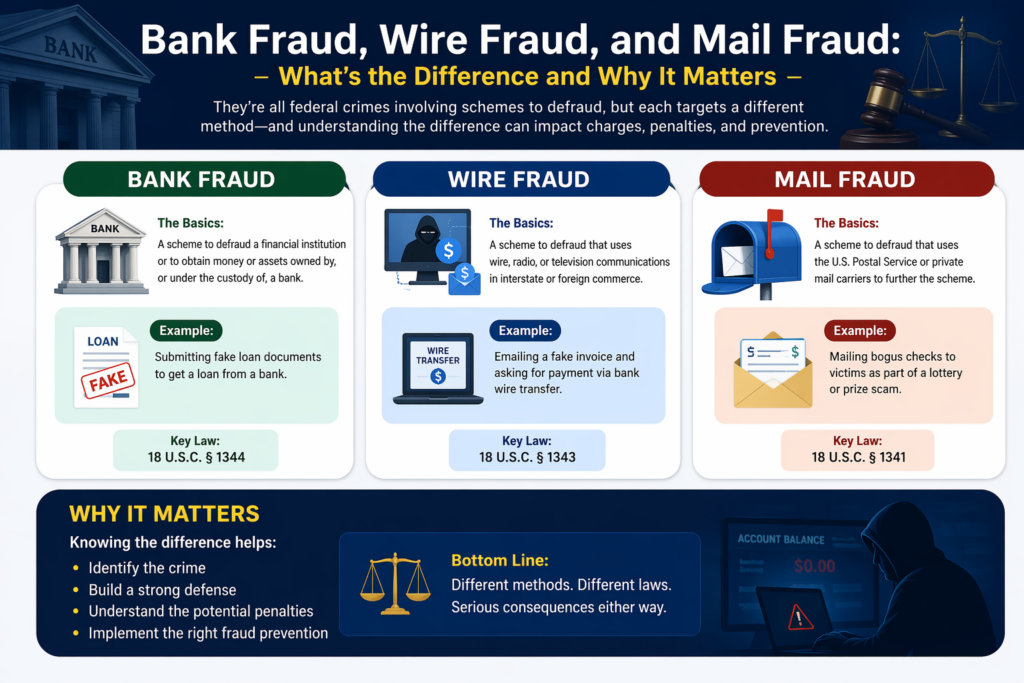
Bank Fraud, Wire Fraud, and Mail Fraud: What’s the Difference and Why It Matters

Bank Fraud, Wire Fraud, and Mail Fraud What’s the Difference and Why It Matters

Federal fraud prosecutions almost always involve multiple statutes charged together. A scheme that uses email communications, involves a bank, and includes documents sent through the mail can produce wire fraud counts, bank fraud counts, and mail fraud counts with each carrying its own penalty, each requiring the same or similar evidence, and each adding to […]