
Legal Blood vs. Hospital Blood: Why the Test Type Matters

Legal blood and hospital blood are not the same thing. Legal blood usually means a forensic whole blood test run by gas chromatography. Hospital blood usually means a clinical serum or plasma test run by an enzyme reaction for medical treatment. Serum and plasma usually read higher than whole blood, but by how much varies from person to person, so a single hospital number can stand for a range of whole blood values that runs on both sides of 0.08. In some badly injured or very sick patients, the enzyme test can also report alcohol that is not there. If a DWI case uses hospital blood, the defense has to ask what was tested, how it was tested, which test kit was used, and whether the number was converted honestly.
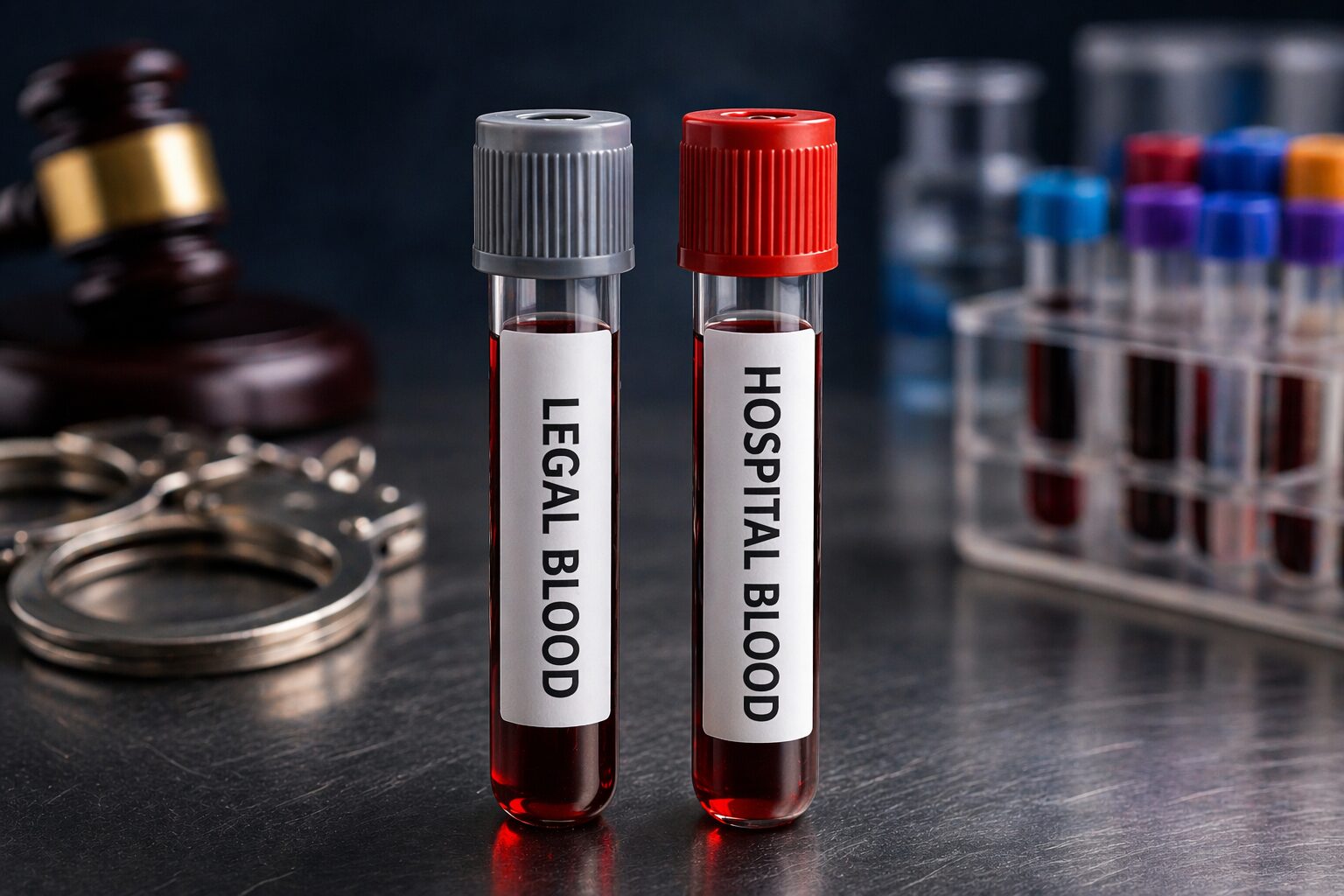
Blood draws are now a routine part of Texas DWI cases, whether the person consents or the officer gets a search warrant, and it is a rare North Texas DWI case today that has no breath or blood alcohol result at all. When blood is involved, one of the first questions the defense must answer is: what kind of blood test produced this result, and how reliable is it?
Not all blood alcohol results are created equal. There are two fundamentally different methods of measuring blood alcohol that appear in Texas DWI cases, and they carry very different levels of forensic reliability. Understanding the distinction between “legal blood” and “hospital blood” is foundational to evaluating the evidence in any blood-draw DWI case.
“Legal Blood”: Gas Chromatography with Flame Ionization Detection (GC-FID)
Blood drawn in DWI arrest cases is delivered to a forensic laboratory for analysis. The method of analysis used by Texas forensic laboratories is headspace gas chromatography with flame ionization detection, which is commonly referred to as GC-FID, or simply “GC.”
GC-FID is a separation science. It works by separating the volatile compounds found within a whole blood specimen so that each can be individually identified and quantified. During analysis, a visual representation of the separation is generated called the chromatogram. When a specimen is properly prepared, the instrument is correctly calibrated, and the separation is adequate, the quantity of ethanol in the sample can be reliably measured and reported as a whole blood alcohol concentration.
Gas chromatography is the gold standard for forensic blood alcohol measurement not because it is perfect, but because it is a direct measurement of the ethanol molecule itself, using a validated methodology with established quality control standards. Blood alcohol results generated by GC-FID analysis in a forensic laboratory are what practitioners refer to as “legal blood.” How the instrument separates, detects, and quantifies that molecule, and where each stage can fail, is on Understanding the GC-FID.
Even with GC-FID analysis, the defense must examine the complete analytical record, not just the reported number. Contamination can occur before, during, or after the blood specimen is drawn. Errors can occur during sample preparation. Instrument calibration must be verified. The chromatogram itself (the visual output of the separation) must be examined for evidence of peak overlap, baseline drift, or other anomalies that can affect the reliability of the reported result.
“Hospital Blood”: Enzymatic Serum Ethanol Testing
The second type of blood alcohol measurement that appears in DWI cases (and the one that is frequently misunderstood by both defendants and their attorneys) is enzymatic serum ethanol testing, or “hospital blood.” This method is used in hospital laboratories, not forensic laboratories.
Enzymatic testing is quick and inexpensive. Unlike GC-FID, which measures the ethanol molecule, enzymatic testing measures alcohol indirectly. An enzyme called alcohol dehydrogenase reacts with the alcohol in the sample, and in the process converts a helper molecule called NAD+ into a related molecule called NADH. The instrument shines ultraviolet light through the sample, measures how much NADH was made, and reports that amount as alcohol. It is not a direct measurement. It is a screening method that, in a clinical context, is entirely appropriate for its intended purpose: rapid assessment of a patient’s alcohol level in an emergency or treatment setting.
Enzymatic testing is not a forensic method of quantifying blood ethanol. A 2025 review of the method by two clinical chemists concluded that it “is not inherently a forensic assay.” The accepted practice is that an enzymatic result should be confirmed by gas chromatography before it is used as evidence. In DWI prosecutions, however, this confirmation step is frequently absent and the hospital lab result is what the State uses to prosecute the case.
The typical case where this type of testing becomes the central issue involves an accident: the driver was transported to a hospital, a blood alcohol level was obtained through the hospital laboratory and noted in the medical records, and those records were later subpoenaed by the State to support prosecution for DWI, intoxication assault, or intoxication manslaughter.
Hospital results also come in different units. A hospital lab usually reports alcohol in milligrams per deciliter (mg/dL), while Texas law states the limit in grams per 100 milliliters. Converting the units is simple: move the decimal point three places, so 100 mg/dL is 0.10 and 80 mg/dL is 0.08. That gets the units right. It does not turn a serum result into a blood result, which is the next problem.
The Critical Difference: Serum vs. Whole Blood
Beyond the methodological differences between GC-FID and enzymatic testing, there is a fundamental specimen difference that makes direct comparison between the two results misleading if not corrected for.
GC-FID forensic analysis is performed on whole blood, which is the complete blood specimen including red blood cells, white blood cells, and platelets. Hospital enzymatic testing is performed on plasma or serum, not whole blood.
Plasma results when whole blood is centrifuged (spun in a centrifuge) and the cellular components (red blood cells, white blood cells, and platelets) are removed. Serum is essentially the same as plasma, minus any coagulation proteins that were active at the time of separation.
Measuring plasma or serum for alcohol concentration yields a result that is, on average, roughly 10 to 20% higher than the alcohol concentration in the corresponding whole blood. This is not a flaw in the measurement. It reflects the fact that ethanol distributes differently between the cellular and fluid components of blood. The water content of plasma is higher than that of whole blood, so a given amount of ethanol appears at a higher concentration in plasma than in the same volume of whole blood.
To estimate whole blood, an expert divides the serum or plasma figure by a conversion factor. Most experts use a factor somewhere between 1.10 and 1.20, though some use factors as high as 1.25. Note that dividing by a factor is not the same as subtracting that percentage: dividing by 1.20 reduces the number by about 17%, and dividing by 1.25 reduces it by 20%. Which factor an expert selects is a choice, and it is a choice worth making them defend, because at a result near the threshold it decides the case.
Why One Conversion Factor Is Not Enough
A conversion factor is an average. The research behind it shows that the real ratio between serum and whole blood varies from one person to the next, and from one laboratory to the next, sometimes by a lot.
The study that best matches the typical DWI fact pattern took 212 consecutive trauma patients, tested their serum by the enzymatic method in the hospital lab, and tested whole blood drawn at the same moment by gas chromatography in a forensic lab. It found that the ratio changes with the alcohol level, averaging from about 1.12 to about 1.18, which the authors said rules out a single conversion factor that fits everyone. By their statistical model, a serum result has to reach about 103 mg/dL before anyone can say with 95% confidence that the whole blood result was at least 0.08.
A second study of 211 hospital patients, run in a clinical laboratory, found individual ratios anywhere from 0.88 to 1.59. For 99% of people, the ratio fell between 0.90 and 1.49. A ratio below 1.0 means the serum number came out lower than the whole blood number for that patient, which reflects the analytical variation that comes with fast, high-volume hospital testing.
Here is what that means for a single hospital result of 0.10, converted across the research rather than by one factor (results truncated to three places, as forensic laboratories report them):
- 0.10 ÷ 1.12 = 0.089 (trauma study, low end of average)
- 0.10 ÷ 1.15 = 0.086 (hospital study, median)
- 0.10 ÷ 1.18 = 0.084 (trauma study, high end of average)
- 0.10 ÷ 0.90 = 0.111 (hospital study, low end of 99% range)
- 0.10 ÷ 1.49 = 0.067 (hospital study, high end of 99% range)
On that research, a single 0.10 serum result is consistent with a whole blood alcohol anywhere from about 0.067 to 0.111. That range runs on both sides of 0.08, and that is the point. A witness who converts with one number and gives no range around it should be asked which study the number came from, how wide the range was, and whether that study was run on hospital specimens or forensic ones. State experts often prefer the narrower ranges from studies run under tightly controlled forensic conditions. Those studies are real, but a hospital result did not come out of those conditions.
This conversion argument is available in every case where the prosecution relies on a hospital enzymatic result, and it is an argument that requires forensic science expertise to make effectively. It matters because the Texas limit is stated in grams of alcohol per 100 milliliters of blood, and a serum or plasma number is not that measurement until someone converts it. What that statutory figure is and how it is measured is on The Legal BAC Limit.
Additional Reliability Concerns with Enzymatic Testing
Beyond the serum-to-whole-blood conversion issue, enzymatic testing has its own reliability vulnerabilities that do not apply to GC-FID:
False positives in badly injured or very sick patients. Because the instrument reads NADH rather than alcohol, anything else in the sample that produces NADH reads as alcohol too. The best documented culprit is the combination of lactate and an enzyme called lactate dehydrogenase (LDH), both of which can climb sharply after major trauma, shock, blood loss, or liver injury. That describes many people taken to the hospital after a serious crash. The College of American Pathologists, which handles the accreditation of most hospital labs, acknowledges in its own inspection checklist that this interference can produce false positive or falsely elevated ethanol results. How much it matters depends heavily on which manufacturer’s test the hospital ran, because some platforms are far more susceptible than others. Lactate is not the whole story either: researchers have documented false readings in liver-injury patients, including one whose lactate was normal. The case reports, the accrediting body’s own test of the analyzers, and the records to ask for are in When the Hospital Finds Alcohol That Isn’t There.
Alcohol swabs. The clinical laboratory guideline for blood alcohol testing says the skin should be cleaned with a disinfectant that contains no alcohol, and many hospital procedures say the same, because an alcohol swab can contaminate the sample. Gas chromatography separates rubbing alcohol (isopropanol) from ethanol, so in a forensic lab the swab is less of a concern. Depending on the kit, an enzymatic test may not make that distinction as cleanly. If the nurse used an alcohol prep pad on the draw site, that is worth knowing.
No forensic chain of custody. Hospital blood draws are performed by medical personnel for treatment purposes under different protocols than forensic blood draws. The documentation of the specimen from collection through analysis is generally not maintained to the standards required for forensic evidence. The chain of custody for a hospital blood specimen is typically less rigorous than for a blood draw performed pursuant to a search warrant.
No sample left to retest. When blood is drawn for the State, the crime lab keeps the tube, and the defense can ask to have that same sample retested by an independent laboratory. A hospital collects blood to treat a patient, not to preserve evidence, and clinical specimens are typically kept only for a short time. By the time charges are filed, there may be nothing left to test.
How the State Gets Your Hospital Results
Most people assume their medical records are private. In a DWI case, that assumption only goes so far. The usual route is a grand jury subpoena to the hospital, and federal privacy law permits a hospital to answer one. The Texas Court of Criminal Appeals has held that a person has no reasonable expectation of privacy in blood alcohol results that a hospital recorded for medical purposes and the State later obtained that way.
That rule covers the hospital’s records. The blood itself is treated differently. If the State wants to take a tube the hospital drew for treatment and run its own test on it, the same court has held that it generally needs a warrant first. Either way, a hospital number that ends up in a DWI file still has to survive the scientific questions above before it deserves any weight.
What This Means for Your Case
If your DWI case involves a blood alcohol result (whether from a forensic laboratory or a hospital) the defense must understand the type of testing performed, the specimen type analyzed, the methodology’s limitations, and whether the result accurately reflects your actual blood alcohol concentration at the time of driving.
In hospital blood cases specifically, the defense should: confirm whether the result is a serum or plasma result rather than a whole blood result; find out which analyzer and test kit produced it; convert it using the range the research supports rather than a single factor; review the chart for lactate, LDH, liver injury, and other clinical conditions that can produce a false reading; find out how the draw site was cleaned; and challenge the use of an unconfirmed screening test as the evidentiary foundation for a criminal prosecution.
The defense attorney handling a DWI case involving blood alcohol evidence needs more than legal knowledge. They need a working understanding of blood alcohol testing methodology, the potential errors that occur during specimen collection and analysis, and the forensic science of ethanol distribution in biological specimens. This is not general legal knowledge. It is analytical chemistry and pharmacology.
Deandra Grant holds the ACS-CHAL Forensic Lawyer-Scientist designation, a Master’s Degree in Pharmaceutical Science, and a Graduate Certificate in Forensic Toxicology. Partner Douglas Huff holds the same ACS-CHAL designation. When blood alcohol evidence is at issue in a North or Central Texas DWI case, it is reviewed at the chemistry level.
If you are facing DWI charges involving a blood alcohol test result (whether from a forensic laboratory or a hospital) call (214) 225-7117 for a free, confidential case review. Or schedule online at texasdwisite.com.
Sources
- Matthew T. Barnhill, Jr. et al., Comparison of Hospital Laboratory Serum Alcohol Levels Obtained by an Enzymatic Method with Whole Blood Levels Forensically Determined by Gas Chromatography, 31 J. Analytical Toxicology 23 (2007). doi.org/10.1093/jat/31.1.23
- Petrie M. Rainey, Relation Between Serum and Whole-Blood Ethanol Concentrations, 39 Clinical Chemistry 2288 (1993). PubMed 8222222
- Cristiano Ialongo & Alan W. Jones, The Enzymatic Analysis of Alcohol (Ethanol) in Serum and Plasma with the Alcohol Dehydrogenase Reagent, 35 Biochemia Medica 030501 (2025). doi.org/10.11613/BM.2025.030501
- Angineh Gharapetian et al., Dehydrogenase Interference with Enzymatic Ethanol Assays: Forgotten but Not Gone, 54 Clinical Chemistry 1251 (2008). PubMed 18593969
- Coll. of Am. Pathologists, Chemistry and Toxicology Checklist, CHM.37000 Ethanol Specificity (Aug. 17, 2016 ed.).
- Donald L. Frederick & Gregory S. King, Lactate Dehydrogenase Can Cause False-Positive Ethanols, Clinical & Forensic Toxicology News 4 (AACC/CAP, June 2012) (platform-to-platform differences).
- NCCLS, Blood Alcohol Testing in the Clinical Laboratory; Approved Guideline, T/DM6-A, § 2.3.3 (1997) (disinfectant).
- Tex. Penal Code § 49.01(1)(B). statutes.capitol.texas.gov
- State v. Hardy, 963 S.W.2d 516 (Tex. Crim. App. 1997). CourtListener
- State v. Martinez, 570 S.W.3d 278 (Tex. Crim. App. 2019). CourtListener
- 45 C.F.R. § 164.512(f)(1)(ii)(B) (disclosure in response to a grand jury subpoena). eCFR
The other guides in this section.
The Breath Test
The Blood Test
The Roadside Tests
Drug Cases
The Science of the Number
The science on this page is the raw material. The moves that turn it into a suppressed result, an excluded expert or a dismissal live in Defenses.
Which county your case is filed in changes how it is charged, who prosecutes it, and which court hears it.
Deandra M. Grant, JD, GC, MS, ACS-CHAL Forensic Lawyer-Scientist
She holds a Master of Science in Pharmaceutical Science and a Graduate Certificate in Forensic Toxicology, both from the University of Florida. She is the author of The Texas DWI Manual and has defended Texas DWI cases since 1994.
Charged With a DWI in Texas?
Intake answers 24/7, and if your case is one we can take on, we schedule a free consultation with an attorney.
Request a Free Case Evaluation
Tell us what happened. We'll respond as soon as possible.