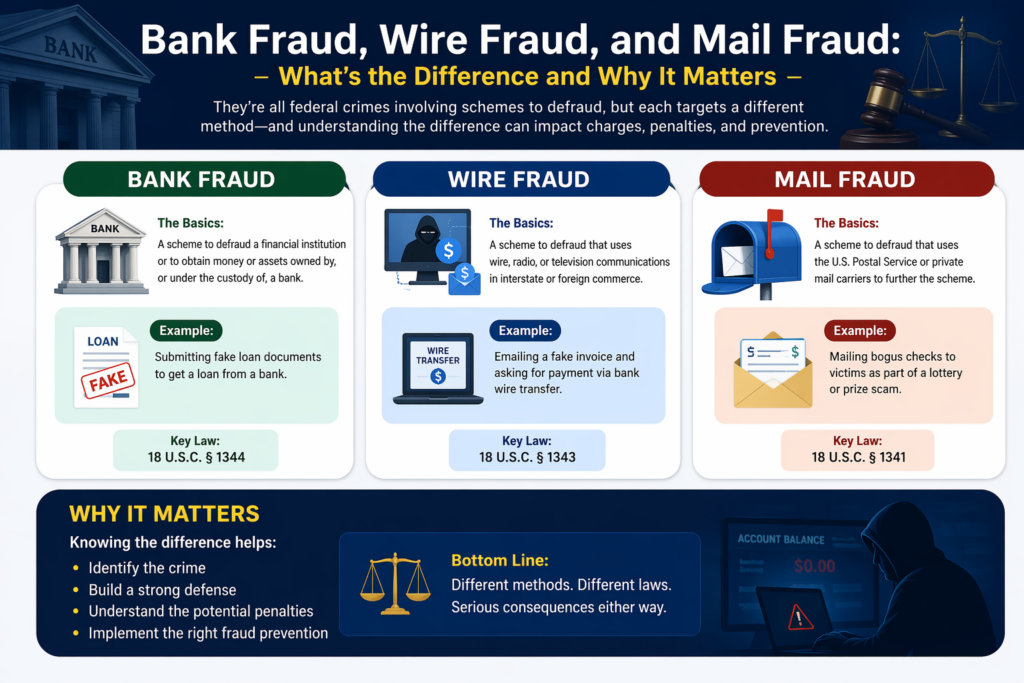
Federal fraud prosecutions almost always involve multiple statutes charged together. A scheme that uses email communications, involves a bank, and includes documents sent through the mail can produce wire fraud counts, bank fraud counts, and mail fraud counts with each carrying its own penalty, each requiring the same or similar evidence, and each adding to the overall sentencing exposure.
Understanding how these three statutes differ (what each requires, what distinguishes them from each other, and why federal prosecutors charge all three simultaneously) is foundational to understanding any federal fraud prosecution.
Wire Fraud: 18 U.S.C. §1343
Wire fraud is the broadest of the three. It requires a scheme to defraud, specific intent to defraud, and the use of interstate wire communications in furtherance of the scheme. The wire communication can be any electronic transmission that crosses state lines: emails, text messages, phone calls, online payments, wire transfers, electronic filings. In the modern economy, virtually every business transaction involves interstate wire communications, making this element almost always satisfiable.
Maximum sentence: 20 years per count. If the fraud affects a financial institution or occurs in connection with a federally declared disaster, the maximum is 30 years.
The key to wire fraud is the breadth of the “wire communication” element. An email scheduling a meeting related to a fraudulent scheme satisfies it. A text message confirming a fraudulent transaction satisfies it. There is no requirement that the communication itself contain false statements. They only need to show that it be used in furtherance of the scheme.
Mail Fraud: 18 U.S.C. §1341
Mail fraud is the predecessor to wire fraud (the same statute adapted for the postal era). It requires a scheme to defraud, specific intent to defraud, and the use of the U.S. mail or a private interstate carrier (FedEx, UPS) in furtherance of the scheme. The elements are substantively identical to wire fraud; the only difference is the communication medium.
Maximum sentence: 20 years per count. Same enhancement to 30 years if the fraud affects a financial institution or involves a declared disaster.
Mail fraud predates wire fraud by nearly a century but remains widely charged because many fraud schemes still involve physical documents: contracts sent by overnight courier, checks deposited through the mail, account statements mailed to victims. In complex fraud prosecutions, prosecutors often charge mail fraud for documents sent physically and wire fraud for electronic communications related to the same scheme, multiplying the counts.
Bank Fraud: 18 U.S.C. §1344
Bank fraud is more specific. It requires a scheme to defraud a financial institution or to obtain money, funds, credits, assets, securities, or other property owned or under the custody or control of a financial institution, by means of false or fraudulent pretenses, representations, or promises.
The critical distinction: bank fraud requires the involvement of a federally insured financial institution as the target or the vehicle of the fraud. If the scheme does not involve a bank, credit union, or other federally insured depository institution, bank fraud cannot be charged. Wire fraud and mail fraud have no such institutional requirement.
Maximum sentence: 30 years per count. This is higher than wire and mail fraud because of the systemic risk that bank fraud poses to the financial system. The 30-year maximum applies across the board. There is no baseline 20-year version for bank fraud the way there is for wire and mail fraud.
Common bank fraud scenarios: fraudulent loan applications (false income statements, inflated collateral values, fabricated employment records); check kiting (exploiting float between accounts to create artificial balances); credit card fraud schemes targeting financial institutions; and PPP and SBA loan fraud, which typically involves both bank fraud (because the SBA-backed lender is a financial institution) and wire fraud (because of the electronic application process).
Why Prosecutors Charge All Three
Federal prosecutors charge wire fraud, mail fraud, and bank fraud together whenever the facts support it for two strategic reasons.
First, each count represents a separate offense with a separate maximum sentence. A defendant convicted of ten counts of wire fraud, five counts of mail fraud, and three counts of bank fraud faces potential consecutive sentences that, while rarely imposed in full, give the court enormous discretion at sentencing and create substantial plea negotiation leverage for the government.
Second, charging multiple statutes provides redundancy. If the defense successfully challenges the bank fraud counts (arguing, for example, that the institution involved does not qualify as a federally insured financial institution) the wire fraud and mail fraud counts remain. The defendant is still convicted. The different elements of each statute make it harder to defeat all counts simultaneously.
Key Differences That Matter for Defense
- Bank fraud requires a financial institution. If the scheme did not involve a federally insured bank or credit union, bank fraud cannot stand. This is the most commonly litigated element in bank fraud cases.
- Wire and mail fraud turn on the communication medium. Challenging the interstate character of the communications, or whether they were truly in furtherance of the scheme, is more often viable in wire and mail fraud cases than in bank fraud.
- Specific intent applies to all three. All three statutes require the government to prove specific intent to defraud. Good faith reliance on advice of counsel, honest belief in the representations made, and absence of any intent to deceive are defenses that apply across all three.
- The statute of limitations differs by circumstance. Wire and mail fraud have a five-year limitations period. Bank fraud has a ten-year limitations period under 18 U.S.C. §3293. In cases involving older conduct, the different limitations periods can determine which charges the government can still bring.
If you are facing federal white collar charges or believe you are under federal investigation in Texas, contact Deandra Grant Law for a free, confidential consultation. Of Counsel James Lee Bright handles federal criminal defense in all four Texas federal districts. Call (214) 225-7117 or visit texasdwisite.com.