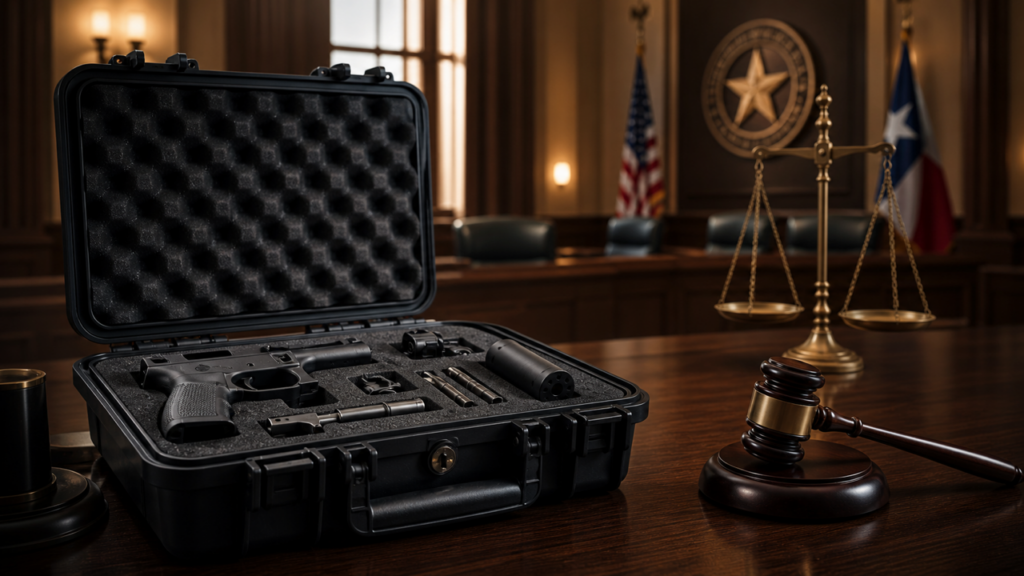
Few areas of firearms law have changed as rapidly as the rules governing homemade firearms and NFA-regulated weapons. A Supreme Court decision in March 2025 settled one major dispute about ghost gun regulations. A new federal law in July 2025 eliminated the $200 NFA tax stamp fee that had been in place since 1934. Texas’s own attempt to circumvent federal suppressor law remains blocked by the federal courts. And law enforcement in the Northern District of Texas (Dallas, Fort Worth, and the surrounding region) has made clear through active prosecution that ghost guns combined with conversion devices draw serious federal attention.
Ghost Guns: What They Are and What Texas Law Says
A “ghost gun” is an informal term for a privately made firearm assembled from a kit, 3D-printed components, or separately purchased parts that does not bear a manufacturer’s serial number. The term has no independent legal definition in Texas. What matters is how the firearm is classified under applicable law and whether the person possessing it is a prohibited person.
Under Texas state law it is legal to manufacture a firearm for personal use if you are not otherwise prohibited from possessing a firearm. Texas does not require firearms registration, does not require serial numbers on privately made firearms, and has no law specifically restricting 80% receiver kits or 3D-printed firearm components when manufactured for personal use.
The legal line under Texas law is manufacturing with intent to sell. Selling or transferring a ghost gun without a federal firearms license is illegal. Possessing a ghost gun while being a prohibited person is illegal (the lack of a serial number does not change prohibited person status).
What Changed Federally: Bondi v. VanDerStok (2025) and the ATF Rule
In 2022, the ATF issued a rule redefining “firearm” under the Gun Control Act to include weapon parts kits and partially complete frames or receivers that can be “readily converted” into working firearms. The rule requires licensed sales, serial numbers, recordkeeping, and background checks for these components at the commercial level.
That rule was challenged in federal court, and the litigation reached the Supreme Court as Bondi v. VanDerStok. On March 26, 2025, the Supreme Court upheld the ATF’s authority to regulate these components, holding that the Gun Control Act “plainly reaches some partially complete items.” The ruling does not prohibit all private manufacturing. It means that commercial sellers of unfinished frames and receivers must treat them as firearms and comply with federal dealer requirements including background checks and serialization.
NFA Firearms: The Federal Framework
The National Firearms Act, 26 U.S.C. Chapter 53, regulates a specific category of weapons that require federal registration, a background check, and historically a $200 tax stamp. These are:
Suppressors (silencers). Any device designed to reduce the report of a firearm.
Short-barreled rifles (SBRs). Rifles with a barrel less than 16 inches or an overall length less than 26 inches.
Short-barreled shotguns (SBSs). Shotguns with a barrel less than 18 inches or an overall length less than 26 inches.
Machine guns. Any weapon that fires more than one round per trigger pull, including Glock switches and other auto-conversion devices.
Destructive devices. Grenades, certain explosive devices, and firearms with a bore over half an inch (with exceptions for shotguns).
Any other weapons (AOWs). Pen guns, certain disguised firearms, and other miscellaneous regulated items.
Possessing any of these items without proper NFA registration is a federal felony — up to 10 years in federal prison, a fine up to $250,000, or both.
The Tax Stamp Fee Is Gone: The Big Beautiful Bill (2025)
For 91 years, the NFA required a $200 tax stamp for each regulated item (a transfer tax paid when an NFA item changes hands). The Big Beautiful Bill, signed on July 4, 2025, eliminated this fee. As of January 1, 2026, the NFA tax stamp for regulated items is $0.
This does not change the registration requirement. NFA items still must go through the federal approval process, the background check, and the ATF’s Form 4 or Form 1 process. The elimination of the fee makes legal compliance significantly cheaper but does not change what is legal and what is not.
The Texas Suppressor Freedom Act: Still Blocked
In 2021, Texas passed House Bill 957, the Texas Suppressor Freedom Act, declaring that suppressors manufactured in Texas and remaining within the state are exempt from federal NFA requirements. The federal courts rejected it. In 2023 and again in 2024, federal courts upheld federal jurisdiction over suppressor regulation regardless of where the suppressor was made. The Fifth Circuit Court of Appeals affirmed that federal law applies throughout Texas as it does everywhere else. The Texas Suppressor Freedom Act has no operative effect. Anyone in Texas possessing an unregistered suppressor, even one made in Texas, is subject to federal NFA prosecution.
Glock Switches and Machine Gun Conversion Devices: The Highest-Risk Category
Auto-conversion devices (commonly called Glock switches, auto sears, or machine gun conversion devices) are among the most aggressively prosecuted NFA violations in the Northern District of Texas. These small devices, often imported from China, convert semi-automatic pistols to fire automatically. They are classified as machine guns under federal law.
A Rockwall, Texas case that drew a statement from the U.S. Attorney for the Northern District makes the prosecution posture clear: importing and possessing these devices (especially when installed in an untraceable ghost gun) is treated as a serious federal case. Possession of a Glock switch is possession of a machine gun under federal law. Manufacturing or importing one without NFA registration is a separate and additional federal offense. These charges can be stacked.
The Ghost Gun + Prohibited Person Problem
None of the discussion about lawful private manufacturing applies to prohibited persons. A person who cannot legally possess a firearm cannot possess a ghost gun. The absence of a serial number does not create a legal exception. Federal prosecution of prohibited persons found with ghost guns is routine, and the untraceability of the weapon typically aggravates the prosecution’s posture rather than creating a defense.
Speak With Deandra Grant Law
Ghost gun and NFA cases frequently involve the intersection of state and federal law, the question of which agency investigated and whether federal prosecution will follow, and the rapidly changing regulatory landscape. Deandra Grant Law brings more than 30 years of criminal defense experience and more than 500 trials to every case. Of Counsel James Lee Bright brings decades of federal criminal defense experience in the Northern and Eastern Districts of Texas.
Call (214) 225-7117 or visit texasdwisite.com for a confidential consultation.