By Deandra Grant, J.D., M.S. (Pharmaceutical Science), ACS-CHAL Forensic Lawyer-Scientist
On March 2, 2026, the Supreme Court heard oral arguments in United States v. Hemani which is a case that could fundamentally reshape how the federal government prosecutes gun crimes against people who use marijuana. A majority of the justices, conservative and liberal alike, expressed skepticism toward the government’s position. A ruling is expected by late June.
The case comes out of the Fifth Circuit (which covers Texas) and it directly affects a category of federal prosecution that we see regularly in our practice: defendants charged under 18 U.S.C. §922(g)(3), the federal statute that makes it a crime for anyone who is “an unlawful user of or addicted to any controlled substance” to possess a firearm. The penalty: up to 15 years in federal prison.
If the Court rules for the defendant, the implications will extend far beyond marijuana. It could reshape how §922(g)(3) is applied to users of any controlled substance and it will accelerate the already-seismic impact of the Bruen decision on federal gun prosecutions nationwide.

"Deandra Grant Law – Criminal & DWI Defense handled my case with diligence and professionalism. Deandra Grant's reputation is stellar and now I know why. She has a team of individuals who provide quality service."
- N. Coulter
"Deandra Grant Law – Criminal & DWI Defense fights hard for their clients and is always willing to go above and beyond. They are the best firm for DWI cases in DFW and beyond. Definitely hire them to represent you in any pending cases."
- P. Williams
"Deandra Grant made a tough situation so much better. She listened to my concerns and helped me so much with my case. I would recommend her to anyone needing legal services."
- M. Haley
The Facts: A Gun, Some Marijuana, and a Very Big Question
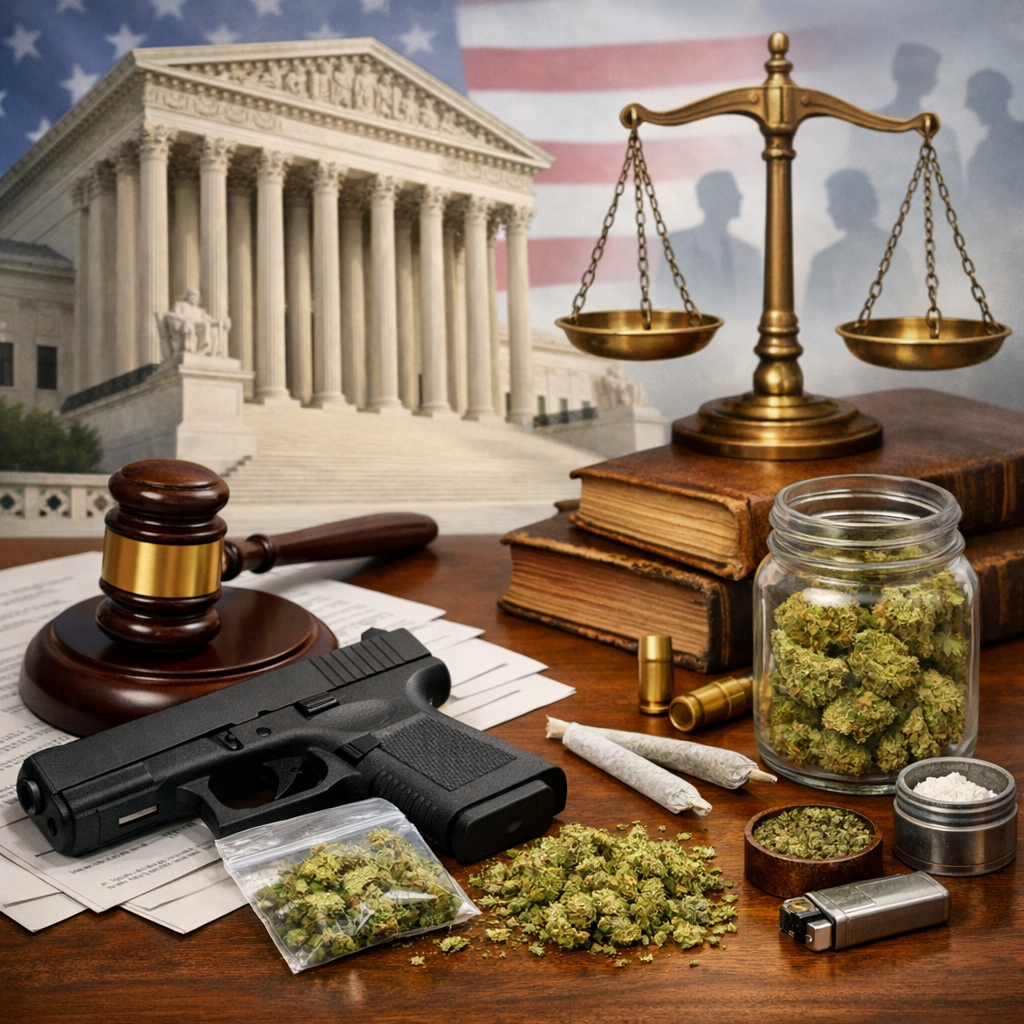
Ali Danial Hemani is a Texas man who was born and raised in the Dallas area. In 2022, the FBI searched his home and found a 9mm pistol (purchased legally and stored securely), approximately 60 grams of marijuana, and a small amount of cocaine. During the search, Hemani told agents he used marijuana roughly every other day.
He was not charged with drug trafficking. He was not charged with any violent offense. He was not alleged to have been intoxicated while handling the firearm. He was charged with a single count under §922(g)(3): possessing a firearm while being an “unlawful user” of a controlled substance.
Hemani moved to dismiss the indictment, arguing that §922(g)(3) violates his Second Amendment right to keep and bear arms. The district court agreed. The Fifth Circuit agreed. The government appealed to the Supreme Court.
The Constitutional Framework: Bruen and What Came After
To understand why Hemani matters, you need to understand the framework the Supreme Court established in New York State Rifle & Pistol Association v. Bruen (2022). In Bruen, the Court held that modern firearms regulations must be “consistent with this Nation’s historical tradition of firearm regulation.” If the government wants to restrict a person’s Second Amendment rights, it is not enough to argue that the restriction serves a public safety purpose. The government must demonstrate that the restriction has a historical analogue which means that similar restrictions existed at or near the time of the founding.
Bruen triggered a wave of constitutional challenges to federal gun laws, including hundreds of challenges to §922(g)(3). The question in every case is the same: does the historical record support categorically disarming people based on their status as drug users?
In 2024, the Court clarified the framework in United States v. Rahimi, upholding a different provision of §922(g) which is the one prohibiting firearm possession by persons subject to domestic violence restraining orders. The Court held that a prohibition based on a judicial finding of dangerousness had sufficient historical support. But Rahimi left open the question of whether a blanket categorical ban, like the one in §922(g)(3), which disarms all “unlawful users” regardless of whether they are dangerous, survives the same analysis.
Hemani is the case that answers that question.
What the Justices Said: Skepticism Across the Ideological Spectrum
The oral arguments on March 2 revealed deep skepticism from justices on both sides of the Court’s ideological divide.
Justice Gorsuch and the Founding Fathers’ Drinking Habits
The government’s primary historical analogue was founding-era “habitual drunkard” laws, which allowed for certain restrictions on people whose alcohol abuse rendered them incapable of managing their own affairs. Justice Gorsuch dismantled this analogy with characteristic directness. He pointed out that John Adams drank a tankard of hard cider with breakfast every morning and James Madison reportedly consumed a pint of whiskey daily and neither was considered a “habitual drunkard.” If the Founders who wrote the Bill of Rights were not habitual drunkards by the standards of their own era, Gorsuch asked, how does someone who uses marijuana every other day in unknown quantities qualify as a “habitual user” sufficient to lose a constitutional right?
Gorsuch also pressed the government on the vagueness of the statute: the federal government, he noted, “has not been able to define what a user is.”
Justice Barrett and the “Dangerousness” Requirement
Justice Barrett’s questions echoed her earlier dissent in Kanter v. Barr, where she argued that the government’s power to disarm people extends only to those who are dangerous and not to entire categories of people based on status. Her line of questioning in Hemani focused on the blanket nature of the prohibition: §922(g)(3) disarms all unlawful users, regardless of whether they pose any danger to anyone. A person who uses a marijuana edible for sleep and keeps a legally purchased handgun locked in a safe is treated identically to a person who uses methamphetamine daily and carries a loaded weapon in public.
Justice Sotomayor and the Conduct vs. Status Distinction
Justice Sotomayor, often on the opposite side of gun cases from the conservative justices, appeared sympathetic to Hemani’s position, focusing on the distinction between historical laws that regulated conduct (being intoxicated while armed) and §922(g)(3)’s regulation of status (being a person who uses drugs). The founding-era drunkard laws targeted people who were actively intoxicated or so severely addicted that they could not function. They did not categorically strip rights from anyone who consumed alcohol regularly.
The Government’s Problem
The government’s advocate, Solicitor General D. John Sauer, argued that “[t]he Second Amendment does not prohibit the government from temporarily disarming habitual marijuana users while they persist in using frequently.” But the justices repeatedly pressed him on what “habitual” or “frequently” actually means and he could not provide a clear definition. The government’s inability to define the very term on which the prosecution depends may prove fatal to its case.
The Coalition That Agrees on Nothing Else
One of the most striking features of Hemani is the lineup of organizations that filed briefs supporting the defendant: the NRA, the National Organization for the Reform of Marijuana Laws (NORML), the Cato Institute, the New York State Rifle & Pistol Association, and a coalition of public defenders and civil liberties organizations.
These groups agree on almost nothing in any other context. But in Hemani, they are united by a principle that crosses ideological lines: the government should not be able to strip a constitutional right from an individual based on a vaguely defined status classification, without any showing of dangerousness, and without any judicial proceeding. It is the same instinct that united the country behind Afroman: when the government overreaches, Americans across the spectrum push back.
What a Ruling for Hemani Would Mean in Texas
Because Hemani comes from the Fifth Circuit (the same circuit that covers Texas) its impact will be immediate and direct in the Northern and Eastern Districts of Texas, where our firm practices.
Pending §922(g)(3) Cases
There are currently hundreds of §922(g)(3) prosecutions pending in federal courts nationwide, including cases in the Northern District of Texas. If the Court strikes down §922(g)(3) as applied to marijuana users, every pending prosecution involving a defendant whose sole disqualifying factor is marijuana use is in jeopardy. Defendants who have already been convicted under §922(g)(3) may have grounds to challenge their convictions through post-conviction relief.
The State/Federal Marijuana Conflict
Forty states have legalized marijuana to some degree (medical, recreational, or both). Texas has the Compassionate Use Program, which allows low-THC cannabis for qualifying medical conditions. But marijuana remains a Schedule I controlled substance under federal law (for now). This means that a person who uses marijuana legally under state law is simultaneously an “unlawful user” under federal law and is therefore prohibited from possessing a firearm under §922(g)(3).
If the Court strikes down §922(g)(3) as applied to marijuana users, it resolves this conflict for firearms purposes: state-legal marijuana use would no longer be a basis for federal firearms prosecution. For the millions of Americans who use marijuana legally under state law and also own firearms, this would eliminate a federal felony trap that many do not even know exists.
Beyond Marijuana: What About Other Substances?
The government warned the Court during oral arguments that a ruling for Hemani could effectively neutralize §922(g)(3) for all controlled substances and not just marijuana. If the Court holds that mere status as a drug user, without a showing of dangerousness, is insufficient to strip Second Amendment rights, the same logic could apply to users of prescription opioids without a valid prescription, users of controlled substances in states where those substances are legal, and potentially users of harder substances if they are not shown to be dangerous.
The scope of the ruling will depend on how narrowly or broadly the Court writes it. A narrow ruling limited to marijuana (recognizing its unique status as a substance that is illegal federally but legal in most states, and that does not inherently produce the kind of dangerousness that Rahimi identified as constitutionally sufficient) would leave §922(g)(3) intact for harder drugs. A broader ruling requiring individualized findings of dangerousness for any §922(g)(3) prosecution would reshape federal firearms enforcement across the board.
Case Results
The ATF’s “Unlawful User” Definition Is Already Dead
Regardless of the Court’s ultimate ruling, one consequence of Hemani is already clear: the ATF’s expansive interpretation of “unlawful user” is finished. The ATF previously maintained that a person qualified as an unlawful user if they had used a controlled substance “in the past year” which is an extraordinarily broad definition that could sweep in anyone who used marijuana once at a party twelve months ago.
The government’s own brief in Hemani retreated from this position, arguing that §922(g)(3) applies “only if [the defendant] engages in the habitual or regular use of a controlled substance.” The ATF has subsequently proposed an interim rule defining an unlawful user as someone who “regularly uses a controlled substance over an extended period of time continuing into the present.” This is a significantly narrower definition than the previous one-year standard and it may narrow further depending on how the Court rules.
What This Means for You Right Now
If You Are Currently Charged Under §922(g)(3)
Your defense attorney should be raising a Second Amendment challenge under the Bruen/Rahimi framework immediately. The Fifth Circuit has already struck down §922(g)(3) as applied to someone who used marijuana regularly, and a majority of Supreme Court justices appear poised to agree. If you are charged in the Northern or Eastern District of Texas, the law is currently in your favor at the circuit level. Your attorney should be filing motions to dismiss now, not waiting for the Supreme Court’s decision.
If You Use Marijuana and Own Firearms
Until the Court rules, §922(g)(3) remains on the books, and federal prosecutors can still bring charges. The safest legal position is to assume the statute is enforceable until the Court says otherwise. But if you are arrested, understand that the constitutional landscape has shifted dramatically in your favor since Bruen, and that the defense arguments available to you today did not exist three years ago.
If You Were Previously Convicted Under §922(g)(3)
A Supreme Court ruling striking down §922(g)(3) as applied to marijuana users could open the door to post-conviction relief for defendants who were convicted under the statute. Whether this relief is available depends on the scope of the ruling, the specific facts of the conviction, and the procedural posture of the case. If you have a prior §922(g)(3) conviction, consult with a federal defense attorney now about whether a challenge may be viable.
Federal Gun Crime Defense at Deandra Grant Law
Hemani is the latest and most significant in a series of post-Bruen cases that are reshaping federal firearms law. The constitutional landscape is changing in real time, and defendants who have experienced federal defense counsel tracking these developments have a significant advantage over those who do not.
James Lee Bright, our Federal Defense Attorney, handles §922(g) prosecutions in the Northern and Eastern Districts of Texas. He understands the Bruen framework, the Rahimi clarification, and the Hemani arguments and he incorporates Second Amendment challenges into every federal gun case where they are viable.
If you are facing federal firearms charges in Texas — whether under §922(g)(3), §922(g)(1) (felon in possession), §924(c) (use during a drug or violence crime), or any other federal gun offense — call (214) 225-7117 or visit texasdwisite.com. The law is moving. Your defense should be moving with it.
Firm Accolades

Better Business Bureaus

D Magazine