By Deandra Grant, J.D., M.S. (Pharmaceutical Science), ACS-CHAL Forensic Lawyer-Scientist
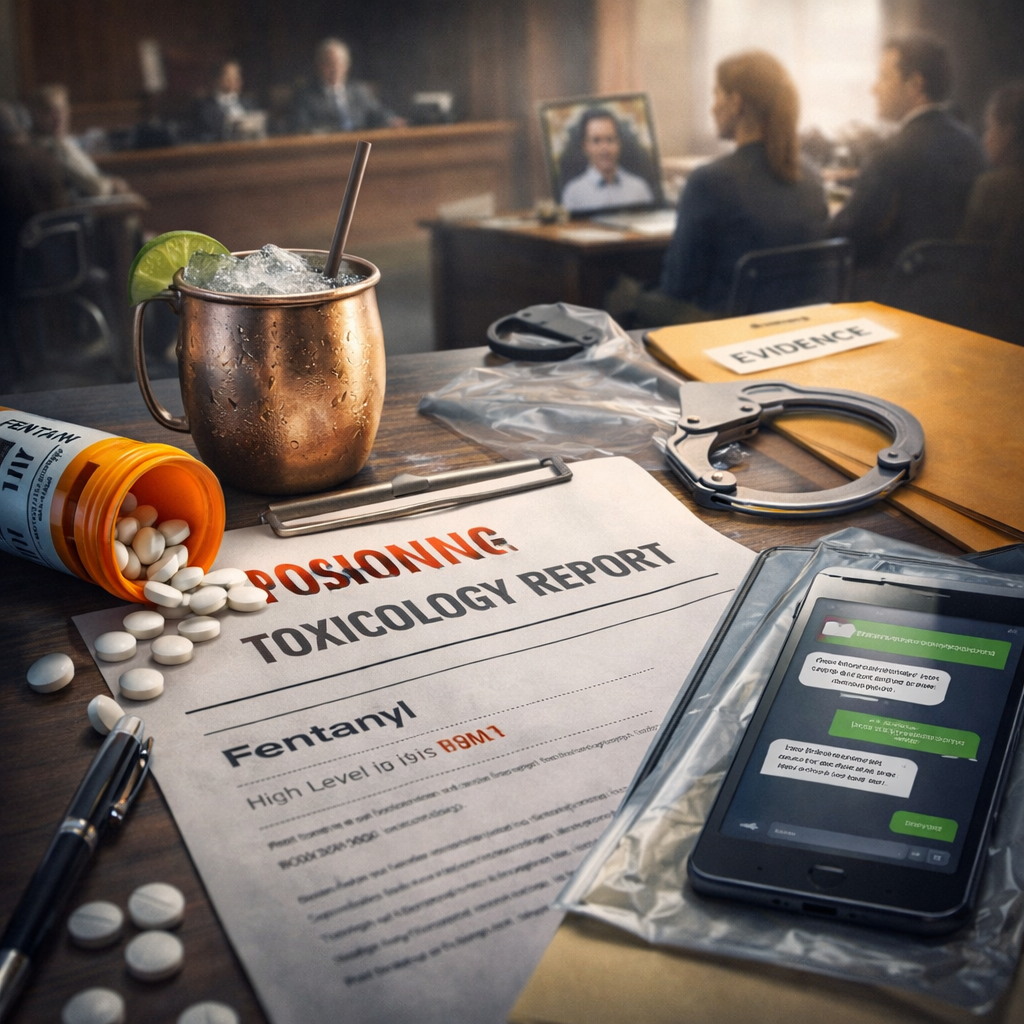
Kouri Richins was convicted of aggravated murder last week in a Utah courtroom. The prosecution’s theory: she poisoned her husband Eric with a lethal dose of fentanyl (nearly five times the fatal amount) mixed into a Moscow Mule cocktail on the night of March 4, 2022. She had tried once before, prosecutors alleged, slipping fentanyl into a sandwich on Valentine’s Day two weeks earlier. Eric survived that attempt. He did not survive the second.
The jury deliberated for about three hours. Guilty on all five counts: aggravated murder, attempted aggravated murder, forgery, and two counts of insurance fraud. She faces 25 years to life.
Here is the remarkable part: prosecutors never definitively proved how the fentanyl got into Eric Richins’ body. Not one of their 42 witnesses testified to seeing Kouri administer the drug. No forensic evidence confirmed the drink was spiked. The defense called no witnesses and put on no case, banking entirely on the argument that the prosecution had failed to prove the mechanism of death.
Defense attorney Wendy Lewis told the jury: “They cannot tell you how Eric ingested that fentanyl. They haven’t done their job, and now they want you to make inferences based on paper-thin evidence.”
The jury made the inferences. And they did it in three hours.
For anyone facing criminal charges, or for anyone who thinks the prosecution needs a “smoking gun” to win a conviction, this case is required reading.

"Deandra Grant Law – Criminal & DWI Defense handled my case with diligence and professionalism. Deandra Grant's reputation is stellar and now I know why. She has a team of individuals who provide quality service."
- N. Coulter
"Deandra Grant Law – Criminal & DWI Defense fights hard for their clients and is always willing to go above and beyond. They are the best firm for DWI cases in DFW and beyond. Definitely hire them to represent you in any pending cases."
- P. Williams
"Deandra Grant made a tough situation so much better. She listened to my concerns and helped me so much with my case. I would recommend her to anyone needing legal services."
- M. Haley
The Myth of the Smoking Gun

The single most dangerous misconception in criminal defense is the belief that the prosecution needs direct evidence to convict. A video. A confession. An eyewitness who saw the act. A fingerprint on the weapon. Jurors who watch crime dramas expect a dramatic moment where the case is cracked by a single piece of irrefutable evidence.
That is not how most criminal cases work. And it is not what the law requires.
Under both federal and Texas law, circumstantial evidence carries the same legal weight as direct evidence. A jury is entitled to draw reasonable inferences from the evidence presented, and a conviction based entirely on circumstantial evidence is just as valid as one based on an eyewitness account or a confession. The jury instruction in Texas criminal cases states this explicitly: there is no legal distinction between direct and circumstantial evidence in terms of the weight the jury may give it.
What the prosecution must do is present enough evidence, whether direct, circumstantial, or both, to prove every element of the offense beyond a reasonable doubt. They do not have to prove how the crime was committed in every mechanical detail. They have to prove that it was committed, who committed it, and the mental state with which it was committed.
The Richins case is a textbook illustration. Prosecutors could not prove the exact moment fentanyl entered Eric’s body. But they could prove everything around it — and the jury found that the surrounding evidence left no reasonable doubt.
How Prosecutors Built a Conviction Without the Mechanism
The prosecution’s case against Kouri Richins was not one piece of evidence. It was a mountain of pieces, each one insufficient alone, but collectively overwhelming. Understanding how they built that mountain is essential for anyone who wants to understand how criminal cases are actually won and lost.
Motive: Financial Desperation
A forensic accountant testified that Kouri Richins’ real estate business was “imploding.” Her net worth was negative $1.6 million the day after Eric’s death. She owed money everywhere. She had purchased a $2 million mansion she planned to flip (against Eric’s wishes) and signed the closing papers the day after he died. Eric’s life was insured for approximately $2.2 million across multiple policies, including one prosecutors argued Kouri had applied for fraudulently without Eric’s knowledge. Eric had been trying to remove Kouri from his life insurance policies and his will before he died.
Motive does not prove murder. But it answers the question the jury is silently asking from the first day of trial: why?
Prior Statements Showing Intent
A witness testified that in December 2021 (three months before Eric’s death) Kouri said that “in many ways it would be better” if Eric “were dead.” Days after the alleged Valentine’s Day poisoning attempt, Kouri texted her boyfriend: “If he could just go away and you could just be here! Life would be so perfect!!”
These statements are devastating not because they prove the act, but because they prove the state of mind. They show a defendant who was thinking about her husband’s death as a solution to her problems weeks and months before it happened.
The Drug Connection
The prosecution’s star witness, a housecleaner named Carmen Lauber, testified that Kouri asked her for drugs multiple times in early 2022. Lauber purchased pills from a man named Robert Crozier at a gas station on two occasions before Eric’s death. Digital forensics corroborated the testimony: cell phone records showed Lauber’s and Crozier’s phones were in the vicinity of the gas station on the dates Lauber described. Hundreds of text messages between Kouri and Lauber from early 2022 had been deleted from both devices, but records confirmed they exchanged multiple texts on each day Lauber said she purchased the drugs.
After Eric’s death, Kouri texted Lauber: “Still have your hookup?”
The prosecution could not prove that these specific pills were the ones that killed Eric. They could prove that Kouri was obtaining illicit drugs from a street source in the weeks before her husband died of a fentanyl overdose. The jury connected the dots.
The Digital Trail
A digital forensics analyst testified about the deleted text messages, the phone location data, and the communication patterns between Kouri, Lauber, and Crozier. The digital evidence did not capture the act of poisoning. It captured the infrastructure of the crime, i.e. the communications, the movements, and the deletions that showed a defendant trying to cover her tracks.
Deleted data is not gone. It is evidence. And juries understand that innocent people do not delete hundreds of messages with the person who supplied the drugs that killed their husband.
Post-Crime Behavior
Prosecutors played Kouri’s 911 call and argued she was “distancing herself” from the death. She published a children’s book about grieving a parent’s death. She collected on life insurance policies. She signed a multimillion-dollar real estate deal the morning after Eric died. Each of these facts, standing alone, could have an innocent explanation. Together, they painted a picture of a person who was not grieving. She was executing a plan.
The Valentine’s Day Attempt
The attempted murder charge, alleging Kouri tried to poison Eric with a fentanyl-laced sandwich on Valentine’s Day, two weeks before his death, was devastating to the defense. It showed a pattern. One poisoning could theoretically be accidental or the act of someone else. Two poisonings, two weeks apart, of the same victim, by the same rare substance, in the same household, following a period in which the defendant was obtaining illicit drugs from a street source. That is not coincidence. That is intent.
What Defense Attorneys Should Take from This Case
1. “They Can’t Prove How” Is Not a Defense
The defense’s core argument was that prosecutors could not prove the mechanism of administration which is how the fentanyl got into Eric’s body. That is a valid evidentiary point. But it is not a defense that resonates with a jury when every other piece of evidence points to guilt. Jurors are instructed that they may draw reasonable inferences. When the defendant had motive, made incriminating statements, obtained illicit drugs, deleted communications with the supplier, had a prior attempt on the victim’s life, and was the last person with the victim before death, the inference about “how” writes itself.
The lesson: a defense built on a single gap in the prosecution’s case is fragile. If the rest of the evidence is overwhelming, the jury will step over the gap.
2. Digital Evidence Is the New Star Witness
The Richins case was won, in significant part, through cell phone records, location data, text messages, and deleted communications. The digital forensics analyst who testified about the deleted texts and phone movements gave the jury the corroboration they needed to believe the housecleaner’s testimony about the drug purchases. Without the digital evidence, the case would have rested on the word of a witness with credibility issues. With it, the prosecution had a documentary backbone that supported every critical claim.
This is why digital forensics capability matters on both sides of a criminal case. Prosecutors use digital evidence to build their case. The defense must be equipped to analyze that same evidence independently to find what was omitted, to challenge how it was extracted, and to present context that the prosecution left out. Doug Huff’s digital forensics training exists for exactly this reason.
Case Results
3. The Defense Called No Witnesses — and Lost
Kouri Richins’ defense team rested without calling a single witness. They did not put Kouri on the stand. Some commentators framed this as a strategic decision reflecting confidence that the prosecution had not met its burden. The jury’s three-hour deliberation suggests otherwise.
There are absolutely cases where the defense should rest without presenting a case such as when the prosecution’s evidence is genuinely insufficient, when putting the defendant on the stand would do more harm than good, or when the defense has effectively dismantled the prosecution’s case through cross-examination. But when the prosecution has built a mountain of circumstantial evidence, resting without a response leaves the jury with only one narrative and that is the prosecution’s.
The decision whether to call witnesses and whether the defendant should testify is one of the most consequential strategic decisions in any criminal case. It requires an honest assessment of the strength of the prosecution’s evidence, the defendant’s ability to withstand cross-examination, and the availability of witnesses who can provide the jury with a credible alternative explanation.
4. Never Underestimate the Jury
Juries are not stupid. They do not need a video of the crime to convict. They do not need a confession. They need a story that fits the evidence and leaves no reasonable alternative explanation. The prosecution in the Richins case gave them that story: a woman in financial desperation, married to a man whose life was insured for $2.2 million, who obtained illicit fentanyl from a street source, who had previously expressed that life would be better if her husband were dead, who had a prior attempt on his life two weeks earlier, and who deleted the communications that would have documented her drug purchases.
Three hours. All five counts. Guilty.
Why This Matters in Texas
Texas juries receive the same instruction: circumstantial evidence carries the same weight as direct evidence. Texas prosecutors build cases the same way which is through motive, opportunity, digital evidence, prior statements, and post-crime behavior. And Texas defendants make the same mistake: believing that the absence of a single “smoking gun” means the prosecution cannot win.
In every case we handle, from DWI to drug possession to murder, we evaluate the prosecution’s evidence not just for what they have but for what story those pieces tell when assembled. If the circumstantial evidence creates a narrative that a jury will accept as proof beyond a reasonable doubt, the defense must either dismantle that narrative piece by piece or provide an alternative narrative that accounts for the same evidence. Simply pointing to what the prosecution cannot prove is not enough if what they can prove tells a complete and compelling story.
The Richins case is a reminder that criminal defense is not about finding the one thing the prosecution got wrong. It is about understanding the full picture the prosecution is presenting and developing a defense strategy that addresses it comprehensively. That may be through suppression, through forensic science challenges, through witness cross-examination, through mitigation, and through strategic decisions about what evidence to present and whether the defendant should testify.
At Deandra Grant Law, that is how we approach every case. If you are facing criminal charges in Texas, call (214) 225-7117 or visit texasdwisite.com. The prosecution is building their story right now. We build the one that answers it.
Firm Accolades

Better Business Bureaus

D Magazine