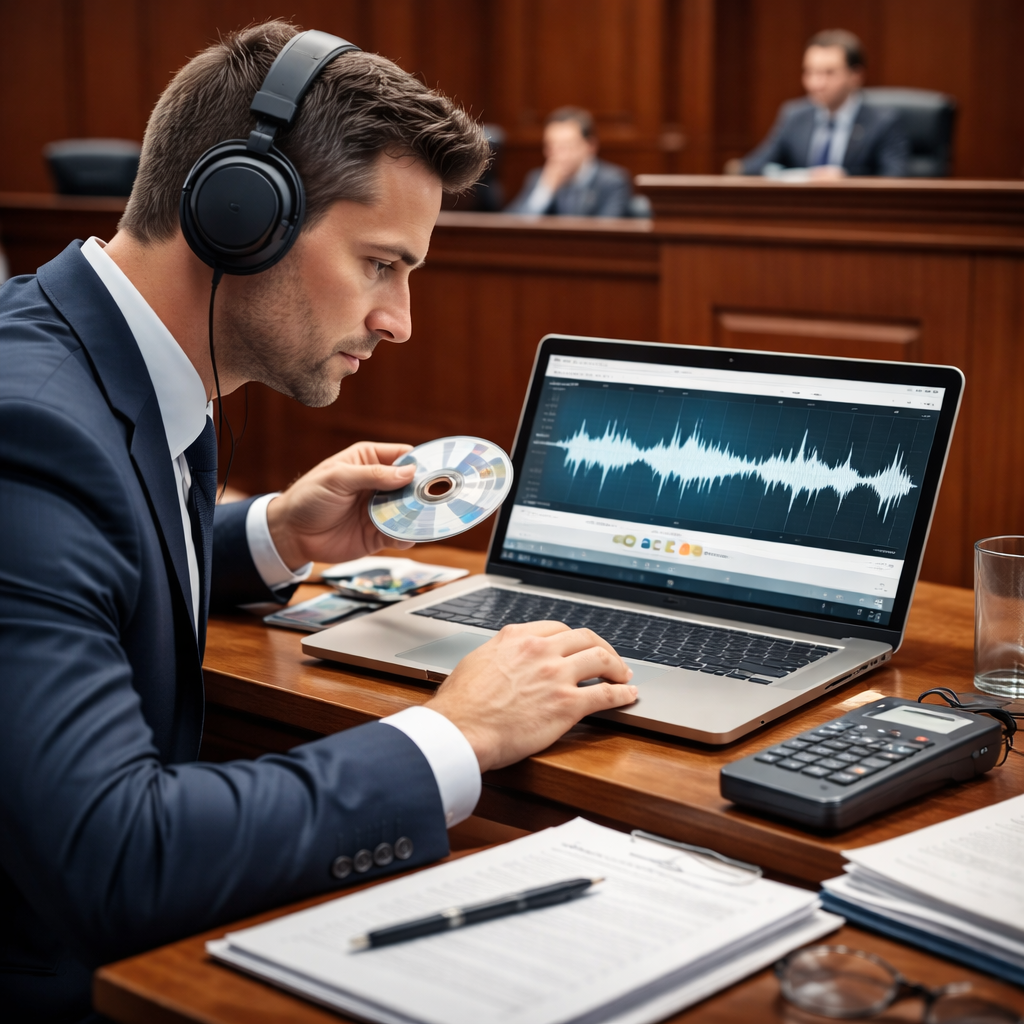
Audio recordings which may come from police interrogations, undercover operations, phone calls, voicemails, and private conversations are powerful evidence in criminal cases. A jury hearing a defendant’s own voice making what sounds like an incriminating statement is profoundly persuasive. But audio evidence is subject to technical limitations, authentication requirements, and legal restrictions that can make it less reliable or inadmissible entirely.

"Deandra Grant Law – Criminal & DWI Defense handled my case with diligence and professionalism. Deandra Grant's reputation is stellar and now I know why. She has a team of individuals who provide quality service."
- N. Coulter
"Deandra Grant Law – Criminal & DWI Defense fights hard for their clients and is always willing to go above and beyond. They are the best firm for DWI cases in DFW and beyond. Definitely hire them to represent you in any pending cases."
- P. Williams
"Deandra Grant made a tough situation so much better. She listened to my concerns and helped me so much with my case. I would recommend her to anyone needing legal services."
- M. Haley
Texas Recording Laws

Texas is a one-party consent state for recording conversations. Under Texas Penal Code §16.02, a person may record a conversation if they are a party to the conversation or if one of the parties has given prior consent to the recording. This means:
- A person can legally record their own phone calls and in-person conversations without telling the other party
- An undercover officer or confidential informant can record conversations with a suspect
- A complainant can record conversations with the defendant
However, recording a conversation to which you are not a party, and to which no party has consented to the recording, is illegal wiretapping under Texas law. Evidence obtained through illegal wiretapping may be subject to suppression.
Authentication Requirements
Before an audio recording can be admitted as evidence, the prosecution must authenticate it. That is, they must establish that the recording is what it purports to be, that the voices belong to the identified speakers, and that the recording has not been altered.
Authentication typically involves a sponsoring witness who can testify that the recording accurately represents the conversation that occurred. But this sponsoring testimony may not address the technical integrity of the recording itself. Forensic audio analysis can determine:
- Whether the recording has been edited, spliced, or altered
- Whether audio has been added, removed, or overdubbed
- Whether background noise patterns are consistent throughout or show discontinuities
- Whether the recording equipment introduced distortion that affects comprehension
- Whether the recording’s metadata is consistent with the claimed recording circumstances
Common Problems with Audio Evidence
Comprehension Issues
Audio recordings made in real-world conditions with noisy environments, moving vehicles, outdoor locations, or through concealed microphones often produce recordings that are difficult to understand. Prosecutors may provide transcripts that interpret ambiguous words and phrases in ways that favor the prosecution. Jurors who read along with a transcript tend to hear what the transcript says, even if the actual audio is unclear.
Doug challenges prosecution transcripts by demanding independent transcription, identifying passages where the audio does not support the prosecution’s interpretation, and presenting alternative transcriptions to the jury.
Selective Recording and Missing Context
Undercover recordings often capture only portions of conversations. What was said before and after the recorded segment may completely change the meaning of the recorded statements. Doug investigates the full context of recorded conversations and challenges the prosecution’s selective presentation.
Coercion and Manipulation
In undercover operations and confidential informant recordings, the government agent may use leading questions, manipulation, or pressure tactics to elicit statements that sound incriminating. The recording itself may document an interaction that was designed to produce a particular result rather than to capture spontaneous admissions.
Forensic Audio Analysis
Audio forensic analysis must be performed in a properly equipped forensic lab following established protocols. Garrett Discovery has audio forensics capabilities to include complete analysis of audio integrity, speaker identification, noise reduction, and authentication which are all performed to standards that withstand courtroom scrutiny.
Doug’s training ensures he knows when forensic audio analysis is needed, what questions it can answer, and how to present the results effectively to a jury.
Case Results
Talk to a Defense Team That Understands Digital Evidence
At Deandra Grant Law, Attorney Douglas Huff is our Partner and Criminal Division Chief — a senior trial attorney Scientist who has completed advanced training in digital forensics with Garrett Discovery, one of the nation’s leading digital forensics firms. Doug doesn’t just read the prosecution’s forensic reports. He has the training to understand the tools, challenge the methods, and expose the weaknesses in digital evidence.
If you are facing criminal charges involving digital evidence of any kind, contact Deandra Grant Law for a free, confidential consultation.
Call (214) 225-7117 or schedule an appointment online at texasdwisite.com.
Firm Accolades

Better Business Bureaus

D Magazine