When someone is accused of a sex crime in Texas, the prosecution’s case often rests on forensic evidence: a DNA match, a digital forensic report, a child’s recorded interview, or a sexual assault examiner’s findings. Prosecutors present this evidence as scientific proof. Juries tend to trust it.
But forensic evidence is not infallible. It is the product of human decisions at every stage which includes collection, preservation, analysis, and interpretation. And at every stage, errors can occur that undermine the reliability of the results. When a defense attorney has the scientific training to identify those errors, forensic evidence can become the very thing that proves a defendant’s innocence or, at minimum, demonstrates that the prosecution has not met its burden of proof.
At Deandra Grant Law, our sex crimes defense practice is led by Attorney Douglas Huff, who holds the ACS-CHAL Forensic Lawyer-Scientist designation a credential that requires graduate-level forensic science training. This is how forensic evidence actually works in sex crime cases, where it goes wrong, and why it matters who is defending you.
DNA Evidence: Powerful, but Not Bulletproof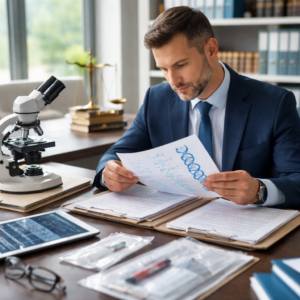
DNA evidence is often treated as the gold standard of forensic proof. Television has conditioned the public to believe that a DNA match is conclusive. In reality, DNA evidence in sex crime cases is far more complicated than most people understand.
First, there is the question of what a DNA match actually proves. The presence of someone’s DNA on another person or at a location proves contact or proximity — it does not prove a crime occurred. In sexual assault cases involving people who had a prior relationship, finding the accused’s DNA may be entirely expected and tells the jury nothing about whether the encounter was consensual.
Second, there are mixture interpretation issues. When a DNA sample contains genetic material from more than one person, the interpretation of that mixture depends on the analyst’s methodology and judgment. Studies have shown that different analysts can reach different conclusions when presented with the same mixture sample. Software-based probabilistic genotyping has improved consistency, but the underlying algorithms involve assumptions that can and should be questioned.
Third, there are collection and contamination problems. Was the sexual assault evidence kit collected within the appropriate timeframe? Were proper protocols followed to prevent cross-contamination? Was the sample stored and transported under conditions that preserved its integrity? Every link in the chain of custody is a potential point of failure.
Douglas Huff’s ACS-CHAL training gives him the ability to read and evaluate DNA lab reports at a scientific level — not just the conclusion, but the methodology, the quality metrics, the statistical calculations, and the analyst’s assumptions. When the science does not support the prosecution’s narrative, he finds it.
Digital Forensics: The New Frontier of Sex Crime Evidence
An increasing number of sex crime cases — particularly those involving CSAM (child sexual abuse material), online enticement, and sex trafficking — are built almost entirely on digital evidence. Federal agencies like the FBI and HSI use sophisticated tools to trace IP addresses, analyze device contents, and recover deleted files. When they present this evidence in court, it can appear overwhelming and irrefutable.
But digital forensic evidence has its own set of vulnerabilities:
- IP address attribution is not identity attribution. An IP address identifies a network connection, not a person. Multiple people may share a WiFi network. IP addresses can be spoofed. VPN and Tor usage can obscure actual locations.
- Device access does not equal device control. If multiple people had physical or remote access to a device, the prosecution must establish that the defendant was the person who downloaded, viewed, or distributed the material in question. Malware, unauthorized remote access, and shared devices are all legitimate defense considerations.
- Metadata can be misleading. File creation dates, modification dates, and access timestamps depend on the accuracy of the device’s system clock and can be altered by software, system updates, or user activity that has nothing to do with criminal conduct.
- Hash value matching has limits. Law enforcement compares file hash values against databases of known illegal material. But hash matching identifies identical files — it does not tell you how a file arrived on a device, whether the user knowingly possessed it, or whether it was in an accessible location on the device.
- Forensic imaging protocols matter. If the examiner did not create a verified forensic image of the device before analysis, or if the write-blocking procedures were not properly followed, the integrity of the evidence may be compromised.
An attorney without forensic training may not know to ask these questions. Douglas Huff does.
Forensic Interviews: Science, Suggestion, and the Truth
In child sexual abuse cases, the forensic interview is often the prosecution’s centerpiece. A trained forensic interviewer sits down with the child, records the conversation, and elicits the child’s account of what happened. When done correctly and according to evidence-based protocols, forensic interviews can produce reliable information. When done incorrectly, they can produce statements that feel compelling to a jury but are fundamentally unreliable.
The research on children’s memory and suggestibility is extensive. We know that young children are more susceptible to suggestion than adults. We know that repeated questioning about the same event can alter a child’s memory of that event. We know that the way a question is phrased can influence the answer. And we know that well-meaning adults such as parents, therapists, investigators can unintentionally shape a child’s account through their own questions and reactions before the formal forensic interview ever takes place.
Douglas evaluates every forensic interview in our cases against the scientific literature on memory, suggestibility, and interview methodology. He looks for protocol deviations, leading questions, source confusion, and pre-interview contamination. When these problems are present, he has the training to explain their significance to a judge and jury in terms that are clear, credible, and grounded in peer-reviewed science.
Medical Evidence: What the Examination Findings Actually Show
Sexual assault nurse examiners (SANEs) and pediatric forensic specialists play an important role in sex crime investigations. Their examination findings are presented to juries as medical evidence of what happened. But the medical literature in this area is more equivocal than many prosecutors represent.
Peer-reviewed studies have consistently shown that the majority of children who have been sexually abused have normal physical examination findings. This means that a normal exam does not disprove abuse — but it also means that the absence of definitive physical findings should not be treated as proof that abuse occurred. Conversely, certain findings that are sometimes attributed to trauma — such as anatomical variants, accidental injuries, or findings related to medical conditions — can be misidentified as evidence of abuse.
A defense attorney who understands this literature can cross-examine prosecution medical witnesses effectively and present the court with a complete and accurate picture of what the medical evidence shows. Douglas Huff brings that understanding to every case.
Toxicology in Drug-Facilitated Sexual Assault Cases
Allegations of drug-facilitated sexual assault present unique forensic challenges. Many substances that are alleged to have been used including GHB, benzodiazepines, and certain antihistamines metabolize quickly and may not be detectable in blood or urine by the time the accuser seeks medical attention. Other substances that are detected may have been voluntarily consumed.
Douglas Huff’s toxicology and DRE training allow him to evaluate the prosecution’s toxicology evidence with scientific precision. He understands detection windows, metabolic pathways, and the limitations of the analytical methods used by forensic toxicology laboratories. When the toxicology evidence does not support the allegation, he can demonstrate that to the court with technical specificity that most defense attorneys simply cannot provide.
Why Your Defense Attorney’s Scientific Training Matters
Most criminal defense attorneys are trained in law. They know procedure, statutes, case law, and courtroom strategy. That training is essential but it is not sufficient when the prosecution’s case is built on forensic evidence.
To effectively challenge forensic evidence, a defense attorney needs to understand the science behind it: how DNA analysis works at a molecular level, how digital forensic tools acquire and process data, how children’s memory functions and how it can be distorted, how toxicological assays are validated and where they can produce misleading results. Without that understanding, a defense attorney is relying on the prosecution’s experts to explain the evidence accurately which is not a strategy, it is a concession.
The ACS-CHAL Forensic Lawyer-Scientist designation exists specifically to bridge this gap. It requires attorneys to complete graduate-level scientific training alongside their legal education. Douglas Huff earned this credential because he believes that the best defense is one that meets the prosecution’s evidence on its own terms — scientifically, methodologically, and with rigor.
Charged with a Sex Crime? Get a Defense Built on Science.
If you are facing sex crime charges in Texas, the forensic evidence in your case may not be as strong as the prosecution claims. But discovering its weaknesses requires an attorney with the scientific credentials and training to find them.
Contact Deandra Grant Law for a free, confidential consultation. We defend clients across Texas, including Dallas, Collin, Tarrant County, Denton, Rockwall and McLennan County, and cases in the Northern and Eastern Federal Districts of Texas.
Call us at (214) 225-7117 or schedule a free consultation at texasdwisite.com/schedule-an-appointment/. Se habla español: (972) 347-8833.
The defense is ready.
Firm Accolades

Better Business Bureaus

D Magazine