
Home »


Do You Need Legal Help?
ARVE error: <a href="https://nextgenthemes.com/plugins/arve/documentation/installation/">ARVE Pro</a> license not activated or valid

"Deandra Grant Law fights hard for their clients and is always willing to go above and beyond. They are the best firm for DWI cases in DFW and beyond. Definitely hire them to represent you in any pending cases."
- P. Williams
"Deandra Grant made a tough situation so much better. She listened to my concerns and helped me so much with my case. I would recommend her to anyone needing legal services."
- M. Haley
"Deandra Grant Law handled my case with diligence and professionalism. Deandra Grant's reputation is stellar and now I know why. She has a team of individuals who provide quality service."
- N. Coulter
New! AI Legal Avatar — Get 24/7 Answers on Texas DWI Law, Penalties, and Defenses
Our AI Legal Avatar provides instant, plain-language answers to your questions about Texas DWI laws—like penalties, license suspension, and defense strategies—anytime, day or night. While it's a helpful starting point, it doesn't replace the clarity and advocacy of our experienced DWI attorneys.
As Seen On






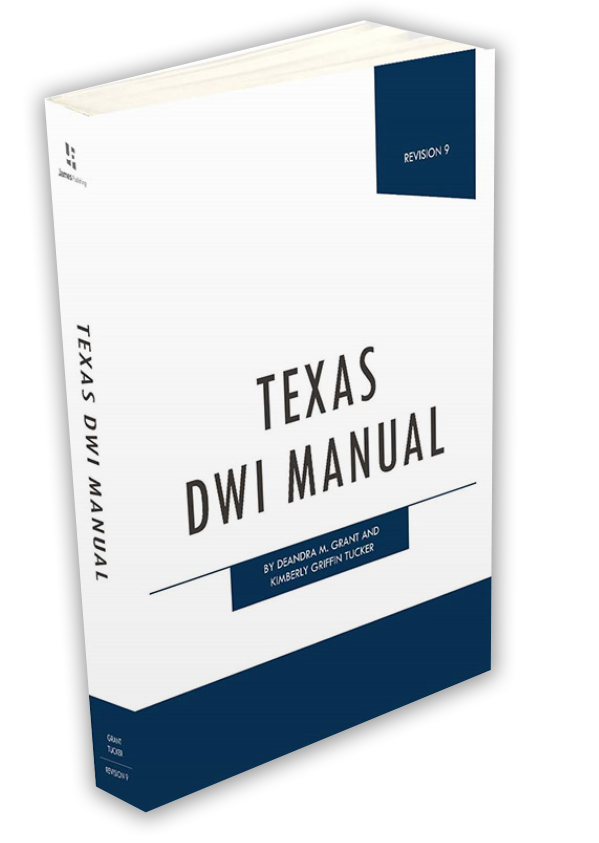
Texas DWI Manual
By Attorney Deandra Grant
Fighting DWI charges can present many challenges, not only for the defense, but prosecutors as well. This is why it is important to be armed with the necessary knowledge so you understand the DWI process.
Attorney Deandra M. Grant is the co-author of the Texas DWI Manual, offering legal advice to both clients and fellow attorneys.
Learn MoreTexas Intoxication Assault Attorneys
Intoxication assault is one of the most common serious felony DWI charges in Texas and one of the most contested. When prosecutors allege that an intoxicated driver caused serious bodily injury to another person, the case turns on two contested questions: whether the defendant was intoxicated at the time of driving, and whether that intoxication caused the injury. Both questions require forensic analysis, not just legal argument.
At Deandra Grant Law, Managing Partner Deandra Grant brings more than 30 years of DWI defense experience, a Master’s Degree in Pharmaceutical Science, and the ACS-CHAL Forensic Lawyer-Scientist designation to every intoxication assault case. Partner Douglas Huff holds the same ACS-CHAL designation and completed advanced digital forensics training. These credentials are directly relevant to evaluating the blood evidence, the crash reconstruction, and the causation theory the prosecution will build its case on.
What the Statute Requires: §49.07
Texas Penal Code §49.07 defines intoxication assault as operating a motor vehicle in a public place while intoxicated and by reason of that intoxication causing serious bodily injury to another person. It is a third-degree felony carrying 2 to 10 years in prison and a fine up to $10,000.
Serious bodily injury. Texas Penal Code §1.07(a)(46) defines serious bodily injury as bodily injury that creates a substantial risk of death, causes death, causes permanent disfigurement, or causes protracted loss or impairment of the function of any bodily member or organ. The definition turns on the nature and duration of the injury: a fracture that fully heals may not qualify; a spinal injury causing long-term impairment almost certainly does. Because the definition depends on medical evidence, the defense must independently evaluate the treating medical records and the prosecution’s characterization of the injury.
Causation. The prosecution must prove that the defendant’s intoxication (not merely their presence at the scene) caused the serious bodily injury. The same concurrent causation analysis that applies in intoxication manslaughter cases applies here: if another driver’s negligence, a road defect, a mechanical failure, or other independent factors caused or contributed to the collision, the causal link between the defendant’s BAC and the injury is directly contested.
Delayed charges. Intoxication assault charges may be filed at a later date if an injury worsens, or if the accident victim is diagnosed with a serious injury that was not initially apparent. When the charge is filed months after the collision, the defense must still evaluate the original blood evidence, the crash scene, and the medical progression of the alleged injury.
Frequently Asked Questions: Navigating Intoxication Assault Charges in Texas
When you’re facing intoxication assault charges in Texas, seeking accurate information is crucial to making informed decisions. At Deandra Grant Law – Criminal & DWI Defense, we understand the uncertainties you might be grappling with, and we’re here to provide you with answers to some of the most common questions you might have during this challenging time.
What is Intoxication Assault in Texas?
Intoxication assault occurs when an individual causes serious bodily injury to another person while operating a vehicle under the influence of drugs or alcohol. This offense is taken very seriously in Texas and can result in severe consequences if convicted.
What Are the Penalties for Intoxication Assault Conviction?
A conviction for intoxication assault can lead to various penalties, including substantial fines, potential jail time, a criminal record, and a suspended driver’s license. The severity of the penalties can vary based on the specifics of the case and any prior convictions.
Should I Speak to the Police without an Attorney?
It’s generally advisable to exercise your right to remain silent and wait for legal representation before speaking to the police. Anything you say can be used against you, so having an attorney present can help ensure your rights are protected.
How Can Deandra Grant Law – Criminal & DWI Defense Help Me?
Deandra Grant Law – Criminal & DWI Defense specializes in handling intoxication assault cases in Texas. Our experienced Texas Intoxication Assault Attorneys will analyze the details of your case, guide you through the legal process, and work to build a strong defense strategy to protect your rights and achieve a positive outcome.
Can I Get My Charges Dismissed?
While every case is unique, there are instances where charges can be dismissed or reduced. Our team will meticulously review the evidence and circumstances surrounding your case to identify potential defense strategies that could lead to a positive outcome.
What Should I Do if I Can't Afford an Attorney?
Everyone deserves a fair defense, and Deandra Grant Law – Criminal & DWI Defense offers free consultations to individuals facing intoxication assault charges. During this consultation, we can discuss your situation, your options, and potential strategies to handle your case.
How Long Does the Legal Process Take?
The timeline can vary based on factors such as the complexity of your case, court availability, and negotiation processes. Your attorney can provide you with a better estimate after reviewing the specifics of your situation.
Can I Keep My Driver's License?
Your driver’s license may be suspended following an intoxication assault arrest. However, our team can work to challenge the suspension and explore alternatives, such as obtaining an occupational license that allows you to drive for essential purposes.
Will My Case Go to Trial?
Not all cases go to trial. Many are resolved through negotiations, plea bargains, or dismissed charges. Our goal is to secure the best outcome for your case, whether that involves trial or alternative resolutions.
How Do I Get Started with Deandra Grant Law – Criminal & DWI Defense?
To get started, simply reach out to us for a free consultation. During this initial conversation, we’ll discuss the details of your case and provide you with information about your rights and potential strategies moving forward.
Civil Liability and the Criminal Case
Individuals injured in a collision with an intoxicated driver may pursue civil claims for compensation. While the criminal case and the civil lawsuit are separate proceedings, a criminal conviction can be used as evidence in the civil case. This means that the plea decision in a criminal intoxication assault case has implications that extend beyond the criminal sentence. A guilty plea that resolves the criminal matter quickly may create substantial civil liability exposure that a contested defense would not.
What the Defense Examines
The Blood Evidence
The blood draw in an intoxication assault case is warrant-authorized and typically analyzed by a forensic toxicology laboratory. In Dallas County, that is SWIFS or DPS. In Tarrant County, the TCME laboratory or the Fort Worth Crime Lab. In other jurisdictions, typically a DPS crime lab. Evaluating whether the blood result accurately reflects the defendant’s BAC at the time of driving (rather than at the time of the draw, which may be hours later) requires pharmacokinetic analysis. If alcohol was still being absorbed at the time of the stop, the BAC at the time of the test may be higher than it was at the time of driving. The rising BAC defense requires exactly the kind of analysis a Master’s Degree in Pharmaceutical Science provides.
The chain of custody, sodium fluoride preservative adequacy, in vitro fermentation risk, and laboratory methodology are all subject to challenge. Learn more about blood test defense.
The Crash Reconstruction
The prosecution will present a crash reconstruction from law enforcement investigators. The defense retains an independent expert to evaluate the methodology, the physical evidence, and the conclusions. Speed calculations, skid mark analysis, point of impact determination, and fault attribution are all technical judgments that can be challenged when the data does not support the conclusions. Event data recorder evidence (the vehicle’s own record of speed, braking, and steering in the seconds before impact) is often more reliable than post-hoc reconstruction.
The Injury Evidence
Whether the alleged injury meets the legal definition of serious bodily injury is a medical question that the defense evaluates independently through the treating records, imaging, and, where appropriate, an independent medical expert. Injuries that were initially characterized as serious may resolve without the permanent impairment or protracted loss of function that the statute requires.
The Constitutional Foundation
Under Texas Code of Criminal Procedure Article 38.23, evidence obtained through a constitutionally defective warrant or an unlawful stop is suppressible. Texas has no good faith exception. The validity of the blood draw warrant and the legality of the initial interaction are the first questions in every intoxication assault defense.
Speak With Deandra Grant Law
Intoxication assault cases require defense on multiple simultaneous fronts: the blood evidence, the crash reconstruction, the injury characterization, and the causation theory. Deandra Grant Law has offices in Dallas, Fort Worth, Allen, Denton, Waco, and Rockwall. We have appeared in North and Central Texas courts for more than 30 years, across more than 500 trials to verdict.
Call (214) 225-7117 for a confidential consultation.
Client Reviews

“Deandra Grant Law – Criminal & DWI Defense handled my case with diligence and professionalism. Deandra Grant’s reputation is stellar and now I know why. She has a team of individuals who provide quality service.”
N. Coulter


(214) 225-7117
Experienced DWI Defense