By Deandra Grant, J.D., M.S. (Pharmaceutical Science), ACS-CHAL Forensic Lawyer-Scientist
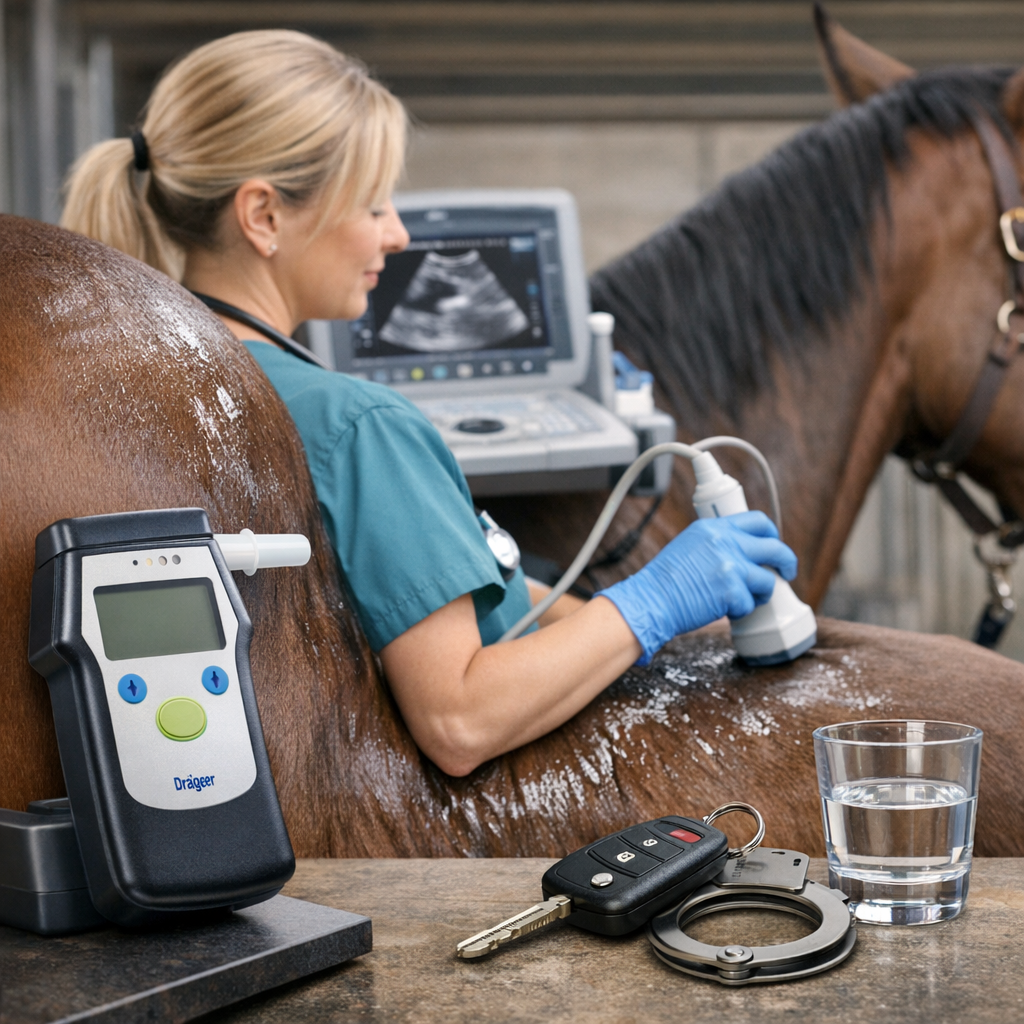
A peer-reviewed study published in Veterinary Sciences examined what happens when equine veterinarians perform abdominal ultrasounds on horses using ethanol as a coupling agent which is a standard, routine procedure in equine medicine. The veterinarians did not drink any alcohol. They poured or sprayed ethanol solution onto the horse’s skin to create contact between the ultrasound probe and the body, the same way they do it every day in every equine practice in the world.
Then they blew into an evidential-grade infrared breath alcohol analyzer which is the same type of instrument used by law enforcement to arrest people for DWI.
The results should concern anyone who has ever been asked to provide a breath sample during a traffic stop.

"Deandra Grant Law – Criminal & DWI Defense handled my case with diligence and professionalism. Deandra Grant's reputation is stellar and now I know why. She has a team of individuals who provide quality service."
- N. Coulter
"Deandra Grant Law – Criminal & DWI Defense fights hard for their clients and is always willing to go above and beyond. They are the best firm for DWI cases in DFW and beyond. Definitely hire them to represent you in any pending cases."
- P. Williams
"Deandra Grant made a tough situation so much better. She listened to my concerns and helped me so much with my case. I would recommend her to anyone needing legal services."
- M. Haley
The Numbers
The study enrolled six veterinary students who each performed six ultrasound examinations on a horse, for a total of 36 sessions. Immediately after each procedure, the operator blew into a Dräger Alcotest 7110 which is a widely used evidential breathalyzer approved in both Europe and Australia.
83% of the time, the breath test was positive. Every single participant tested positive in at least four of their six sessions without consuming any alcohol.
The highest reading recorded was 0.087% which is above the legal limit in every state in the United States, including Texas. That reading came from a person who had not had a drink in at least 24 hours. They were sober. They had been examining a horse.
Among the key findings:
- 30% of the readings at time zero were above 0.050% which is the legal threshold in many countries and above what would trigger an arrest in the United States
- 53% were in the “positive but below the legal limit” range (0.019%–0.050%)
- Positive results persisted for up to 60 minutes after the procedure ended
- When more than 1 liter of ethanol was used (common in extended colic exams), 100% of participants tested positive, with a median reading of 0.023% still registering at 30 minutes post-procedure
- Results above the legal driving limit persisted for up to 35 minutes in some cases
The study’s authors concluded that equine veterinarians who attend colic emergencies (which can happen at any hour of the day or night) can test positive on a breath alcohol test for up to an hour after the procedure, and recommended waiting at least 35 minutes before driving.
How Does This Happen?
The veterinarians were not drinking. They were not absorbing alcohol through their skin because they wore nitrile gloves throughout the procedures. They were inhaling ethanol vapor while working in close proximity to a large surface area saturated with 90% ethanol solution.
Breath alcohol testing works on a fundamental assumption: that the alcohol detected in the breath sample came from the subject’s blood, crossed from the bloodstream into the lungs through the alveolar membrane, and was exhaled in a proportion that correlates with blood alcohol concentration. The standard blood-to-breath ratio used by most instruments (including the ones used in Texas DWI enforcement) is 2100:1, meaning the instrument assumes that 2,100 milliliters of breath contain the same amount of alcohol as 1 milliliter of blood.
But that assumption fails when the alcohol in the breath did not come from the blood. If alcohol is present in the mouth, the throat, the esophagus, or the upper airways (i.e. from any source other than alveolar air) the instrument cannot tell the difference. It reads the alcohol, applies the 2100:1 ratio, and reports a number that looks like a blood alcohol concentration but is not.
This is called mouth alcohol contamination and it is one of the most well-documented sources of false positive breath test results in forensic science. Prior research had established that hand sanitizer vapors and alcohol-based mouthwashes can produce positive breath tests for 5–10 minutes. Law enforcement protocols address this through a 15-minute observation period before testing, designed to let any residual mouth alcohol dissipate.
The equine ultrasound study demonstrated that 15 minutes is not always enough. When the ethanol exposure is prolonged and the quantity is large, positive results persisted for 30, 45, and in one case 60 minutes. And the study’s authors suspect that at least some of the readings reflected actual pulmonary absorption of ethanol vapor meaning the alcohol entered the bloodstream through the lungs, not the stomach, producing a genuine (though involuntary) blood alcohol level.
Why This Matters for DWI Defense
Nobody is going to get arrested for performing an ultrasound on a horse. But the science in this study has direct implications for DWI defense, because the mechanism that produced these false positives (mouth alcohol contamination from environmental ethanol exposure) is the same mechanism that can produce false positives in a traffic stop.
The 15-Minute Observation Period Is Not Foolproof
Texas DWI enforcement protocol requires a 15-minute deprivation (observation) period before administering a breath test. During this period, the officer is supposed to observe the subject to ensure they do not eat, drink, vomit, belch, or introduce any substance into their mouth. The purpose is to allow any residual mouth alcohol to dissipate so that the breath sample reflects only alveolar (deep lung) air.
The equine study shows that 15 minutes is insufficient when the ethanol exposure is significant. Veterinarians who used more than 1 liter of ethanol during the procedure were still testing positive at 30 minutes. Some were still positive at 60 minutes. If environmental ethanol exposure can defeat the 15-minute observation period in a controlled study, the defense must ask: was the 15-minute observation period sufficient in this case? Was the defendant exposed to any environmental ethanol source (occupational, medical, or incidental) that could have contaminated the breath sample?
The Instrument Cannot Distinguish Source
The Dräger Alcotest 7110 used in the equine study is an evidential-grade instrument with both electrochemical and infrared sensors. It is sophisticated. It is accurate. And it cannot tell the difference between alcohol that crossed the alveolar membrane from the bloodstream and alcohol that was inhaled, ingested as residue, or present in the upper airways from any other source.
The Intoxilyzer 9000, which is the instrument used in Texas DWI enforcement, has the same fundamental limitation. It measures the concentration of ethanol in the breath sample. It applies a fixed ratio. It reports a number. If the alcohol in the sample came from a source other than the defendant’s blood, the number is wrong and the instrument will not flag it.
Case Results
Occupational and Environmental Ethanol Exposure Is More Common Than You Think
The equine veterinarian scenario is vivid, but it is not the only context in which occupational or environmental ethanol exposure can produce false breath test results. Consider:
- Healthcare workers who use alcohol-based hand sanitizer dozens of times per shift
- Industrial workers exposed to ethanol-based solvents, degreasers, or cleaning agents
- Painters and auto body technicians working with ethanol-containing coatings and finishes
- Workers in breweries, distilleries, and wineries who inhale ethanol vapor throughout the workday
- People who use alcohol-based asthma inhalers or nebulizers
- People who used alcohol-based mouthwash within the hour before the traffic stop
In each of these scenarios, the breath test instrument will report a number. It will look like a blood alcohol concentration. It may be above 0.08. And it may have nothing to do with how much the person actually drank.
GERD, Acid Reflux, and the Mouth Alcohol Problem
The mouth alcohol problem extends beyond environmental exposure. Gastroesophageal reflux disease (GERD), acid reflux, and other conditions that cause stomach contents to travel back into the esophagus and mouth can introduce alcohol vapor into the breath sample (i.e. alcohol that came from the stomach, not from alveolar air). A person with GERD who consumed a moderate amount of alcohol may produce a breath test reading that significantly overstates their actual BAC because the instrument is measuring both alveolar air and refluxed alcohol vapor.
The equine study adds to a growing body of forensic science literature demonstrating that breath alcohol testing is not the simple, infallible measurement that prosecutors present it to be. The instrument produces a number. The question is whether that number accurately reflects the defendant’s blood alcohol concentration at the time of driving and the answer depends on factors that the instrument itself cannot evaluate.
The Defense Takeaway
A breath test result is a piece of evidence. It is not proof. It is a number generated by a machine that operates on assumptions about the source of the alcohol, about the blood-to-breath ratio, about the absence of interfering substances, and about the adequacy of the observation period. When any of those assumptions is wrong, the number is wrong.
The equine veterinarian study is a powerful illustration of this principle because the scenario is so clean: six sober people, controlled conditions, an evidential-grade instrument, and results that would have put every one of them over the legal limit. No drinking. No impairment. Just ethanol vapor and a machine that cannot tell where the alcohol came from.
In every DWI case we handle, we evaluate the breath test result not as a conclusion but as a data point that must be interrogated: Was the observation period adequate? Was there any source of mouth alcohol contamination? Does the defendant have GERD or another condition that could introduce alcohol vapor into the breath sample? Was the instrument properly calibrated and maintained? Was the operator properly trained and certified? Did the instrument’s internal quality checks pass?
Deandra Grant’s Master’s Degree in Pharmaceutical Science, ACS-CHAL Forensic Lawyer-Scientist designation, and training at Axion Analytical Labs give her the scientific credentials to challenge breath test results at the scientific level — not just the number on the printout, but the science behind how that number was generated and whether it can be trusted. When a breath test result is the centerpiece of a DWI prosecution, the defense must be equipped to ask the questions the instrument cannot answer.
If you have been arrested for DWI in Texas based on a breath test result, call (214) 225-7117 or visit texasdwisite.com. The number on the printout may not be what the prosecution says it is.
Firm Accolades

Better Business Bureaus

D Magazine