
The prosecution’s blood test result in your DWI case is only as reliable as the integrity of the blood sample it was derived from. If the sample was contaminated at any point (during collection, transportation, storage, or analysis) the BAC result does not accurately reflect the alcohol concentration in your bloodstream at the time the blood was drawn.
At Deandra Grant Law, forensic training gives us the knowledge to identify contamination and present the evidence to a jury.

"Deandra Grant Law – Criminal & DWI Defense handled my case with diligence and professionalism. Deandra Grant's reputation is stellar and now I know why. She has a team of individuals who provide quality service."
- N. Coulter
"Deandra Grant Law – Criminal & DWI Defense fights hard for their clients and is always willing to go above and beyond. They are the best firm for DWI cases in DFW and beyond. Definitely hire them to represent you in any pending cases."
- P. Williams
"Deandra Grant made a tough situation so much better. She listened to my concerns and helped me so much with my case. I would recommend her to anyone needing legal services."
- M. Haley
Sources of Contamination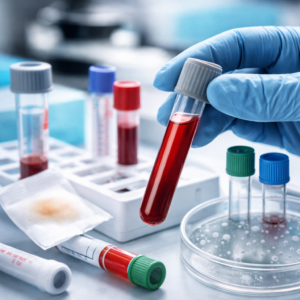
Alcohol-Based Skin Antiseptic
This is one of the most straightforward contamination issues. When blood is drawn for forensic DWI testing, the phlebotomist should use a non-alcohol antiseptic (such as betadine or povidone-iodine) to clean the skin at the venipuncture site. If an alcohol-based swab (isopropanol or ethanol) is used instead, alcohol from the swab can enter the blood sample through the needle puncture. This is a violation of standard operating procedures for a forensic blood draw.
Many hospitals and emergency rooms stock only alcohol-based antiseptic swabs for routine blood draws. If law enforcement takes a DWI suspect to the ER for a blood draw, the medical staff may use their standard alcohol swabs out of habit which may contaminate the forensic sample.
Incorrect Collection Tubes
DWI blood samples must be collected in tubes containing sodium fluoride (a preservative that inhibits microbial fermentation) and potassium oxalate (an anticoagulant that prevents clotting). These are called gray-top tubes. If the phlebotomist uses a different type of tube (a red-top tube (no preservative or anticoagulant), a purple-top EDTA tube, a green-top heparin tube, or a gray top tube that does not contain the correct additives in the appropriate amounts) the sample may undergo chemical changes that affect the accuracy of the BAC result.
Insufficient Preservative
Even when the correct gray-top tube is used, the amount of sodium fluoride may be insufficient if the tube is overfilled (diluting the preservative below its effective concentration) or if the tube is old and the preservative has degraded. Insufficient sodium fluoride allows microbial activity, including in vitro fermentation, which produces ethanol in the tube.
Improper Mixing
After blood is drawn into the collection tube, the tube must be gently inverted 8–10 times to distribute the preservative and anticoagulant throughout the sample. If the phlebotomist fails to mix the tube properly, the preservative may not reach all portions of the blood, allowing localized fermentation or clotting.
Environmental Contamination
Blood samples that are stored improperly (in hot vehicles, in unsecured evidence rooms, or in proximity to volatile chemicals) can be exposed to environmental contaminants that affect the analysis. Temperature extremes accelerate chemical degradation and microbial growth.
Case Results
Laboratory Cross-Contamination
In the laboratory, contamination can occur through carryover (residual material from a previous sample), contaminated pipettes or syringes, contaminated internal standard solutions, or failure to follow proper decontamination procedures between samples.
How We Identify Potential Contamination
- Discovery requests. We subpoena the complete blood draw records: the type of antiseptic used, the tube type, the phlebotomist’s credentials, the time of collection, and the storage conditions from collection to laboratory analysis.
- Chain of custody analysis. We trace every hand that touched the sample, every location it was stored, every temperature it was exposed to, and every gap in the documentation.
- Chromatogram review. We examine the GC-FID chromatogram for peaks that indicate the presence of contaminants (i.e. isopropanol from alcohol swabs, fermentation byproducts from microbial activity, or interfering substances from environmental exposure)
- Second tube comparison. Texas requires two blood tubes. If the two tubes produce different BAC results, the discrepancy may indicate contamination, fermentation, or degradation in one or both samples.
- Expert testimony. We retain independent forensic toxicologists who can testify about the specific contamination pathways and their expected effect on the BAC result.
Your DWI Defense Should Be Built on Science
At Deandra Grant Law, our forensic credentials give us the foundation to challenge the prosecution’s evidence at a scientific level. If you are facing DWI charges in Texas, contact us for a free, confidential consultation.
Call (214) 225-7117 or schedule an appointment online at texasdwisite.com.
Firm Accolades

Better Business Bureaus

D Magazine