By Deandra Grant, J.D., M.S. (Pharmaceutical Science), ACS-CHAL Forensic Lawyer-Scientist
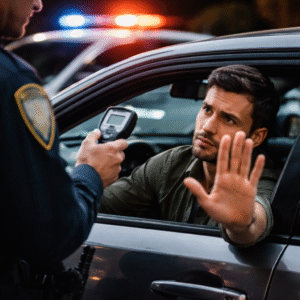
When a Texas law enforcement officer asks you to blow into an Intoxilyzer, you are standing at one of the most consequential decision points of your entire DWI case. What you do in that moment, before you’ve spoken to an attorney, before you understand what evidence already exists against you, may shape everything that follows.
Most of what you’ll read online about breath test refusal is written from the prosecution’s perspective: refusal is bad, the penalties are severe, you should comply. That framing serves the state’s interest in collecting evidence, not yours. The reality is more nuanced. Whether refusing a breath test is the right decision depends on specific factors and understanding those factors is what this piece is about.

"Deandra Grant Law – Criminal & DWI Defense handled my case with diligence and professionalism. Deandra Grant's reputation is stellar and now I know why. She has a team of individuals who provide quality service."
- N. Coulter
"Deandra Grant Law – Criminal & DWI Defense fights hard for their clients and is always willing to go above and beyond. They are the best firm for DWI cases in DFW and beyond. Definitely hire them to represent you in any pending cases."
- P. Williams
"Deandra Grant made a tough situation so much better. She listened to my concerns and helped me so much with my case. I would recommend her to anyone needing legal services."
- M. Haley
What Texas Implied Consent Actually Means
Texas Transportation Code §724.011 establishes implied consent: by operating a motor vehicle on a public road in Texas, you have legally agreed to submit to a breath or blood test if a peace officer arrests you for DWI and requests one.
A few things that implied consent does not mean:
It does not mean you must consent before arrest. The obligation to submit to chemical testing arises after a lawful arrest for DWI and not at the investigative stop stage. Roadside portable breath tests prior to arrest are a separate matter and are not admissible as evidence of BAC.
It does not mean refusal is a criminal offense. Refusing a breath test in Texas is not a crime. It triggers administrative and evidentiary consequences, which are significant but it is not, by itself, a criminal act (as it is in some other states).
It does not mean the officer can compel a breath sample. Unlike a blood draw obtained pursuant to a warrant, an officer cannot physically force you to exhale into a breathalyzer. The consequences for refusal are the state’s mechanism for incentivizing compliance and not a legal basis for compelled performance.
The Real Consequences of Refusing
Administrative License Revocation
Refusing a breath test triggers the Administrative License Revocation (ALR) process. Your license can be suspended for 180 days for a first refusal, or two years if you have a prior DWI conviction or prior ALR action within ten years.
The officer will issue a temporary driving permit valid for 41 days. After that, if you have not requested an ALR hearing within the ALR window it takes effect automatically.
This is a serious consequence. But it is a separate proceeding from your criminal case and it can be contested.
Evidentiary Use of Refusal
Texas law permits the prosecution to introduce your refusal as evidence in a DWI trial. The argument the state will make is that you refused because you knew you were intoxicated. Courts have consistently held this is admissible as consciousness of guilt evidence.
That said, refusal is not an admission. It is an inference the prosecution will ask a jury to draw and an inference a prepared defense attorney can address directly at trial.
The State Will Pursue Other Evidence
Refusing a breath test removes one category of evidence from the prosecution’s case. It does not remove the case. Officers can and do build DWI prosecutions on field sobriety test performance, driving behavior, dash and body camera footage, officer observations, and witness testimony. In many cases, that evidence is already documented before the breath test request is even made.
The Blood Draw Question After Refusal
If you refuse a breath test, the officer may seek a blood draw. Under Missouri v. McNeely (2013), the U.S. Supreme Court held that the natural dissipation of alcohol in the blood does not automatically create the exigency required to justify a warrantless blood draw which means officers generally need a warrant.
In practice, Texas law enforcement agencies have become increasingly efficient at obtaining telephonic warrants for blood draws after refusals, often within an hour or less. The warrant process is not the barrier it once was. Refusal will slow the collection of blood evidence, but in most Texas jurisdictions it will not prevent it.
If a blood draw is conducted pursuant to a valid warrant, it is lawful and the results are normally admissible. If the warrant is defective, or if the draw was conducted without a warrant in circumstances that didn’t justify an exception, that is a suppression issue your attorney can pursue.
Whether to Refuse: The Factors That Actually Matter
There is no universal right answer on breath test refusal. The calculus depends on circumstances that are different in every case. Here are the factors that matter most:
How much time has passed since your last drink? BAC rises and falls. Depending on when you stopped drinking relative to when you were stopped, a breath test taken later may read higher or lower than your BAC while you were actually driving. This is the retrograde extrapolation issue, and it cuts both ways.
What evidence already exists? If the stop was recorded on dashcam, if you performed poorly on field sobriety tests, and if the officer’s report already documents significant signs of impairment, a breath test refusal may not meaningfully change the evidentiary picture. If the stop was weak and the officer’s observations were thin, a refusal denies the state what might be their strongest evidence.
What are your prior history and current circumstances? A prior DWI conviction means an enhanced ALR suspension period if you refuse. If your license is critical to your employment, that calculation changes. If you are on probation with conditions that include no alcohol use, a positive test may trigger consequences beyond the DWI case itself.
What medical or physiological factors are present? If you have a condition that can affect breath test results such as acid reflux, GERD, diabetes, certain respiratory conditions, or occupational chemical exposure, a breath test result may be unreliable in ways a blood test would not be. In that circumstance, refusing the breath test and requesting a blood draw may actually produce more accurate evidence in your favor.
None of these factors can be weighed in the seconds between the officer’s request and your response. That is the fundamental problem with the decision as it actually arises. It happens before you have access to counsel, before you understand the full evidence picture, and before you can think through the implications clearly.
The ALR Hearing: What It Is and Why the 15-Day Deadline Is Not Optional
If you refused a breath test, or if you submitted and the result was at or above 0.08, you have the right to contest the resulting license suspension through an ALR hearing before the State Office of Administrative Hearings.
You have 15 days from the date you were served notice of suspension to request this hearing. Not 15 business days. 15 calendar days. If that deadline passes without a request, the suspension becomes effective automatically and you lose your right to contest it entirely.
The ALR hearing is not a formality. At the hearing, the state must establish that the officer had reasonable suspicion to stop you, probable cause to arrest you, that you were requested to submit to a chemical test, and that you refused or failed. Each of those elements can be contested.
Beyond the license suspension issue, the ALR hearing serves an important secondary function: it is an opportunity to examine the arresting officer under oath before the criminal case proceeds to trial. The testimony and admissions obtained in that hearing can be significant in your criminal defense.
If you refused a breath test, requesting the ALR hearing on time is the single most time-sensitive action in your entire case. Do not wait.
Case Results
What Happens in the Criminal Case
The criminal DWI case and the ALR proceeding are separate. Winning the ALR hearing does not resolve the criminal charges. Losing it does not mean you will be convicted.
In the criminal case, a refusal changes the evidentiary landscape in specific ways if the police do not obtain a blood search warrant. The prosecution cannot introduce a BAC number which eliminates the per se DWI theory based on a 0.08 or higher result. They must instead prove impairment through other evidence. That is a more difficult case to make, and it is one that is more amenable to challenge at trial.
At the same time, the refusal itself becomes part of the trial. Prosecutors will argue that you refused because you knew you were intoxicated. How effectively that argument lands depends on the full context of your case and the quality of your defense.
The Decision You Can’t Unmake
The breath test refusal decision is made in a moment, under pressure, without counsel, and with consequences that unfold over months. What matters after that moment is what you do next.
If you refused, the ALR clock is already running. If you submitted and the result was above the legal limit, that evidence exists and needs to be examined for instrument reliability, calibration records, observation period compliance, and physiological factors that may have affected the result.
Either way, the decision you made at the roadside is not the last word. It is the beginning of a defense that, built correctly, accounts for every piece of evidence the state has and every gap in the case they’re trying to make.
DWI Defense at Deandra Grant Law
Managing Partner Deandra Grant brings more than 30 years of DWI defense experience, a Master’s Degree in Pharmaceutical Science, and an ACS-CHAL Forensic Lawyer-Scientist designation to every case. Whether you submitted to a breath test or refused, the earlier we examine the evidence, the more options you have. Call (214) 225-7117 or visit texasdwisite.com to schedule a confidential consultation.
Firm Accolades

Better Business Bureaus

D Magazine