By Deandra Grant, J.D., M.S. (Pharmaceutical Science), ACS-CHAL Forensic Lawyer-Scientist
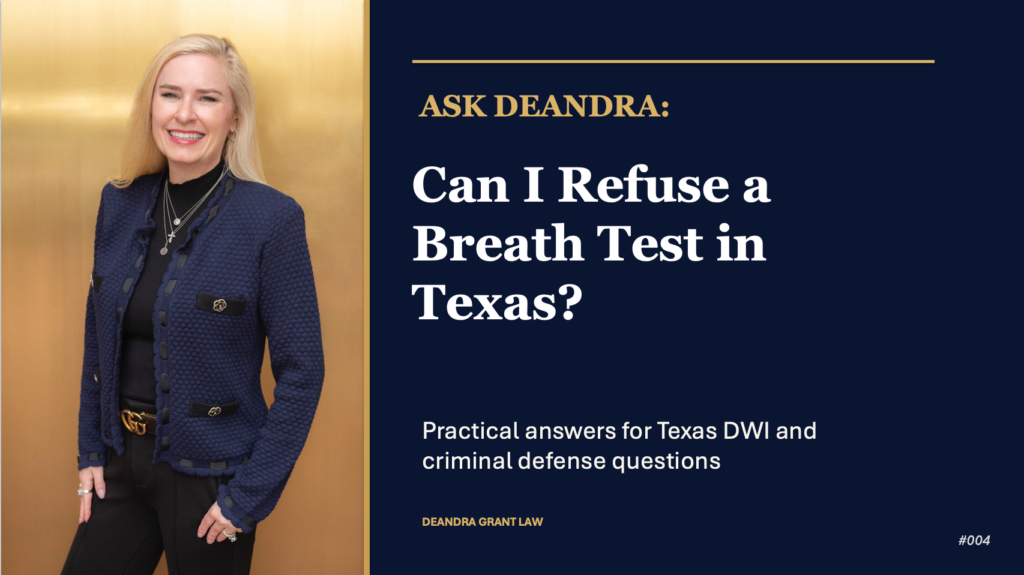
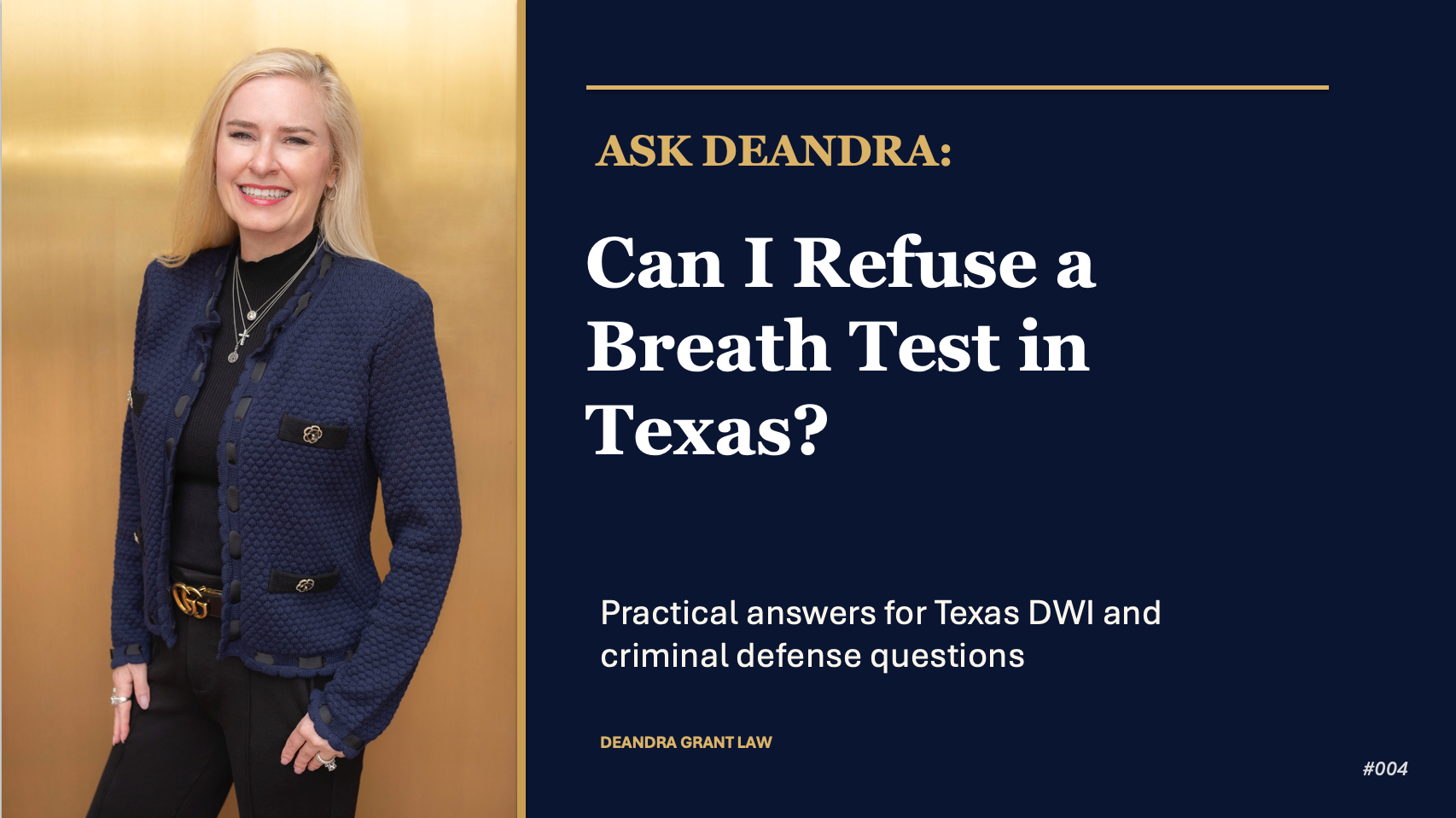
The question: Can I refuse a breath test in Texas?
The short answer: Yes. You can legally refuse a breath test in Texas after a DWI arrest, but refusal carries consequences under the state’s implied consent law including an automatic driver’s license suspension and the possibility that prosecutors will use your refusal as evidence at trial. In certain situations, the officer can also obtain a warrant and require a blood draw. Whether refusal is the right choice depends on the facts of your case.
Here is the longer answer: what Texas law actually requires, what happens when you say no, and how the decision plays out in real DWI cases.

"Deandra Grant Law – Criminal & DWI Defense handled my case with diligence and professionalism. Deandra Grant's reputation is stellar and now I know why. She has a team of individuals who provide quality service."
- N. Coulter
"Deandra Grant Law – Criminal & DWI Defense fights hard for their clients and is always willing to go above and beyond. They are the best firm for DWI cases in DFW and beyond. Definitely hire them to represent you in any pending cases."
- P. Williams
"Deandra Grant made a tough situation so much better. She listened to my concerns and helped me so much with my case. I would recommend her to anyone needing legal services."
- M. Haley
Texas Implied Consent: The Law Behind the Request
Under Texas Transportation Code §724.011, every person who operates a motor vehicle in a public place in Texas is deemed to have consented to the taking of one or more specimens of breath or blood to determine alcohol concentration or the presence of a controlled substance, if arrested on suspicion of DWI or another intoxication offense. This is called the implied consent law.
Implied consent does not mean you cannot say no. It means that if you say no, the State has already set up a series of consequences for that refusal and the officer is required to read them to you, in writing, in a document called the DIC-24 statutory warning.
Before any breath or blood test is requested, the officer must provide the DIC-24, which warns you that refusal will result in license suspension and that the refusal itself can be used against you in court. Only after the DIC-24 is read and you are given a chance to respond can the officer report your answer as a refusal.
What Happens If You Refuse
If you refuse a breath or blood test after a lawful DWI arrest, three things happen in short order:
- Automatic license suspension. Under the Administrative License Revocation (ALR) process, the Texas Department of Public Safety will seek to suspend your driver’s license for 180 days on a first refusal and for up to two years if you have had a prior alcohol-related enforcement contact. The suspension is administrative which means it happens independent of the criminal DWI case.
- You have 15 days to request a hearing. The deadline to request an ALR hearing runs from the date you were served with the notice of suspension (not the date of arrest though it may be the same date). Missing that deadline means losing the license by default. This is one of the most common and costly mistakes in a Texas DWI case.
- Your refusal becomes evidence. Under Texas case law, the State can tell the jury that you refused and can argue that your refusal shows consciousness of guilt. Prosecutors routinely use this at trial.
A refusal is not a dead end. It just shifts where the fight happens. A well-prepared ALR hearing can preserve driving privileges even when the criminal case is still pending, and the consciousness-of-guilt argument has defensible responses when the refusal is put in context.
What Happens If You Consent
If you consent and take the breath test, you are blowing into an Intoxilyzer 9000 which is the current instrument in use across Texas. The machine produces a number that will be presented to a jury as a blood alcohol concentration. That number is not as reliable as the State would like you to believe. Among the issues a forensic defense addresses:
- Partition ratio variability. The Intoxilyzer assumes a fixed 2,100:1 ratio of alcohol in blood to alcohol in breath. Real partition ratios vary from roughly 1,100:1 to 3,400:1 across individuals and conditions. A ratio below 2,100:1 produces a falsely elevated reading.
- The 15-minute observation period. Texas DPS protocol requires the officer to observe the subject for a continuous 15 minutes before testing, to rule out burping, regurgitation, and mouth alcohol. Video review regularly reveals observation failures.
- GERD, acid reflux, and diabetes. Medical conditions that produce mouth alcohol or alter breath chemistry can artificially elevate readings.
- Calibration and maintenance. Every Intoxilyzer has maintenance and calibration records that can be obtained and challenged.
Consenting to a breath test does not mean the number is unbeatable. It means the defense fight moves from implied consent and refusal to the forensic reliability of the instrument.
Can the Police Still Get Your Blood If You Refuse?
Yes in several situations: Refusal does not end the inquiry. Under Texas Transportation Code §724.012 and United States Supreme Court precedent, the officer has two paths after a refusal:
- Mandatory testing circumstances (requires exigency). If the DWI arrest involves an accident with death or serious bodily injury, a child passenger under fifteen, or certain repeat-offender situations, §724.012 authorizes mandatory specimen collection. Case law (described below) requires exigency to do a warrantless blood draw under this statute.
- Search warrant for blood. In any DWI case, the officer can apply for a search warrant authorizing a blood draw.
Under Missouri v. McNeely, 569 U.S. 141 (2013), the natural dissipation of alcohol in the bloodstream does not, by itself, create the kind of emergency that lets officers skip the warrant requirement. Texas cases including State v. Villarreal, 475 S.W.3d 784 (Tex. Crim. App. 2014), confirmed that warrantless, non-consensual blood draws are unconstitutional in most DWI cases. The practical result: in most refusal cases, a valid warrant (or an exception to the warrant requirement) is required before blood can be drawn.
Warrants are defensible. Every warrant is only as strong as the affidavit supporting it. A defense review of the warrant affidavit frequently surfaces material omissions, conclusory language, boilerplate recitations, and factual errors that support a motion to suppress.
The Strategic Question: Should You Refuse?
There is no universal right answer. The decision depends on facts you will not fully know in the moment. That said, the considerations that actually drive the analysis are:
- Your estimated BAC. If you have had one or two drinks and are confident you are under the legal limit of 0.08, consenting may produce a number that ends the case. If you have had significantly more, the number on the machine is harder to defend than the fact of refusal alone.
- Whether this is a first or repeat offense. A refusal following a prior refusal triggers a longer ALR suspension. Prior DWI convictions change the mandatory testing analysis under §724.012 as well.
- Your license needs. If you rely on driving for work, the length and terms of any suspension matter enormously. Occupational driver’s licenses and ignition interlock restricted licenses exist to mitigate the hardship, but each has its own procedural requirements.
- The circumstances of the stop and arrest. A weak stop, a thin probable-cause basis, or a flawed warrant affidavit changes the forensic calculus. Sometimes the strongest defense is not avoiding the test. It is attacking the arrest itself.
This is why so many DWI attorneys advise clients in advance: if you are ever going to be stopped, you should already know how you would respond. Deciding under the flashing lights at 2 a.m., with an officer who is not neutral, is the worst possible time to try to think through the law for the first time.
Case Results
What to Do If You Have Already Refused
If you have already refused a breath or blood test, the single most important step is the 15-day ALR deadline. Once the notice of suspension is served, the clock starts running. Specifically:
- Calendar the 15-day deadline. Count from the date of service of the notice, not the date of arrest (though that may be the same day). Missing the window forfeits the hearing.
- Do not talk to prosecutors or investigators without counsel. Anything you say can be used against you, and friendly-sounding outreach from a prosecutor’s office is not the neutral conversation it is presented to be.
- Hire a DWI defense lawyer with forensic training. Breath and blood cases are forensic cases. The defense attorney should be able to read a chromatogram, question the instrument’s validation, and cross-examine the analyst (not just negotiate with the prosecutor).
The Bottom Line
You can refuse a breath test in Texas. Refusal is not a crime, and refusal is not a confession. But refusal has real consequences including a potential license suspension, a 15-day deadline that is easy to miss, a statutory framework that lets officers pursue a blood warrant anyway, and a courtroom narrative that prosecutors will try to turn against you. None of these consequences are unbeatable. All of them are easier to address with a defense lawyer who understands both the law and the science.
DWI Defense at Deandra Grant Law
Deandra Grant Law defends DWI and intoxication-offense cases across North and Central Texas including Dallas, Fort Worth, Plano, McKinney, Frisco, Allen, Lewisville, Denton, Rockwall, and Waco. Our team includes an ACS-CHAL Forensic Lawyer-Scientist with a Master of Science in Pharmaceutical Science and a Graduate Certificate in Forensic Toxicology.
If you have been arrested for DWI (whether you refused a test or took one) call Deandra Grant Law at (214) 225-7117 or visit texasdwisite.com to schedule a confidential consultation. If you refused, remember the 15-day ALR deadline. Call today.
Have a DWI question you want answered in this series? Submit it at texasdwisite.com — you might see it featured in a future Ask Deandra post.
Firm Accolades

Better Business Bureaus

D Magazine