On December 29, 2024, Brianna Longoria (a California woman in Phoenix for her wedding) was pulled over, arrested for DUI, and booked into jail. Her breathalyzer result: triple zeros. Her blood test: zero alcohol, zero drugs. The red light violation that justified the stop: later voided by the arresting officer herself after reviewing body camera footage that showed the light was green.
The DUI charge was dropped by the Phoenix City Attorney in April 2025 but the damage had already been done. Longoria, who was battling cancer, missed a medical procedure. Her California driver’s license was suspended for months, blocking her from driving to treatment. Her honeymoon was cancelled. Her path to nursing school was jeopardized.
In April 2026, Longoria filed a federal civil rights lawsuit against the City of Phoenix. The lawsuit’s most striking evidence is not the forensic data. It is what two Phoenix officers said to each other on body camera while Longoria was being processed at the station.

"Deandra Grant Law – Criminal & DWI Defense handled my case with diligence and professionalism. Deandra Grant's reputation is stellar and now I know why. She has a team of individuals who provide quality service."
- N. Coulter
"Deandra Grant Law – Criminal & DWI Defense fights hard for their clients and is always willing to go above and beyond. They are the best firm for DWI cases in DFW and beyond. Definitely hire them to represent you in any pending cases."
- P. Williams
"Deandra Grant made a tough situation so much better. She listened to my concerns and helped me so much with my case. I would recommend her to anyone needing legal services."
- M. Haley
What the Body Camera Captured
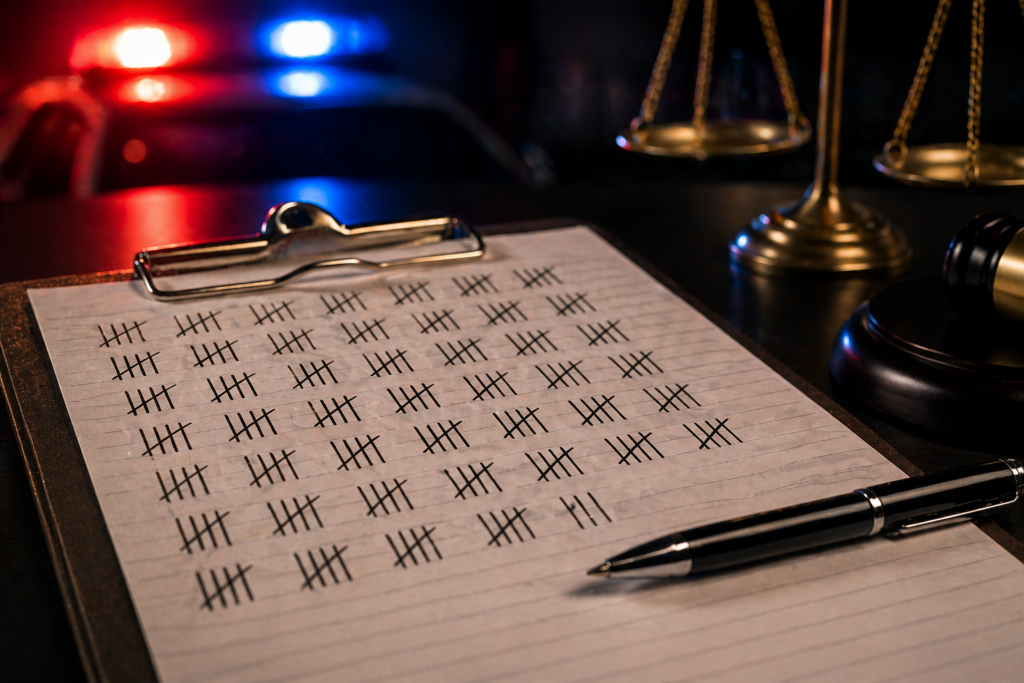
Officer Hannah: “They’re gonna kick me off squad if I don’t get a DUI. But I seriously pulled like so … I can’t just conjure one up. I have tried.” Officer Metheny: “You can. You can.” Officer Hannah: “I hung out on Seventh Ave, by those bars.”
Station personnel reviewed Longoria’s test results and described them as “super in the norms.” Officer Metheny had already told Longoria “triple zeroes like I thought” and then arrested her for DUI anyway. The arrest report, according to the lawsuit, listed field sobriety test results that the complaint characterizes as fabricated.
The Phoenix Police Department denied the existence of quotas. Officers Metheny and Hannah remain employed. The city filed a motion to dismiss the DUI charge without prejudice in April 2025, preserving the option to refile. Longoria’s lawsuit asks a federal court to clear her record, order policy changes, and award damages under 42 U.S.C. §1983 which is the federal civil rights statute that allows individuals to sue government officials for constitutional violations.
This Is Not an Isolated Story
The Phoenix case is the most documented recent example of arrest-quota pressure on DWI enforcement, but it is not unique. In Texas, a similar pattern made news when Buffalo Bills defensive tackle Ed Oliver was arrested in Montgomery County despite a breathalyzer reading of .00%. All charges against Oliver were eventually dropped. “I felt like I was guilty until proven innocent, not innocent until proven guilty,” Oliver told ESPN.
The common thread in both cases is not officer malice as the primary explanation. It is the broader structural question of what law enforcement agencies measure and reward. When officers are evaluated on arrest numbers rather than arrest quality, the pressure to produce arrests regardless of underlying impairment is predictable. Whether that pressure comes from an explicit written quota, an informal departmental culture, or a supervisor’s offhand comment, the effect on the person arrested is the same.
What Texas Law Actually Says About DWI Quotas
Texas Transportation Code §720.002: The Quota Prohibition
Texas has prohibited traffic-offense quotas since 1995. Texas Transportation Code §720.002 provides that a political subdivision or state agency may not establish or maintain, “formally or informally,” a plan to evaluate, promote, compensate, or discipline a peace officer based on the officer’s issuance of a predetermined or specified number of traffic citations. The prohibition applies to both written policies and informal expectations. A violation by an elected official is grounds for removal from office. A violation by a non-elected official is grounds for removal from their position.
The critical limitation: §720.002 covers traffic citations — it does not expressly cover DWI arrests. The statute prohibits quota plans based on citation issuance, not on arrest counts. DWI is a criminal offense, not a traffic infraction, and the arrest-versus-citation distinction matters legally. A supervisor who pressures officers to make more DWI arrests as a matter of departmental performance may not be violating the plain text of §720.002 even though the conduct creates the same perverse incentive that the statute was designed to eliminate.
This is a genuine gap in Texas law, and the Phoenix lawsuit may generate legislative attention to it. Several states have explicitly extended their quota prohibitions to cover arrests, not just citations. Texas has not done so. The result is that the practice the Phoenix body camera footage describes (officers feeling they will be removed from specialized DWI squads if they do not produce arrests) may be unlawful under the Fourth Amendment and civil rights law while remaining unaddressed by the specific Texas statutory prohibition.
What the Fourth Amendment Requires
Every traffic stop in Texas must be based on reasonable suspicion that a traffic violation or criminal offense has occurred. Every DWI arrest must be supported by probable cause that the driver is intoxicated. These are constitutional requirements, not discretionary guidelines. An arrest made to satisfy a quota (rather than because the officer had actual probable cause to believe the driver was impaired) is an unconstitutional arrest regardless of whether the officer’s department officially acknowledges having a quota.
The Fourth Amendment analysis does not require proving that a quota existed. It requires examining whether the specific stop and arrest were constitutionally justified. If the stop lacked reasonable suspicion (as the Longoria case appears to demonstrate, given that the officer later voided the red light citation after reviewing footage showing a green light) everything that followed is constitutionally tainted.
Article 38.23: Texas’s Stronger Exclusionary Rule
In Texas, the constitutional protection against quota-driven DWI enforcement goes beyond the Fourth Amendment. Texas Code of Criminal Procedure Article 38.23 is the state exclusionary rule that prohibits the use of evidence obtained in violation of the Texas or United States Constitutions. The critical difference from federal law: Texas has no good faith exception.
Under the federal good faith exception established in
United States v. Leon, evidence obtained by officers who reasonably relied on a facially valid warrant or established legal precedent may be admitted even if the underlying legal basis is later found deficient. Texas has no equivalent. Under Article 38.23, if the stop was unlawful, the evidence is out. The officer’s subjective belief about the legality of the stop does not save tainted evidence in Texas courts.
What this means practically: In a Texas DWI case where the stop lacked reasonable suspicion (lacked an actual lawful basis for the initial encounter) the breath test result, blood draw, field sobriety test observations, and all evidence flowing from that stop are suppressible. A successful Article 38.23 motion in these cases does not just create a defense argument. It eliminates the prosecution’s evidence entirely.
The “Zero BAC” DWI Arrest: How It Happens Under Texas Law
The Longoria case raises a question that confuses many people: how can someone be arrested for DWI with a breathalyzer reading of zero?
In Texas, intoxication has two definitions. The per se definition (a blood alcohol concentration of 0.08% or greater) is the one most people know. But the second definition applies regardless of BAC: not having the normal use of mental or physical faculties by reason of alcohol, a controlled substance, a drug, a dangerous drug, a combination of substances, or any other substance.
This means a person with a BAC of zero can still be arrested for DWI if an officer believes their faculties are impaired by another substance (most commonly marijuana, prescription drugs, or another controlled substance). In the Longoria case, Officer Metheny stated she suspected marijuana impairment despite the zero breathalyzer result. This is the theory that justified the arrest in the officer’s account.
There is nothing inherently illegitimate about DUID enforcement under this theory. A driver impaired by marijuana is as dangerous as a driver impaired by alcohol, and Texas law correctly prohibits operating while impaired regardless of the substance. The problem in Longoria’s case was that her blood test showed no marijuana, no drugs, no alcohol and the station personnel described her test results as normal. The marijuana impairment theory was, according to the evidence the lawsuit describes, a post-hoc justification for an arrest made under different pressures.
The lesson for any Texas driver: a zero breathalyzer result does not guarantee against a DWI arrest. The impairment definition under §49.01(2)(A) does not require a positive chemical test. An arrest is always possible based on an officer’s subjective observations which is why the lawfulness of the stop and the constitutional integrity of the investigation matter so much.
The ALR Problem: Criminal Dismissal Is Not the End
One of the most damaging aspects of the Longoria case was not the criminal charge — it was the license suspension. Even after the DUI charge was dropped in April 2025, Longoria’s California driver’s license remained suspended until July 2025, when an administrative law judge dismissed the suspension after finding no reasonable grounds for the arrest. For seven months after the criminal case ended, she could not drive.
The same dynamic applies in Texas. The Administrative License Revocation process is separate from and parallel to the criminal DWI case. A Texas driver arrested for DWI who fails or refuses a chemical test has 15 days from receiving the notice of suspension to request an ALR hearing. If that deadline is missed, the license is automatically suspended and the suspension stands regardless of what happens in the criminal case.
A criminal DWI dismissal does not automatically restore a suspended license. The ALR process must be won independently. And because the ALR hearing is also the earliest opportunity to cross-examine the arresting officer under oath (before the criminal case comes to trial) it creates a factual record that can be used in the criminal defense. In a quota-driven arrest case, that cross-examination at the ALR hearing is where the weakness in the officer’s account first becomes part of the official record.
What to Do If You Believe Your DWI Stop Was Pretextual
If you were stopped for a traffic violation that you believe was fabricated or exaggerated, and that stop led to a DWI investigation and arrest, the lawfulness of the initial encounter is the first and often most consequential question in your defense. In Texas, the analysis runs through Article 38.23 and there is no good faith exception to rescue improperly obtained evidence.
The defense examination of a potentially pretextual stop includes:
- Body camera footage. Every officer interaction in Texas is potentially on camera. The footage of the stop, the officer’s stated reason for pulling you over, what they actually observed, and any discrepancies between their report and the recording are all examined.
- Dashboard camera footage. The traffic violation the officer claims to have observed (running a red light, failing to signal, weaving) may be captured on the patrol vehicle’s own camera. Like the Longoria case, the footage sometimes contradicts the officer’s account.
- CAD and dispatch records. Computer-aided dispatch records document when the officer initiated the stop, what they radioed in, and the sequence of events. Discrepancies between the CAD record and the arrest report are meaningful.
- The officer’s enforcement pattern. In discovery, the defense can examine the officer’s prior arrest history, the times and locations of their DWI arrests, and whether their enforcement patterns are consistent with community safety concerns or with quota pressure.
- Communications and supervisory records. In the Longoria lawsuit, the body camera audio of the quota conversation was the central evidence. In Texas civil rights litigation and criminal suppression hearings, internal communications and supervisory records may be obtainable through discovery or public records requests.
-
Case Results
The Broader Lesson
The Longoria case is extreme in its documentation because the officers were recorded on their own body cameras discussing quota pressure while a sober woman sat waiting. Most quota-driven arrests are not this well-documented. But the legal framework for challenging a pretextual or insufficiently supported DWI arrest exists in Texas regardless of whether there is a recorded conversation about quotas.
Article 38.23 does not require a plaintiff to prove a quota system existed. It requires proving that the stop lacked reasonable suspicion or that the arrest lacked probable cause. If either is true, the evidence is gone. The systemic pressure that produced the stop is relevant context but the constitutional violation is what drives suppression.
Every DWI arrest in Texas begins with a stop. If the stop/encounter was not lawful (whether because of quota pressure, a fabricated traffic violation, or a pretextual basis) the case built on that stop is vulnerable from its foundation. Deandra Grant Law examines the basis for the initial stop in every DWI case before any other element of the defense is built.
Related Reading
- What to Do After a DWI Arrest
- Reasonable Suspicion – What counts as reasonable suspicion?
- Driving Under the Influence of Drugs (DUID) and here
Sources
- ABC15 Phoenix — “They’re gonna kick me off squad if I don’t get a DUI” (April 24, 2026): abc15.com
- Arizona’s Family — Longoria lawsuit coverage (April 24, 2026): azfamily.com
- 12News Phoenix — Quota allegations reporting: 12news.com
- Texas Transportation Code §720.002 — Prohibition on Traffic-Offense Quotas: statutes.capitol.texas.gov
- Texas Code of Criminal Procedure Art. 38.23 — Evidence Obtained in Violation of the Constitution: statutes.capitol.texas.gov
- Texas Penal Code §49.01 — Definition of Intoxication: statutes.capitol.texas.gov
- ESPN — Ed Oliver DWI arrest, Montgomery County, Texas (2019)
If you have been arrested for DWI in Texas and believe the stop was pretextual or lacked a lawful basis, call (214) 225-7117 for a free, confidential consultation. The 15-day ALR deadline is running. Or schedule online at texasdwisite.com.
Firm Accolades

Better Business Bureaus

D Magazine