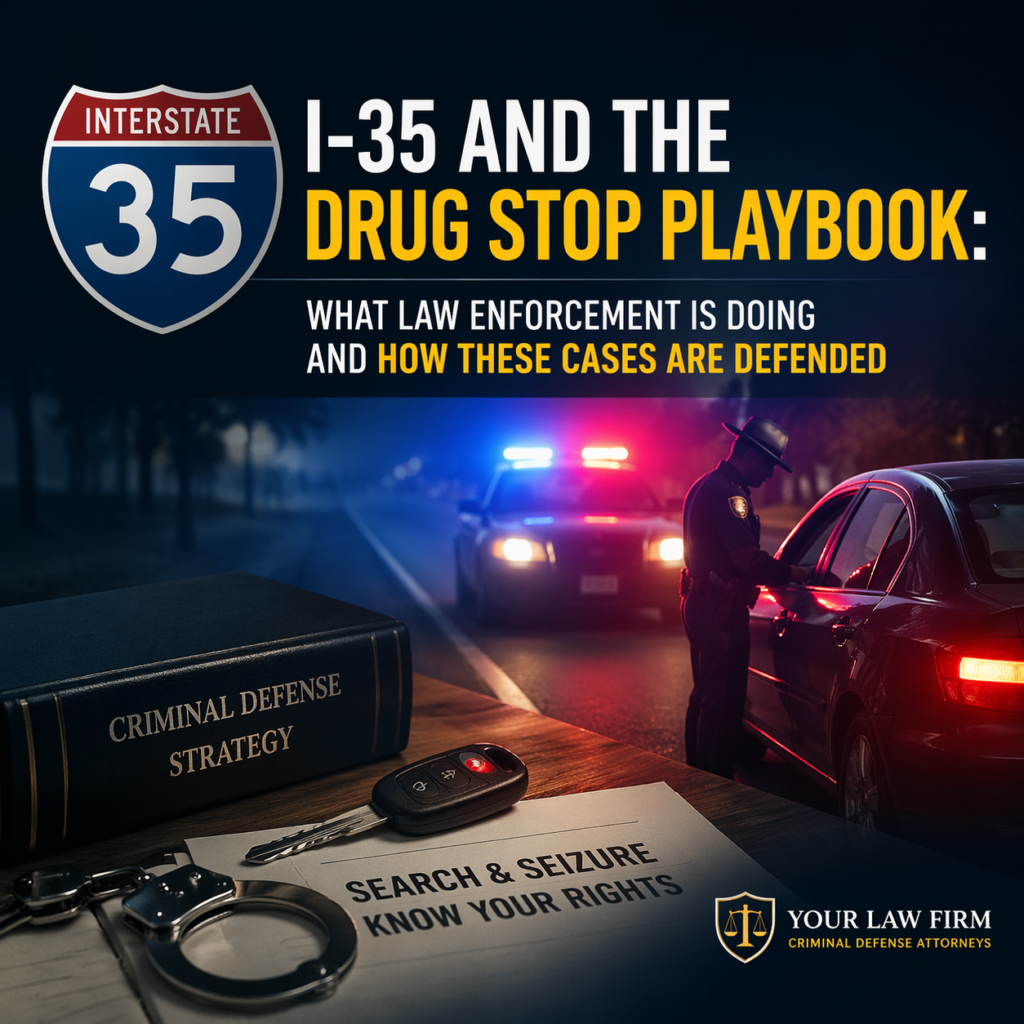
you were stopped on I-35 in North or Central Texas and found yourself facing drug charges, you were not the victim of random bad luck. You were the target of a structured enforcement operation that has been running on this highway for decades. Understanding how that operation works is the starting point for understanding how these cases are defended.
Why I-35: The Geography of Drug Trafficking
Interstate 35 runs 504 miles through Texas from the Oklahoma border to Laredo, passing through some of the state’s largest population centers: Dallas, Fort Worth, Denton, Waco, Austin, and San Antonio. The North Texas HIDTA (the federal High Intensity Drug Trafficking Area program that coordinates enforcement across the Dallas-Fort Worth region) has formally identified I-35 as the primary corridor used to move cocaine, methamphetamine, heroin, fentanyl, and marijuana through the DFW region and beyond.
The DEA’s Dallas Division has described the DFW area, including Denton County, as both a destination market and a transshipment zone. Drug trafficking organizations use I-35 to move product from the southern border toward Dallas and then onward to distribution points in the Midwest and Southeast. In 2020, DEA agents working Denton County seized what the Dallas Division called its largest methamphetamine seizure in county history (1,950 pounds with a street value estimated at $45 million) from an 18-wheeler stopped off I-35. In April 2025, 20 individuals were federally indicted in Waco following a DEA investigation into a methamphetamine trafficking conspiracy that had been operating since 2024 along the I-35 corridor through McLennan County.
The scale of trafficking activity on I-35 explains why law enforcement has deployed dedicated interdiction resources along this specific highway. It also explains why an ordinary driver who happens to be on I-35 when an officer decides to conduct a stop can find themselves in the middle of a serious drug prosecution.
How Interdiction Stops Work: The Officer’s Playbook
Drug interdiction on I-35 is not random. Officers working highway interdiction (whether from DPS, the Lewisville Police Department, the Denton County Sheriff’s Office, or a federal task force) are trained in specific techniques for identifying vehicles worth stopping and then developing a basis to search them. Understanding those techniques is the first step in understanding where the defense begins.
The Pretextual Stop
An interdiction officer who wants to stop a vehicle they have identified as suspicious cannot simply pull it over because they have a hunch. They need a legal basis and the Supreme Court in Whren v. United States (1996) made clear that any valid traffic violation provides that basis, regardless of the officer’s actual motive. If the officer can articulate a traffic violation (however minor) the stop is legally justified under federal constitutional law even if the real reason for the stop was a desire to investigate for drugs.
The violations most commonly used as pretextual bases for I-35 interdiction stops include:
Following too closely. Texas Transportation Code §545.062 requires drivers to maintain a safe following distance. What constitutes a safe distance is subjective, and “following too closely” is one of the most frequently cited pretextual bases for I-35 stops because it is almost impossible to disprove without dashcam footage showing the actual spacing.
Unsafe lane change. Changing lanes without signaling, or changing lanes when unsafe, is a common citation basis. Officers observing multiple vehicles on a crowded interstate can typically find lane movement to characterize as a violation.
Failure to maintain a single lane. Briefly crossing a lane line (even momentarily) provides a technical basis for a stop. This is particularly common in stops of drivers who may be tired, distracted, or simply adjusting their position on a long drive.
Equipment violations. A broken taillight, cracked windshield, or obscured license plate provides a clean, objective basis for a stop that is difficult to challenge. Officers conducting interdiction have latitude to approach any vehicle with a visible equipment issue.
The critical point: Texas’ Article 38.23 exclusionary rule carries no good faith exception. If the traffic violation the officer cited as the basis for the stop did not actually occur (if the dashcam footage shows the vehicle was maintaining safe distance, or the lane change was legal, or the equipment violation was fabricated or exaggerated) the stop was unlawful and everything that followed is suppressible. Unlike federal courts after Leon, Texas courts cannot save unlawfully obtained evidence by finding that the officer believed in good faith that their conduct was legal.
The Initial Contact and Drug Detection
Once the vehicle is stopped, the officer’s focus shifts to developing indicators of drug trafficking during the traffic contact itself. Officers are trained to observe and document during the ordinary license and registration exchange: the driver’s nervousness, inconsistencies in travel story, a rental vehicle being driven far from its origin city, the presence of air fresheners or dryer sheets, inconsistency between the driver’s stated destination and the vehicle’s contents, and other behavioral and circumstantial markers.
None of these indicators, individually or in combination, is necessarily sufficient to establish probable cause to search the vehicle. They are the building blocks of a reasonable suspicion argument that the officer uses to justify extending the stop and that is where the next critical legal issue arises.
The Drug Dog and the Rodriguez Clock
In many I-35 interdiction stops, the officer calls for a drug detection dog while writing the citation or running the license check. The Supreme Court’s decision in Rodriguez v. United States (2015) established a rule that is directly relevant to how these stops play out: a traffic stop cannot be extended beyond the time reasonably needed to complete the mission of the stop (the license check, the insurance verification, the citation or warning) without independent reasonable suspicion of criminal activity.
This means the officer cannot simply make a driver wait on the side of I-35 while a drug dog is brought to the scene, unless the officer already has reasonable suspicion of drug activity separate from the traffic violation. If the dog does not arrive within the time the traffic stop would ordinarily take to complete, and the officer has no independent reasonable suspicion to justify the extended detention, the extended stop violates the Fourth Amendment and any evidence discovered by the dog is suppressible.
The timeline of an I-35 stop matters enormously. How long did the stop last from the initial contact to the moment the dog alerted? What was the officer doing during that time? Was the license check run promptly, or was it delayed to give the dog time to arrive? Were there other officers present from the beginning suggesting the stop was pre-planned? These are the factual questions that determine whether a Rodriguez challenge succeeds.
The Drug Dog Alert
When a drug dog alerts on a vehicle, that alert constitutes probable cause to search the vehicle under Florida v. Harris (2013). But probable cause based on a dog alert is only as reliable as the dog. The dog’s training records, its certification history, its field performance history (including how often it has alerted on vehicles where no drugs were found) and whether the handler followed proper procedures during the sniff are all discoverable and subject to challenge.
A dog that is poorly trained, improperly certified, or has a documented history of false alerts does not provide reliable probable cause. A handler who cued the dog (intentionally or inadvertently) by body language or positioning has contaminated the alert. The defense examination of a drug dog alert begins with a public records request for the dog’s complete training and deployment records.
Consent Searches
A significant number of drug discoveries on I-35 do not follow a dog alert. They follow a consent search which is a driver who agreed, when asked, to let the officer search the vehicle. Consent is a recognized exception to the Fourth Amendment’s warrant requirement, but the consent must be voluntary. It cannot be the product of coercion, and it cannot be given under a reasonable but mistaken belief that the driver had no right to refuse.
The circumstances of many I-35 roadside encounters do not look like voluntary consent. A driver stopped at night on the side of a busy interstate, surrounded by one or more officers, after a traffic stop that has already gone on for fifteen minutes, being asked by a law enforcement officer in uniform whether they mind if the officer takes a look in the vehicle. That is not a neutral setting in which a reasonable person would feel free to say no. Whether the totality of the circumstances made the consent voluntary or coerced is a factual inquiry that belongs at the center of every consent-search drug case.
Where These Cases Are Won: Article 38.23
Texas Code of Criminal Procedure Article 38.23 is the most powerful tool available in I-35 drug stop defense cases. It provides that no evidence obtained by an officer or other person in violation of any provision of the Constitution or laws of the State of Texas, or of the Constitution or laws of the United States, shall be admitted against the accused.
Texas’s exclusionary rule has no good faith exception. The federal good faith exception, established in United States v. Leon (1984), allows evidence obtained through a defective warrant to be admitted if officers reasonably believed the warrant was valid. Texas does not follow Leon. A Texas court evaluating the legality of an I-35 stop does not ask whether the officer acted in good faith. It asks whether the stop was lawful. If the stop was unlawful, the evidence is out.
This makes the lawfulness of the initial stop (the traffic violation, the factual basis the officer articulates in their report, and whether that account is consistent with the dashcam footage) the single most important issue in many I-35 drug cases. A traffic violation that did not happen, or that the footage contradicts, is the end of the prosecution’s case before the weight of the drugs or the identity of the substance is ever reached.
The Federal Dimension
Drug cases originating from I-35 stops are not always prosecuted in state court. When quantities are large, when the investigation involved federal agencies, or when the trafficking pattern crosses state lines, federal prosecution under 21 U.S.C. §841 is a real possibility. Federal drug trafficking charges carry mandatory minimums that do not exist in state court, the United States Sentencing Guidelines govern the sentencing range, and the safety valve (which can reduce a sentence below the mandatory minimum for defendants who meet specific criteria) requires meeting conditions that not every defendant can satisfy.
James Lee Bright, Of Counsel at Deandra Grant Law, has more than 25 years of federal trial experience across all four Texas federal districts, including the Eastern District of Texas (Sherman Division) which covers Denton County and the Western District of Texas (Waco Division) which covers McLennan County. I-35 drug cases that become federal matters require federal defense counsel from the outset.
What to Do If You Are Stopped on I-35
Pull over promptly and safely. Move to the right shoulder, turn on your hazard lights, and come to a complete stop. Erratic driving after seeing emergency lights adds to the officer’s documented observations.
Provide your license, registration, and insurance when asked. These are required. Nothing else is.
Exercise your right to remain silent. You are not required to answer questions about where you are going, where you have been, what you are doing, or whether anything in your vehicle belongs to someone else. “I’d prefer not to answer questions” is a complete response.
Do not consent to a search. You can decline a request to search your vehicle. Say clearly: “I do not consent to a search.” This does not prevent the officer from searching if they develop probable cause independently but it preserves the consent issue for the defense and prevents the most common pathway to drug discovery in the absence of a dog.
Note the time and everything that happens. The Rodriguez clock matters. If you can note what time the stop began and what time the dog arrived, that information may be critical to your defense. Write it down as soon as you are able.
Call a drug defense attorney immediately. The factual record from an I-35 stop deteriorates quickly. Dashcam footage has retention windows. Dog deployment records need to be preserved. The defense investigation should begin the same day as the arrest.
Deandra Grant Law defends drug charges arising from I-35 traffic stops throughout North and Central Texas, including Lewisville, Denton, and Waco. Managing Partner Deandra Grant and Partner Douglas Huff both hold the ACS-CHAL Forensic Lawyer-Scientist designation. Of Counsel James Lee Bright handles federal drug charges across all four Texas federal districts. Call (214) 225-7117 for a free, confidential consultation.