You started a new medication your doctor prescribed. You took the recommended dose before driving. A while later, flashing lights appear in your rearview mirror, and the officer tells you that you are being investigated for driving while intoxicated. You didn’t have a single drink. Can this actually result in a criminal charge?
Yes, and it happens more often than most people realize. But the prosecution of a prescription drug DWI is also scientifically more complex than an alcohol-related DWI, and that complexity creates meaningful defense opportunities that do not exist in the same way in standard DWI cases.
How Texas Law Defines Intoxication
Texas Penal Code §49.04 makes it an offense to operate a motor vehicle in a public place while intoxicated. The critical word is “intoxicated.” Most people assume intoxication means alcohol. Texas law defines it more broadly.
Under §49.01(2), intoxicated means: (A) not having the normal use of mental or physical faculties by reason of the introduction of alcohol, a controlled substance, a drug, a dangerous drug, a combination of two or more of those substances, or any other substance into the body; or (B) having a blood alcohol concentration of 0.08% or greater.
Definition (A) is the one that applies to prescription drug cases. It does not require a positive breath test. It does not require any particular concentration of a substance in your blood. It requires proof that you did not have the normal use of your mental or physical faculties while driving. A prescription drug that impairs your ability to safely operate a vehicle (that slows your reaction time, affects your coordination, impairs your judgment, or causes drowsiness) can satisfy this definition.
Importantly, having a valid prescription is not a defense to DWI. It is a defense to the charge of possessing the substance without authorization. The DWI charge does not require the drug to be illegal. It requires the drug to have impaired your driving.
Which Prescription Drugs Are Most Commonly Involved
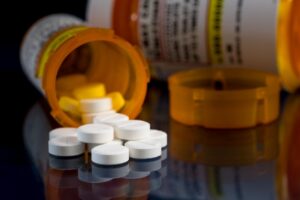
Any prescription medication that affects the central nervous system can potentially support a prescription drug DWI charge. The most commonly involved categories include:
- Opioids (hydrocodone, oxycodone, morphine, fentanyl): Prescribed for pain management. Side effects include sedation, impaired judgment, slowed reaction time, and physical coordination problems.
- Benzodiazepines (alprazolam/Xanax, diazepam/Valium, lorazepam/Ativan, clonazepam/Klonopin): Prescribed for anxiety and sleep disorders. Side effects include sedation, impaired motor coordination, and memory impairment.
- Muscle relaxants (cyclobenzaprine/Flexeril, carisoprodol/Soma): Prescribed for musculoskeletal conditions. Significant sedation potential.
- Sleep aids (zolpidem/Ambien, eszopiclone/Lunesta): Prescribed for insomnia. Residual sedation from nighttime doses can persist into the following morning, making next-day driving potentially dangerous even when the patient feels alert.
- Stimulants (amphetamine/Adderall, methylphenidate/Ritalin): Prescribed for ADHD. Paradoxically, in some circumstances or at higher doses, stimulant medications can impair driving in ways distinct from sedation.
- Antihistamines and anticonvulsants: Both categories can cause sedation and cognitive impairment that affects driving ability.
The Most Important Defense Argument: Presence Is Not Impairment
This is the central issue in almost every prescription drug DWI case, and it is the issue the prosecution is most likely to blur. The presence of a prescription drug in a blood specimen does not establish impairment at the time of driving. These are two different questions requiring two different types of evidence, and the prosecution must prove impairment and not just presence.
Every prescription drug has a therapeutic concentration range which is the range within which the medication produces its intended clinical effect without causing significant adverse effects. Most patients driving to work after taking their prescribed morning dose of a benzodiazepine or an opioid are driving at or near a therapeutic concentration, not at a concentration that causes measurable impairment of driving performance.
The relationship between the concentration of a drug detected in a blood specimen and the level of actual driving impairment is not straightforward. It depends on the specific drug, the patient’s tolerance (which develops with regular use), the timing of the last dose relative to the blood draw, and individual pharmacokinetic variables. An experienced driver on a stable dose of a medication they have taken for years may show a measurable drug concentration in their blood while experiencing no meaningful driving impairment. The prosecution’s blood test result does not by itself answer the question of whether this particular defendant was impaired at this particular time.
Deandra Grant’s Master’s Degree in Pharmaceutical Science and Graduate Certificate in Forensic Toxicology apply directly to this analysis. The pharmacokinetic relationship between drug concentration and behavioral impairment is not a legal argument. It is a pharmacology argument, and it requires training to make effectively.
How the Prosecution Builds a Prescription Drug DWI Case
Field Sobriety Tests — and Why They Don’t Transfer
As the original version of this blog correctly noted, the three standardized field sobriety tests (HGN, Walk and Turn, and One Leg Stand) were validated specifically for detecting alcohol impairment. The NHTSA validation studies did not assess performance by individuals impaired by prescription medications. An officer administering the HGN test to look for nystagmus is applying a test that was not validated for the substance they are investigating.
This does not mean SFST performance is irrelevant. An officer can testify about observed balance and coordination difficulties as evidence of impairment. But the specific accuracy figures associated with SFST administration in alcohol cases do not apply, and the scientific foundation of the evidence is substantially weaker. Deandra Grant is a trained SFST instructor and challenges this evidence at the protocol and validation level.
The Drug Recognition Expert Protocol
In prescription drug DWI cases, particularly when a breath test produces no result or a negative result, officers frequently call a Drug Recognition Expert (DRE) which is an officer trained in a 12-step evaluation protocol designed to identify drug impairment. The DRE will evaluate the subject’s eyes, vital signs, muscle tone, and behavioral indicators, then form an opinion about whether the subject is impaired and, if so, by what category of drug.
The DRE protocol is subject to its own challenges. The 12-step evaluation has been criticized for excessive reliance on the DRE’s subjective interpretation, inconsistency in how evaluators apply the protocol, the protocol’s limitations in accurately identifying specific drug categories, and the assumption that the behavioral indicators observed during the evaluation reflect the defendant’s state at the time of driving which may be hours earlier. The DRE’s opinion is evidence, but it is not infallible, and it is subject to cross-examination by an attorney with pharmaceutical science training.
Blood Testing: LC-MS/MS and Its Limitations
Blood specimens in prescription drug DWI cases are analyzed using liquid chromatography-tandem mass spectrometry (LC-MS/MS), which can identify and quantify prescription drugs and their metabolites at very low concentrations. The technology is sensitive and specific but a positive LC-MS/MS result showing the presence of a medication at a measurable concentration does not, by itself, establish that the defendant was impaired at the time of driving.
The defense examines the complete LC-MS/MS data package (the mass transitions used, the calibration range, the internal standards, and the quality control samples) not just the summary report. The concentration reported must be evaluated against the therapeutic range for the specific drug, the defendant’s dosing history and tolerance, and the timing of the blood draw relative to the last dose and the time of driving.
No Legal Limit for Prescription Drugs in Texas
Texas has a per se BAC limit of 0.08% for alcohol. There is no equivalent per se limit for any prescription medication. This means the prosecution cannot simply point to a number and say the defendant was legally over the limit. They must prove actual impairment of normal mental or physical faculties. This higher evidentiary burden (compared to an alcohol case where a BAC result above 0.08% creates a presumption of intoxication) is one of the reasons prescription drug DWI cases are often more defensible.
The Penalties Are the Same
If convicted, the penalties for a prescription drug DWI are identical to those for an alcohol DWI. A first offense is a Class B misdemeanor carrying 72 hours to 180 days in county jail and a fine up to $2,000. A first-offense DWI with no prior DWI convictions and a recorded drug concentration that satisfies the HB 3582 criteria may be eligible for deferred adjudication. Subsequent offenses escalate to Class A misdemeanor and eventually to felony status under the same enhancement ladder that applies to alcohol DWI.
A Note on Our Experience with These Cases
Deandra Grant Law has defended prescription drug DWI cases across North and Central Texas. In one such case, a jury returned a not guilty verdict within 12 minutes of deliberations. The outcome in any individual case depends on its specific facts, the evidence gathered, and the defense strategy applied but it reflects what is possible when the forensic science challenges in these cases are pursued at the level they require.
Managing Partner Deandra Grant holds the ACS-CHAL Forensic Lawyer-Scientist designation, a Master’s Degree in Pharmaceutical Science, and a Graduate Certificate in Forensic Toxicology. These credentials exist precisely for the pharmacokinetic and analytical chemistry questions that prescription drug DWI cases turn on.
If you have been charged with DWI involving a prescription medication in Texas, call (214) 225-7117 for a free, confidential consultation. Or schedule online at texasdwisite.com.