
Self-Defense in Texas Murder Cases: Stand Your Ground, the Castle Doctrine, and What the Law Actually Requires

Texas has the most robust self-defense laws in the country. A person who kills another person in self-defense has committed no crime. This is not a technicality, an excuse, or a mitigation strategy. It is a complete defense that, if proven, results in an acquittal. But the law’s strength on paper does not mean self-defense cases are simple. The prosecution will challenge every element, and the jury will scrutinize the defendant’s account against the physical evidence, the forensic evidence, and the testimony of every available witness.
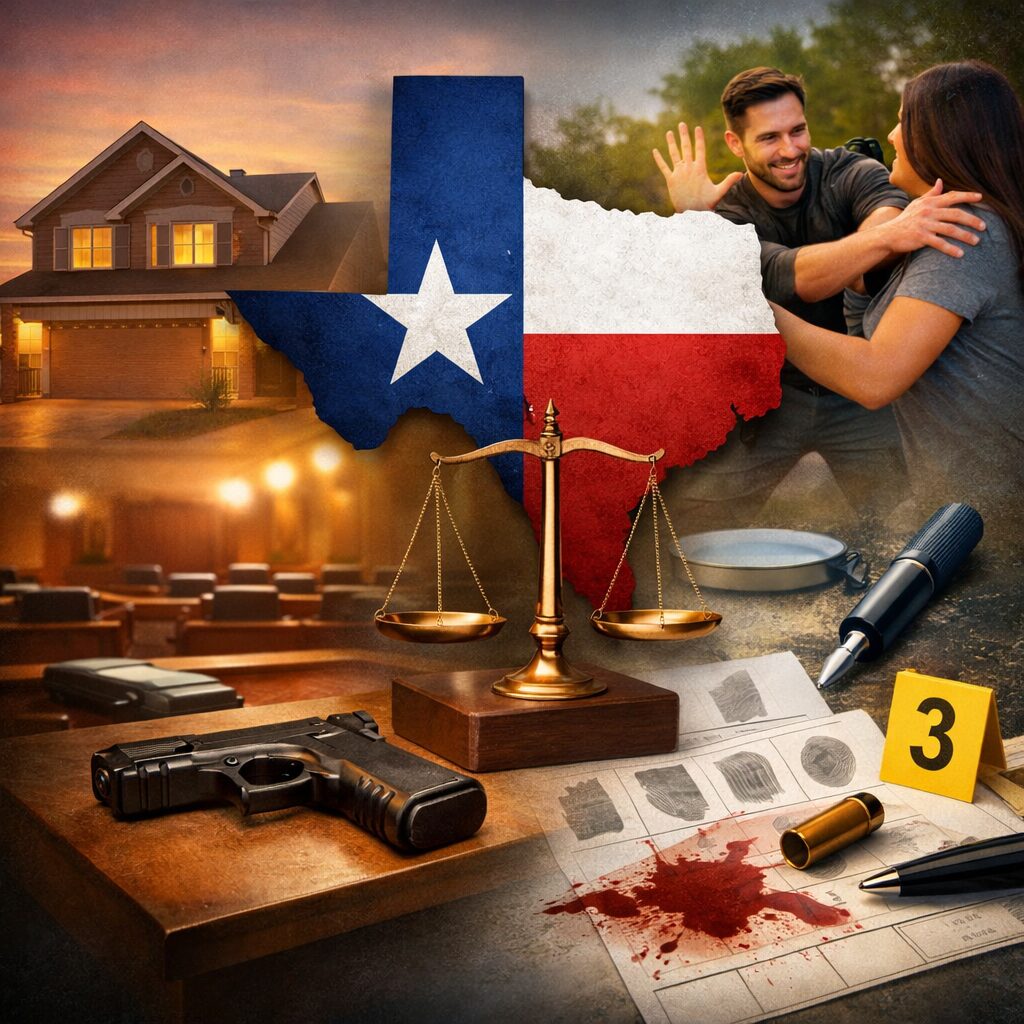
If you have been charged with murder or manslaughter in Texas and you acted in self-defense, the outcome of your case will depend on whether your defense team understands the statutory framework, the evidentiary requirements, and the forensic science well enough to prove that your actions were legally justified. This article explains how self-defense works in Texas murder cases including the statutes, the standards, the common factual patterns, and the forensic evidence that can make or break the defense.
The Right to Use Force: Penal Code §9.31

Under Penal Code §9.31(a), a person is justified in using force against another when and to the degree the person reasonably believes the force is immediately necessary to protect themselves against the other’s use or attempted use of unlawful force. Three elements must be satisfied:
- Reasonable belief. The defendant must have genuinely believed that force was necessary, and that belief must be one a reasonable person in the same circumstances would have shared. This is an objective-subjective standard: the belief must be both personally genuine and objectively reasonable.
- Immediately necessary. The force must have been needed at that moment. A preemptive strike based on a general fear of future harm does not qualify. Retaliatory force after the threat has passed does not qualify. The threat must be present and imminent.
- The force used must be proportionate to the threat. Non-deadly force is justified against non-deadly threats. Deadly force requires a separate and higher justification under §9.32.
No Duty to Retreat: §9.31(e)
Texas has no duty to retreat. Under §9.31(e), a person who (1) has a right to be present at the location where force is used, (2) has not provoked the other person, and (3) is not engaged in criminal activity at the time has no obligation to retreat before using force, including deadly force. This is Texas’s “stand your ground” provision. You are not required to run, hide, or attempt to escape before defending yourself.
The no-duty-to-retreat rule applies everywhere: in your home, in your car, on a public street, in a parking lot, at your workplace, in a bar. As long as you have a legal right to be where you are, you did not start the fight, and you are not committing a crime, you are entitled to stand your ground.
The Right to Use Deadly Force: Penal Code §9.32
Deadly force (force intended or known to cause death or serious bodily injury) is justified under a narrower set of circumstances. Under §9.32(a), a person is justified in using deadly force if:
- They would be justified in using non-deadly force under §9.31, and
- They reasonably believe deadly force is immediately necessary to protect themselves against the other’s use or attempted use of unlawful deadly force; or
- They reasonably believe deadly force is immediately necessary to prevent the other’s imminent commission of aggravated kidnapping, murder, sexual assault, aggravated sexual assault, robbery, or aggravated robbery
The enumerated offenses are critical. If the defendant reasonably believed the other person was about to commit one of these specific offenses, deadly force is justified — even if the defendant could have retreated, even if the defendant was not personally in danger of being killed, and even if the threat was directed at a third person (under the defense-of-others provision in §9.33).
The Castle Doctrine: §9.31(a) and §9.32(b)
The Castle Doctrine is the strongest self-defense protection in Texas law. Under §9.32(b), the law presumes that the defendant’s belief in the necessity of deadly force was reasonable if the other person:
- Was unlawfully and with force entering or attempting to enter the defendant’s occupied habitation, vehicle, or place of business or employment; or
- Was unlawfully and with force removing or attempting to remove the defendant from the defendant’s occupied habitation, vehicle, or place of business or employment; or
- Was committing or attempting to commit aggravated kidnapping, murder, sexual assault, aggravated sexual assault, robbery, or aggravated robbery
The word “presumes” is what makes the Castle Doctrine so powerful. When the presumption applies, the defendant does not have to prove that their belief was reasonable. The law assumes it was. The burden shifts to the prosecution to overcome the presumption by proving beyond a reasonable doubt that the defendant’s use of deadly force was not justified. This is an extremely difficult burden for the prosecution to meet in a home invasion, carjacking, or armed robbery scenario.
The Castle Doctrine does not apply if the person against whom deadly force was used had a right to be in the habitation (such as a co-occupant), unless that person was committing or attempting to commit one of the enumerated offenses. It also does not apply if the defendant provoked the encounter or was engaged in criminal activity at the time.
When Self-Defense Is Not Available
Self-defense is not a universal shield. Texas law specifically identifies circumstances in which the defense is unavailable or significantly weakened:
Provocation: §9.31(b)(4)
If the defendant provoked the other person’s attack, self-defense is not available — unless the defendant abandoned the encounter, clearly communicated that abandonment to the other person, and the other person continued or escalated the attack. The prosecution will frequently argue provocation in cases involving verbal arguments, mutual combat, or escalating confrontations. The question is whether the defendant’s words or conduct were sufficient to provoke the other person’s use of force and whether the defendant subsequently withdrew before the deadly encounter.
Criminal Activity
Under §9.31(e), the no-duty-to-retreat provision does not apply if the defendant was engaged in criminal activity at the time. If the defendant was committing a crime when the encounter occurred (ex. drug transaction, illegal weapons possession, trespass) the prosecution will argue that the self-defense protection is forfeited. However, this limitation applies to the stand-your-ground provision, not to the general right of self-defense. Even a person engaged in criminal activity retains some right of self-defense, although the analysis becomes significantly more complicated.
Excessive Force
The force used must be proportionate to the threat. A defendant who responds to a push with a gunshot, or who continues to use deadly force after the threat has ended, may lose the self-defense justification. The prosecution will present evidence of the timing and sequence of events to argue that the defendant’s response exceeded what was necessary. This is where the forensic evidence (i.e. autopsy findings, wound trajectories, blood spatter, shell casing locations, surveillance footage) becomes decisive.
Initial Aggressor
A defendant who was the initial aggressor in the encounter faces a significantly higher burden. Under §9.31(b)(4), the initial aggressor must have abandoned the encounter and communicated that abandonment before regaining the right to self-defense. The prosecution will argue that the defendant started the fight and therefore cannot claim to have been defending themselves. The defense must demonstrate that the encounter had de-escalated or that the other person’s response was disproportionate to the initial provocation.
Common Factual Patterns in Texas Self-Defense Murder Cases
Home Invasion
The classic Castle Doctrine scenario. An intruder enters or attempts to enter an occupied home unlawfully and by force. The homeowner uses deadly force. The presumption of reasonableness under §9.32(b) applies, making these cases among the strongest for the defense. The prosecution’s primary avenues of challenge are: (1) the intruder had a right to be in the home (co-occupant, invited guest), (2) the defendant provoked the encounter, or (3) the defendant was engaged in criminal activity.
Bar Fight or Street Confrontation
These cases are the most contested. Both parties are often intoxicated. Both may have been verbally aggressive. The question of who was the initial aggressor, who escalated to deadly force, and whether the defendant had a reasonable belief that deadly force was immediately necessary is fought over every piece of evidence: witness testimony (often conflicting and unreliable), surveillance footage (often incomplete), and physical evidence (wound locations, defensive injuries, blood evidence). Provocation and mutual combat arguments are common prosecutorial strategies.
Road Rage
Road rage homicides present a distinctive challenge. The defendant and the victim typically had no prior relationship, the encounter escalated rapidly, and there is often dashcam or surveillance footage that captures part of the event. The prosecution will argue that the defendant had the option to drive away (even though Texas imposes no duty to retreat). The defense must show that the defendant reasonably believed deadly force was immediately necessary based on the other driver’s actions — brandishing a weapon, attempting to force the defendant off the road, or approaching the defendant’s vehicle aggressively.
Domestic Violence Victim Who Kills the Abuser
These are among the most emotionally complex self-defense cases. A person who has suffered prolonged domestic abuse kills their abuser during a violent episode. Texas law does not require the defendant to have been in imminent danger at the precise moment of the killing in the traditional sense. The jury is entitled to consider the defendant’s entire history with the abuser, including prior violence, threats, escalating behavior, and the defendant’s reasonable perception of danger based on that history. Expert testimony on intimate partner violence (formerly called “battered spouse syndrome”) is admissible under Texas Rule of Evidence 702 to help the jury understand how prolonged abuse affects the defendant’s perception of threat and their response to it.
These cases require both legal skill and sensitivity. The defense must present the history of abuse through medical records, police reports, protective order filings, witness testimony, and often the defendant’s own account — while simultaneously navigating the prosecution’s argument that the killing was retaliatory rather than defensive.
Defense of a Third Person
Under §9.33, a defendant is justified in using force or deadly force to protect a third person if, under the circumstances as the defendant reasonably believed them to be, the third person would have been justified in using that force to protect themselves. This defense arises in cases where a parent protects a child, a bystander intervenes to stop an attack, or a person uses deadly force to protect someone who is being robbed, sexually assaulted, or kidnapped. The same reasonableness and proportionality requirements apply.
The Forensic Evidence That Decides Self-Defense Cases
Self-defense cases are rarely decided by testimony alone. When two people are involved in a deadly encounter and one of them is dead, the survivor’s account is the only direct testimony available and the prosecution will challenge every word of it. The forensic evidence is what corroborates or contradicts the defendant’s account, and it is often the most important evidence in the case.
Wound Trajectory and Autopsy Findings
The location, angle, and direction of gunshot wounds or stab wounds can establish the relative positions of the defendant and the victim at the time of the fatal injury. A wound to the front of the body is consistent with a face-to-face confrontation. A wound to the back may suggest the victim was retreating. Downward trajectories may indicate the victim was on the ground. These findings must be interpreted in context (the defendant may have been knocked down, the victim may have been lunging, or the positions may have changed during a struggle) but the autopsy findings are always central to the prosecution’s case and the defense’s response.
Blood Spatter and Crime Scene Reconstruction
Blood spatter patterns can establish where the victim was standing or falling when struck, the direction of movement, and the sequence of events. Crime scene reconstruction combines blood evidence, shell casing locations, bullet trajectories, and physical damage to reconstruct the dynamics of the encounter. This evidence can powerfully support a self-defense narrative or undermine it. The 2009 National Academy of Sciences report and subsequent research have identified significant limitations in blood spatter analysis, and a defense attorney with forensic science training can challenge the prosecution’s expert on methodology, assumptions, and alternative interpretations.
Ballistics and Shell Casing Analysis
The number and location of shell casings, the distance from which shots were fired (determined by gunshot residue patterns and stippling), and the trajectory of bullets through the scene can all corroborate or contradict the defendant’s account. Multiple shots fired at close range may support a claim of an aggressive attacker at close quarters. Shots fired from a distance may be harder to reconcile with an imminent threat narrative.
Surveillance Footage and Digital Evidence
In cases occurring in public places (ex. bars, parking lots, gas stations, streets) surveillance footage is often the most important evidence. It captures what happened in real time, eliminates conflicting witness accounts, and can decisively establish who was the aggressor. But footage is not always complete, and camera angles can be misleading. Cell phone video, dashcam footage, GPS data, and call/text logs can also establish timelines and corroborate the defendant’s account of events.
Doug Huff, a partner at Deandra Grant Law and an ACS-CHAL Forensic Lawyer-Scientist, evaluates every category of forensic evidence in self-defense cases with scientific rigor. His digital forensics training allows him to evaluate surveillance footage, cell tower data, GPS records, and device forensics independently. When the forensic evidence supports the defendant’s account, Huff presents it with the scientific precision that juries trust. When the prosecution’s forensic narrative has weaknesses, he finds them.
The Self-Defense Jury Instruction
In Texas, the defendant is entitled to a jury instruction on self-defense if the evidence, viewed in the light most favorable to the defendant, raises the issue. Under Saxton v. State, 804 S.W.2d 910 (Tex. Crim. App. 1991), the defendant bears the burden of producing some evidence to raise the self-defense claim, but once raised, the prosecution bears the burden of disproving self-defense beyond a reasonable doubt. The jury is instructed that if it has a reasonable doubt as to whether the defendant acted in self-defense, it must acquit.
This burden allocation is critical. The defendant does not have to prove self-defense by a preponderance of the evidence. The defendant only has to produce enough evidence to raise the issue. Once raised, the prosecution must disprove it beyond a reasonable doubt. The same standard that applies to every element of the charged offense. In practice, this means that if the forensic evidence is ambiguous, if the witnesses are conflicting, and if the defendant’s account is plausible, the jury should acquit. The defense’s job is to create that ambiguity.
Self-Defense Cases at Deandra Grant Law
A self-defense claim in a murder case is not a simple denial. It is an affirmative assertion that you were legally justified in using deadly force, supported by forensic evidence, witness testimony, and the full statutory framework of Texas law. The quality of the defense (i.e. the forensic analysis, the crime scene reconstruction, the cross-examination of the prosecution’s experts, and the presentation of the self-defense narrative to the jury) determines whether you walk out of the courtroom or spend the rest of your life in prison.
At Deandra Grant Law, Doug Huff’s ACS-CHAL Forensic Lawyer-Scientist credential and digital forensics training give our self-defense clients something most defense teams cannot provide: the ability to independently evaluate and challenge every piece of forensic evidence the prosecution presents. Combined with Deandra Grant’s 30+ years of trial experience we build self-defense cases that meet the prosecution’s case at every level.
With offices in Dallas, Fort Worth, Allen, Denton, Waco, and Rockwall, we defend murder and self-defense cases across North Texas. Call (214) 225-7117 or visit DeandraGrantLaw.com for a confidential consultation.
Which county your case is filed in changes how it is charged, who prosecutes it, and which court hears it.
Deandra M. Grant, JD, GC, MS, ACS-CHAL Forensic Lawyer-Scientist
She holds a Master of Science in Pharmaceutical Science and a Graduate Certificate in Forensic Toxicology, both from the University of Florida. She is the author of The Texas DWI Manual and has defended Texas DWI cases since 1994.
Facing Criminal Charges in Texas?
The sooner a defense lawyer is involved, the more can be done to protect your record and your freedom. Talk to us today.
Request a Free Case Evaluation
Tell us what happened. We'll respond as soon as possible.