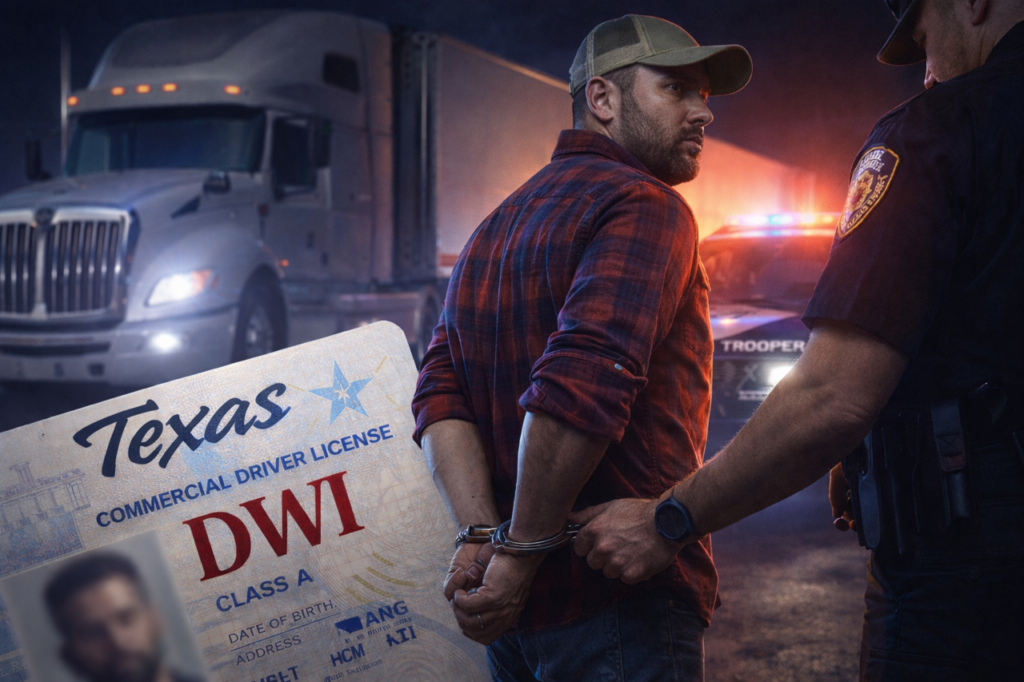
For a CDL holder, a DWI arrest is not just a criminal matter. It is a career emergency. The administrative consequences (CDL disqualification) move faster than the criminal case, there is no occupational license available to preserve your ability to drive commercially during the disqualification period, and the BAC threshold that triggers the violation is half the standard that applies to non-commercial drivers. A first offense can cost you your CDL for a year. A second offense triggers lifetime disqualification.
Understanding how CDL disqualification works, what the deadlines are, and where the defense focuses is essential for any commercial driver facing a DWI arrest in Texas.
The 0.04% Threshold: Why CDL Cases Are Different
 Federal regulations under 49 C.F.R. Part 383, incorporated into Texas law, set the per se BAC limit for commercial vehicle operation at 0.04% which is exactly half the 0.08% standard that applies to non-commercial drivers. A CDL holder operating a commercial vehicle who provides a breath or blood sample at or above 0.04% has committed a per se violation regardless of whether their driving showed any signs of impairment.
This lower threshold has a significant forensic consequence: CDL cases are disproportionately near-threshold cases. A reading of 0.05% or 0.06% in a CDL case is legally over the limit but is a measurement that carries substantial uncertainty from partition ratio variability, instrument precision, and the timing of the test relative to the peak absorption phase. The same BAC reading that would be a clear violation at the 0.08% standard may be genuinely contestable at the 0.04% standard when the forensic science is properly examined.
The 0.04% standard applies only when driving a commercial vehicle. If the CDL holder was arrested while driving a personal vehicle, the standard 0.08% limit applies to the DWI charge itself. However, even a DWI conviction arising from personal vehicle operation can still disqualify the CDL. The disqualification consequence follows the CDL holder regardless of which vehicle they were driving when arrested.
CDL Disqualification: How It Works
CDL disqualification is distinct from a standard driver’s license suspension. The critical difference: a driver facing a regular license suspension may be eligible for an occupational license, which allows limited driving for work, school, and household essentials. A CDL holder whose commercial privileges are disqualified has no equivalent option. There is no occupational CDL. If your commercial driving privileges are disqualified, you cannot legally operate a commercial vehicle during the disqualification period — period.
Disqualification Periods
First-time refusal, test failure, or DWI conviction: 1 year.
First-time refusal, test failure, or DWI conviction while transporting hazardous materials: 3 years.
Second refusal, test failure, or DWI conviction: Lifetime disqualification. After 10 years, a CDL holder may apply for reinstatement if they meet eligibility criteria. A subsequent DWI after reinstatement results in permanent disqualification with no further eligibility for reinstatement.
Cross-offense disqualification: The disqualification rules apply to BWI (boating while intoxicated) convictions as well as DWI. And a DWI conviction in a personal vehicle triggers CDL disqualification on the same schedule as a commercial vehicle DWI.
The ALR Process for CDL Holders
A DWI arrest for a CDL holder triggers the same Administrative License Revocation process as any DWI but with higher stakes because of the no-occupational-license rule.
If you refused a chemical test: The officer issued a notice of disqualification at the scene. You have 15 days from the date you were served with that notice to request an ALR hearing. Missing the deadline results in automatic disqualification effective on the 40th day after service of the notice.
If you provided a specimen and the result was at or above the applicable limit: You have 15 days from the date you are served with notice of the disqualification to request an ALR hearing. The notice may be served at the scene or by mail depending on the circumstances of the arrest.
The ALR hearing does not determine guilt or innocence. It focuses on two questions: whether the officer had reasonable suspicion for the stop and probable cause for the arrest, and whether you refused or failed the chemical test. If the Administrative Law Judge finds in your favor, the disqualification does not take effect. If they find against you, the disqualification stands regardless of the outcome of the criminal case.
Requesting the ALR hearing also has strategic value beyond preserving the CDL. It compels the arresting officer to testify under oath before the criminal case reaches those issues, creating a sworn record that can be used for cross-examination and impeachment throughout the defense.
The Forensic Science Defense in CDL Cases
Because CDL cases so frequently involve near-threshold BAC readings, the forensic science challenges that apply to any DWI case carry extra weight here. A reading that is marginally over 0.04% is not the same as a reading of 0.15% and challenging whether the measurement accurately reflects the driver’s true BAC at the time of driving requires the kind of pharmacokinetic analysis that a general practice defense attorney is not equipped to conduct.
Partition Ratio Variability
Breath testing instruments like the Intoxilyzer 9000 estimate blood alcohol concentration by measuring alcohol in expired breath and applying a standardized 2100:1 blood-to-breath conversion factor. But the actual blood-to-breath ratio varies across the population from approximately 1,100:1 to 3,400:1. A driver whose true ratio is on the lower end of this range will produce a breath reading that overstates their actual BAC. At 0.04%, this variability can be the difference between a result that is over the limit and one that is not.
Retrograde Extrapolation
Blood draws and breath tests in DWI cases occur after the stop, booking, and transport to a testing facility sometimes hours after the traffic stop. The prosecution must establish the driver’s BAC at the time of driving, not at the time of the test. Retrograde extrapolation (calculating backward from the measured BAC to estimate the BAC at the earlier time) uses the Widmark formula and requires assumptions about the driver’s elimination rate, absorption phase, and last drink timing. When a CDL holder’s measured BAC is 0.05% and the blood draw occurred 90 minutes after the stop, the question of whether the driver was above or below 0.04% at the time of driving is a genuinely uncertain pharmacokinetic question.
In Vitro Fermentation
Blood samples that are improperly stored or transported can undergo in vitro fermentation (the conversion of glucose to ethanol by bacteria or yeast present in the sample) which artificially elevates the measured BAC. This is a documented source of false elevation in blood alcohol testing and is most significant in cases where the measured BAC is near a threshold value. Examining the chain of custody documentation and storage conditions for any blood specimen is essential in every near-threshold CDL case.
SFST Challenges
Field sobriety test performance is frequently used to support the probable cause determination for a CDL arrest even when the chemical test result is the primary evidence. Deandra Grant is a trained SFST instructor who administers and grades the ACS-CHAL and DUIDLA Board Certification exams. SFST cross-examination in CDL cases focuses on administration errors, environmental conditions, and the officer’s scoring of clues. A suppression of the stop or arrest based on defective SFST administration can end the case before the BAC question is ever reached.
What to Do After a CDL DWI Arrest
Request the ALR hearing within 15 days of notice of disqualification. This is the most time-critical step. The hearing preserves your CDL during the pending period and creates a strategic record for the criminal defense.
Do not drive a commercial vehicle. During the period between your arrest and the resolution of the ALR and criminal proceedings, driving a commercial vehicle while disqualified is a separate federal violation with its own consequences. Your attorney will advise you on the specific restrictions that apply based on the status of your case.
Get independent evaluation of the chemical test evidence. In near-threshold CDL cases (any BAC reading between 0.04% and approximately 0.07%) the forensic science analysis should happen immediately. The sooner the testing methodology, chain of custody, and retrograde extrapolation assumptions are examined, the stronger the defense.
If you hold a CDL and have been arrested for DWI in North or Central Texas, call Deandra Grant Law at (214) 225-7117 for a confidential consultation. Managing Partner Deandra Grant holds a Master’s Degree in Pharmaceutical Science, a Graduate Certificate in Forensic Toxicology, and the ACS-CHAL Forensic Lawyer-Scientist designation. The ALR deadline may already be running.