Of all the scientific challenges to blood test accuracy in DWI cases, coelution may be the most technically significant and the least understood by defense attorneys. Coelution occurs when two or more chemical compounds exit the gas chromatography column at the same time, causing their detector signals to overlap. When this happens, the instrument cannot distinguish between the compounds and reports a combined measurement as if it were a single compound.
In a DWI blood test, if a non-ethanol compound coelutes with ethanol, the GC-FID instrument reports a BAC that is higher than the actual ethanol concentration in the sample. The laboratory report says your BAC was 0.09, but part of that 0.09 was actually a different chemical compound that happened to exit the column at the same time as ethanol.

"Deandra Grant Law – Criminal & DWI Defense handled my case with diligence and professionalism. Deandra Grant's reputation is stellar and now I know why. She has a team of individuals who provide quality service."
- N. Coulter
"Deandra Grant Law – Criminal & DWI Defense fights hard for their clients and is always willing to go above and beyond. They are the best firm for DWI cases in DFW and beyond. Definitely hire them to represent you in any pending cases."
- P. Williams
"Deandra Grant made a tough situation so much better. She listened to my concerns and helped me so much with my case. I would recommend her to anyone needing legal services."
- M. Haley
How Coelution Happens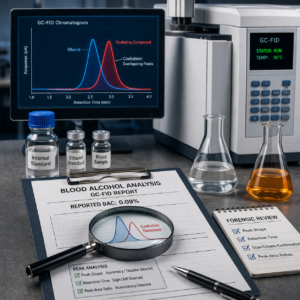
In gas chromatography, compounds are separated based on how they interact with the column’s stationary phase. Each compound has a characteristic retention time which is the time it takes to travel through the column and reach the detector. Ethanol has a specific retention time under a given set of conditions (column type, temperature, carrier gas flow rate).
Coelution occurs when another compound has a retention time that is identical or very close to ethanol’s under the same conditions. When both compounds reach the detector at the same time, the FID measures the combined signal and attributes it entirely to ethanol.
Compounds That Can Coelute with Ethanol
- Produced naturally by the body during fat metabolism, and at elevated levels in diabetic individuals experiencing ketoacidosis. Depending on the GC column and conditions used, acetone can coelute with or elute very close to ethanol.
- Isopropanol (isopropyl alcohol). Found in rubbing alcohol and hand sanitizers. Can be present in blood samples due to environmental exposure or use of isopropanol-based skin antiseptics during blood draws.
- Methanol (methyl alcohol). Present in trace amounts in the body as a normal metabolic byproduct. Can also be present from consumption of certain beverages or exposure to solvents.
- Other volatile organic compounds. Various occupational and environmental exposures can introduce VOCs into the blood that may coelute with ethanol under certain chromatographic conditions.
How to Detect Coelution
Detecting coelution requires examination of the chromatogram which is the graphical output of the GC analysis. An trained attorney knows what to look for:
- Peak shape analysis. A pure ethanol peak should have a symmetrical, Gaussian shape. A peak that is asymmetric, unusually broad, or has a shoulder may indicate the presence of a coeluting compound.
- Retention time comparison. The retention time of the ethanol peak in the sample should match the retention time of ethanol in the calibration standards. A slight shift may indicate interference from a coeluting compound.
- Dual-column confirmation. Laboratories can run the sample on a second column with different separation properties. If the two columns produce different results, it suggests coelution on one or both columns. However, not all laboratories routinely use dual-column confirmation for DWI samples.
- Peak area ratios. The ratio of the ethanol peak area to the internal standard peak area should be consistent across replicate injections. Inconsistency may indicate interference.
Why Most Attorneys Miss Coelution
Identifying coelution requires the ability to read and interpret chromatograms which is a skill that is not taught in law school, at CLE seminars, or as part of Board Certification in Criminal Law. An attorney who has never been trained in gas chromatography will look at the laboratory report, see the BAC number, and have no way to evaluate whether coelution inflated that number. Our forensic training specifically covers chromatogram interpretation, and we request and review the actual chromatographic data in every blood test DWI case.
Your DWI Defense Should Be Built on Science
At Deandra Grant Law, our forensic credentials give us the foundation to challenge the prosecution’s evidence at a scientific level. If you are facing DWI charges in Texas, contact us for a free, confidential consultation.
Call (214) 225-7117 or schedule an appointment online at texasdwisite.com.
Firm Accolades

Better Business Bureaus

D Magazine