
ARVE error: <a href="https://nextgenthemes.com/plugins/arve/documentation/installation/">ARVE Pro</a> license not activated or valid
Do You Need Legal Help?
ARVE error: <a href="https://nextgenthemes.com/plugins/arve/documentation/installation/">ARVE Pro</a> license not activated or valid

"Deandra Grant Law fights hard for their clients and is always willing to go above and beyond. They are the best firm for DWI cases in DFW and beyond. Definitely hire them to represent you in any pending cases."
- P. Williams
"Deandra Grant made a tough situation so much better. She listened to my concerns and helped me so much with my case. I would recommend her to anyone needing legal services."
- M. Haley
"Deandra Grant Law handled my case with diligence and professionalism. Deandra Grant's reputation is stellar and now I know why. She has a team of individuals who provide quality service."
- N. Coulter
New! AI Legal Avatar — Get 24/7 Answers on Texas DWI Law, Penalties, and Defenses
Our AI Legal Avatar provides instant, plain-language answers to your questions about Texas DWI laws—like penalties, license suspension, and defense strategies—anytime, day or night. While it's a helpful starting point, it doesn't replace the clarity and advocacy of our experienced DWI attorneys.
As Seen On






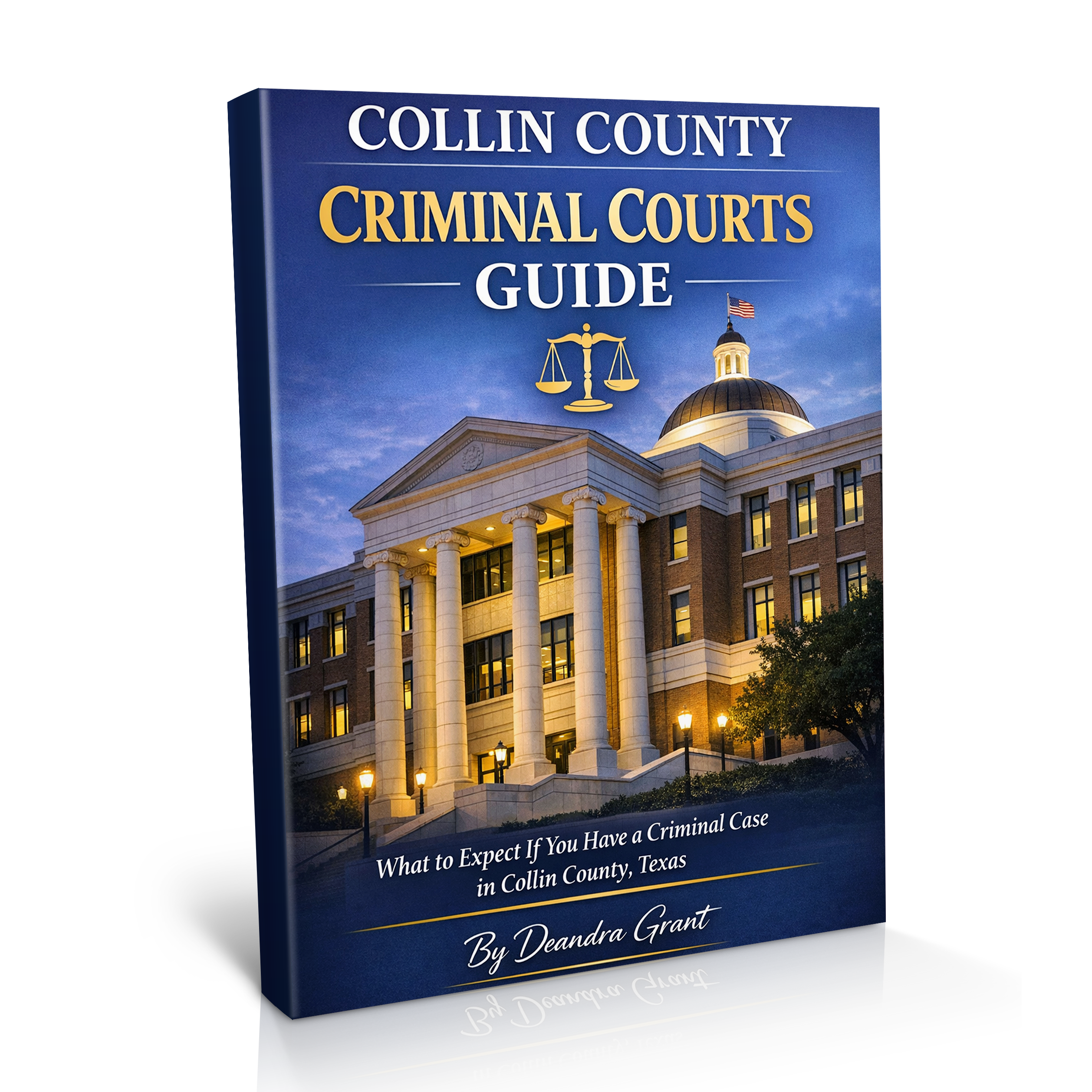
Collin County Criminal Courts Guide
By Attorney Deandra Grant
If you’re facing a criminal charge in Collin County, understanding how the local courts work can make the process far less confusing. This guide explains where cases are heard, what each court handles, and what you can expect as your case moves through the system.
Read NowMcKinney DUID Lawyers
A drug DWI in Texas is still a DWI. There is no separate “DUID” statute. Texas Penal Code § 49.04 covers alcohol, drugs, and everything in between. But drug DWI cases operate differently at the forensic and investigative level than alcohol cases. There is no per se drug limit the way there is a 0.08 BAC. The state relies on blood toxicology, Drug Recognition Evaluations, and circumstantial evidence to prove impairment. And because many drugs produce metabolites that linger long after the psychoactive effects have ended, the gap between what the lab report says and what actually happened on the road is often larger than the state’s case suggests.
DUID charges arising in McKinney are prosecuted by the Collin County District Attorney’s Office at the Collin County Courthouse, 2100 Bloomdale Road, McKinney, TX 75071. Many McKinney-area DUID arrests originate from traffic stops on US-75 (Central Expressway), SH-121 (Sam Rayburn Tollway), SH-380 (University Drive), and the eastern terminus of the President George Bush Turnpike.
Deandra Grant Law has defended DUID charges in Collin County for more than 30 years. Our Allen office is minutes from the Collin County Courthouse in McKinney. Managing Partner Deandra Grant is a trained SFST instructor and holds the ACS-CHAL Forensic Lawyer-Scientist designation along with a Master of Science in Pharmaceutical Science and a Graduate Certificate in Forensic Toxicology.
Drug DWI in Texas — Penal Code § 49.04 and § 49.01
Under Penal Code § 49.04(a), a person commits DWI if the person is intoxicated while operating a motor vehicle in a public place. “Intoxicated” is defined in § 49.01(2):
- (A) Not having the normal use of mental or physical faculties by reason of the introduction of alcohol, a controlled substance, a drug, a dangerous drug, a combination of two or more of those substances, or any other substance into the body; or
- (B) Having an alcohol concentration of 0.08 or more.
The (B) per se prong applies only to alcohol. There is no per se drug concentration in Texas DWI law. Every drug DWI case requires the state to prove actual impairment under the (A) prong.
The State’s Impairment Burden — And Why It Is Contestable
In an alcohol DWI case with a 0.08 BAC result, the state can secure a conviction on the per se prong regardless of how the defendant behaved or performed on field sobriety tests. In a drug DWI case, there is no per se shortcut. The state must establish:
- That the defendant was not in normal use of mental or physical faculties at the time of driving;
- That the loss of normal use was caused by a drug, controlled substance, dangerous drug, or other substance (not by fatigue, medical condition, or other factors);
- That the substance was in fact present in the defendant’s system at impairing concentrations at the time of driving.
Each of these elements is contestable. A driver who was fatigued, had a medical episode, or was under stress may exhibit impairment signs without drug involvement. Even where a drug is detected, whether it was present at impairing concentrations (and whether it in fact caused the observed impairment) is rarely as clear-cut as the state presents it.
Common DUID Substance Categories
Marijuana and THC
The most-prosecuted DUID category in North Texas. Several structural features of cannabis pharmacology make these cases particularly defensible:
- No per se THC threshold. Texas has no statutory cutoff for THC blood concentration. A number standing alone cannot prove impairment.
- THC is lipid-soluble and persists long after impairment ends. Active THC can remain detectable in blood for days to weeks in regular users, far beyond the typical 3-to-4-hour impairment window after consumption.
- THC metabolites (11-nor-9-carboxy-THC, or “carboxy-THC”) are not psychoactive. Lab results often report carboxy-THC alongside active THC. A positive carboxy-THC result alone indicates past use, not current impairment.
- Hemp-derived products with trace THC. Legal hemp products containing less than 0.3% Δ9-THC can contribute to blood THC readings in the low nanogram range without causing impairment.
Prescription Medications
Opioids (hydrocodone, oxycodone, tramadol), benzodiazepines (alprazolam, diazepam, clonazepam), sleep aids (zolpidem, eszopiclone), ADHD medications, and various SSRI/SNRI antidepressants all appear in DUID cases. The critical legal point:
- A valid prescription is not a defense under §49.10. Penal Code §49.10 expressly bars the fact of a valid prescription from serving as a defense to a DUID charge. Even a patient taking a medication exactly as prescribed can be convicted of DUID if the state proves loss of faculties caused by that medication.
- “Took as directed” is relevant to mitigation, not to guilt. Prescription compliance does not defeat the charge, but it may affect how the DA’s office approaches resolution and how a jury views culpability.
- Polypharmacy interaction. Combinations of prescribed medications (often prescribed by different doctors with no cross-awareness) can produce impairment that none of the individual medications would cause. This is a genuine defense complication and a jury-comprehensible narrative in appropriate cases.
Controlled Substances
Methamphetamine, cocaine, heroin, MDMA, and other Penalty Group substances appear in DUID cases. Special defense considerations:
- Methamphetamine: d-meth vs l-meth. Standard immunoassay screens do not distinguish illegal d-methamphetamine from l-methamphetamine, the active ingredient in legal OTC products such as Vicks inhalers. Only LC-MS/MS confirmatory testing with chiral separation distinguishes the two. A positive methamphetamine screen alone does not establish illegal methamphetamine use.
- Cocaine metabolites. Benzoylecgonine (a cocaine metabolite) can persist long after cocaine itself is cleared. A positive benzoylecgonine result alone indicates past exposure, not current impairment.
McKinney Criminal & DWI Defense
Criminal Defense Assault Boating While Intoxicated Cocaine Defense Drug Crimes DUID DWI Felony DWI Gun Crimes Intoxication Assault Murder Defense Theft Defense Warrants
Related Videos
Certified in the science and testing of DWI enforcement
Appealing a DWI or BWI
Biggest Mistakes of a DWI Charge
Lawyer Scientist Certification
Boating while intoxicated with a child
DWI with a child in the car
Can I travel out of country with a DWI?
Going to Canada with a DWI
Choosing a DWI attorney
Choosing quality over cost with a DWI attorney
Cost of a DWI attorney
Cost of a BWI attorney
DWI on your criminal record
DWI probable cause
DWI while operating a boat
DWI with prior convictions
Emotional state of a DWI client
How long does a DWI conviction stay on my record?
How long will a DWI case take?
Operating a boat during pending DWI charges
Out-of-state DWI Arrest
Police didn’t have probable cause
Relieving stress of a DWI client
Prescription Drug DWI
Texas DWI Manual
Underage DWI Penalties
Hiring a lawyer who has an ACS-CHAL Forensic Lawyer-Scientist designation
What do officers watch for during a DWI traffic stop?
How do police reports affect a DWI case?
No Miranda warning given
Prior DWI conviction penalties
Challenging breathalyzer and blood test results
Legal strategies to challenging DWI charges
Mandatory minimum sentences for DWI convictions
Steps to take after being pulled over for DWI
Criminal process of a DWI
Charged with a DWI while sitting in your car
First time DWI charge
Second DWI charges
Third DWI charges
Being sent to jail for a first time DWI
Being sent to jail for multiple DWIs
Can I defend myself against a DWI charge?
Can I refuse a breathalyzer test?
Can refusing a breath or blood test help my case?
College age child arrested for DWI
Court process for a DWI charge
DWI license suspension
Driving during your license suspension
Legal alcohol limit
DWI with injury penalties
DWI written case evaluations
Expunging a DWI charge
Ignition Interlock Device
Losing your job from a DWI
Losing your license from a DWI
Penalties from a DWI conviction
Plea bargaining a DWI charge
Will pleading guilty reduce a DWI charge?
Refusing to answer police questions during a DUI arrest
Refusing field sobriety tests
Why you should choose a DWI attorney with lawyer scientist certification
Should I take a field sobriety test?
Administrative license revocation (ALR) process
Diversion programs for first-time DWI offenders
DWI defenses
What causes poor performance of field sobriety tests?
Charged with DWI after blowing below .08 BAC
Handgun in your vehicle during a DWI arrest
Can I choose between a breath or blood test?
What evidence is used against me for DWI?
The Polypharmacy Problem
Many drug DWI arrests involve multiple substances (ex. an antidepressant combined with a benzodiazepine; marijuana combined with alcohol; opioid medication combined with muscle relaxants). When the state’s blood testing reveals multiple substances, the causation analysis becomes significantly more difficult:
- Which substance caused which observed effect?
- Were any of the substances present at impairment-level concentrations?
- Did interactions between substances produce effects that neither would have caused alone?
- Was the driver’s impairment caused by one specific substance, a combination, or neither?
The state bears the burden of proving impairment “by reason of” the drug (meaning specific causation). In polypharmacy cases, that burden is often hard to meet.
Drug Recognition Expert (DRE) Evidence and Its Limits
Many drug DWI arrests in Collin County involve a Drug Recognition Expert which is a police officer trained in a 12-step drug evaluation protocol developed by the International Association of Chiefs of Police. The DRE testifies at trial as an “expert” about the category of drug present and the impairment observed.
The DRE protocol includes breath alcohol testing, interview with the arresting officer, preliminary examination and first pulse, eye examinations (HGN, Lack of Convergence, VGN), divided attention psychophysical tests, vital signs and second pulse, dark room examinations, muscle tone, injection sites and third pulse, subject statements, opinion of the evaluator, and toxicological examination.
Key defense issues with DRE evidence:
- The 12-step protocol is subject to substantial operator error and subjective interpretation.
- Research on DRE accuracy has shown error rates ranging roughly 30–56% across various drug categories in validation studies.
- The DRE is trained to identify seven drug categories, not specific drugs. The identification is based on physiological observations, not chemistry.
- DRE testimony is often admitted without a Daubert-style reliability hearing, despite known accuracy limits.
- Cross-examination on the specific steps, the protocol’s empirical basis, and the officer’s training and experience is central to challenging DRE testimony.
Forensic Defense — LC-MS/MS and Screening vs Confirmation
Drug identification in Texas DUID cases generally proceeds in two stages: a screening test (typically immunoassay) followed by a confirmatory test (typically liquid chromatography-tandem mass spectrometry, or LC-MS/MS). McKinney-area DUID blood specimens are typically submitted to the DPS Crime Lab in Garland. The distinction between screening and confirmation matters:
- Immunoassay screens produce false positives. Cross-reactivity with legal substances is well documented. A positive screen alone is not a reliable basis for a DUID conviction.
- LC-MS/MS confirmation is the gold standard. But LC-MS/MS has its own methodological requirements (calibration, internal standards, matrix effects, quantification limits) that are all contestable. Measurement uncertainty at low concentrations is often substantial.
- Chain of custody. Every transfer of the blood sample from collection through analysis must be documented without interruption. Breaks in chain of custody create grounds to challenge identification of the sample.
- ACS-CHAL-level review. As Texas’s first ACS-CHAL Forensic Lawyer-Scientist, Deandra Grant reads the underlying laboratory packet — chromatograms, calibration curves, quality control data, method validation — not just the summary report. Douglas Huff holds the same ACS-CHAL credential.
Defense Strategies in Collin County DUID Cases
Challenging the loss-of-faculties element. Because there is no per se threshold, the state must prove loss of normal mental or physical faculties. Video of the stop, field sobriety performance, speech and coordination observations, and driving behavior are all relevant and all contestable. Conduct consistent with normal faculties despite drug presence is the core reasonable-doubt narrative in appropriate cases.
Separating presence from impairment. Drug presence in blood proves only that the drug was used at some point in the detection window. For substances with long detection windows (THC, benzodiazepines, long-acting opioids), presence does not equal current impairment. This is a jury-comprehensible distinction that matters.
SFST limitations on DUID cases. Standard Field Sobriety Tests are validated for alcohol impairment detection. Their reliability for drug impairment detection is materially weaker. HGN, in particular, is not reliable for many drug categories. As a trained SFST instructor, Deandra Grant addresses these limitations in every DUID case.
Forensic and methodological challenges. Calibration, chain of custody, screening vs confirmation methodology, measurement uncertainty, and analyst qualifications are all contestable at the chemistry level.
Article 38.23 — no good faith exception. Stops, field sobriety investigations, arrests, and blood warrants are all subject to constitutional review. Texas’s exclusionary rule carries no good faith exception so evidence from an unlawful stop or search is suppressible regardless of what it shows.
ALR as discovery. Requesting the ALR hearing produces sworn officer testimony and early discovery that shapes the criminal defense strategy. The ALR deadline is 15 days from the date of notice of suspension.
Related Blogs

The Complete Guide to Court-Ordered Alcohol Monitoring Devices in Texas DWI Cases
SCRAM, Ignition Interlock, Soberlink, and the New Wave of Wearables — What They Are, Who [...]
Ask Deandra: Can I Be Arrested for DWI in Texas if I’m Under 0.08?
The question: Can I be arrested for DWI in Texas if my BAC is under [...]

Ask Deandra: Should I Answer the Officer’s Questions After a DWI Arrest?
The question: Should I answer the officer’s questions after a DWI arrest? The short answer: [...]

Ask Deandra: Do I Have to Take a Field Sobriety Test in Texas?
The question: Do I have to take a field sobriety test in Texas? The short [...]

Ask Deandra: What Should I Do If I’m Pulled Over and the Officer Thinks I’m Drunk?
The question: What should I do if I’m pulled over and the officer thinks I’m [...]
Ask Deandra: Should I Fight My DWI in Texas?
By Deandra Grant, J.D., M.S. (Pharmaceutical Science), ACS-CHAL Forensic Lawyer-Scientist The question: Should I fight [...]

Ask Deandra: How Long Does a DWI Stay on My Record in Texas?
By Deandra Grant, J.D., M.S. (Pharmaceutical Science), ACS-CHAL Forensic Lawyer-Scientist The question: How long does [...]

What Happens at My First DWI Court Date? | Ask Deandra
By Deandra Grant, J.D., M.S. (Pharmaceutical Science), ACS-CHAL Forensic Lawyer-Scientist The question: What happens at [...]
Why Deandra Grant Law for McKinney DUID Defense
-
- Office in Allen — minutes from McKinney. 30+ years in Collin County courts. 500+ trials to verdict. The Collin County Courthouse is in McKinney itself, and the Collin County DA’s office is familiar ground.
- Trained SFST Instructor — Deandra Grant. Field sobriety test administration, scoring, and interpretation challenged in every case — including the limitations of SFSTs for drug impairment detection.
- ACS-CHAL Forensic Lawyer-Scientist — Deandra Grant and Douglas Huff. LC-MS/MS methodology, immunoassay cross-reactivity, chain of custody, and the State’s forensic evidence evaluated at the chemistry level.
- Master of Science in Pharmaceutical Science + Graduate Certificate in Forensic Toxicology. Drug metabolism, detection windows, dose-response relationships, and the pharmacology of impairment — credentials that matter more in DUID cases than in standard alcohol DWIs.
- Article 38.23 — no good faith exception. Every DUID case begins with the lawfulness of the stop, search, or seizure.
- Federal defense capability. James Lee Bright handles federal cases in the Eastern District of Texas (Sherman Division).
- 17 published law books. Including The Texas DWI Manual
- Texas Super Lawyer since 2011.
- AV® Preeminent rated by Martindale-Hubbell®.
If you are facing DUID or drug-related DWI charges in Collin County, call (214) 225-7117 for a free, confidential consultation. Or schedule online at texasdwisite.com.
Client Reviews

“Deandra Grant Law – Criminal & DWI Defense handled my case with diligence and professionalism. Deandra Grant’s reputation is stellar and now I know why. She has a team of individuals who provide quality service.”