

Do You Need Legal Help?

"Deandra Grant Law fights hard for their clients and is always willing to go above and beyond. They are the best firm for DWI cases in DFW and beyond. Definitely hire them to represent you in any pending cases."
- P. Williams
"Deandra Grant made a tough situation so much better. She listened to my concerns and helped me so much with my case. I would recommend her to anyone needing legal services."
- M. Haley
"Deandra Grant Law handled my case with diligence and professionalism. Deandra Grant's reputation is stellar and now I know why. She has a team of individuals who provide quality service."
- N. Coulter
As Seen On






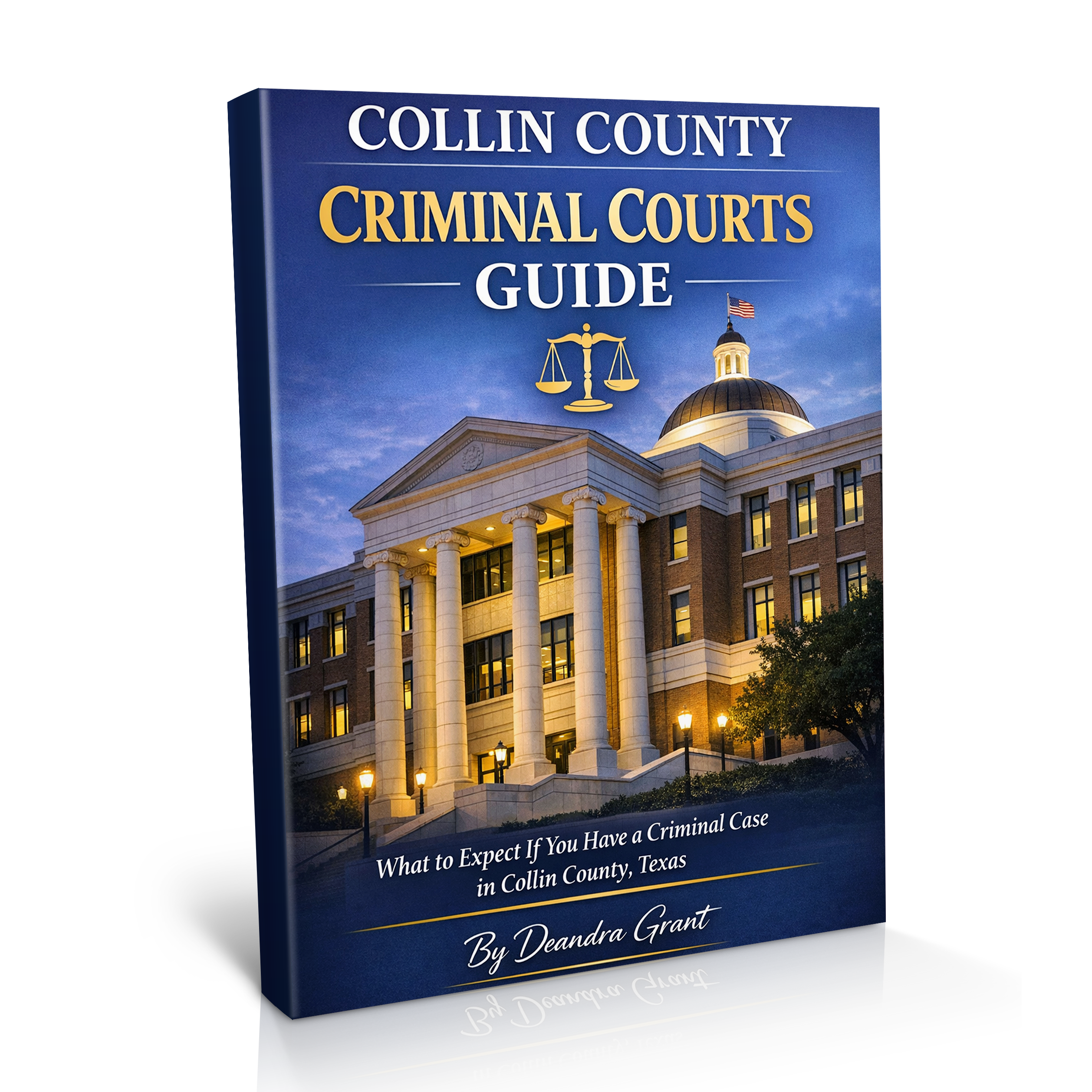
Collin County Criminal Courts Guide
By Attorney Deandra Grant
If you’re facing a criminal charge in Collin County, understanding how the local courts work can make the process far less confusing. This guide explains where cases are heard, what each court handles, and what you can expect as your case moves through the system.
Read NowMcKinney Assault Defense Lawyers
Assault charges in Collin County range from a Class C misdemeanor to a first-degree felony carrying life in prison, depending on the conduct alleged, the extent of any injury, whether a deadly weapon was involved, and the identity of the alleged victim. Misdemeanor assault cases are heard in the Collin County Courts at Law. Felony assault and aggravated assault cases are prosecuted by the Collin County District Attorney’s Office and heard in the District Courts at the Collin County Courthouse, 2100 Bloomdale Road, McKinney, TX 75071.
Deandra Grant Law has defended assault and aggravated assault charges in Collin County for more than 30 years. More than 500 cases have been tried to verdict. Every assault case begins with a rigorous examination of the evidence, the credibility of the complaining witness, and whether the stop, search, or arrest was constitutionally sound.
Assault and Aggravated Assault Under Texas Law
Assault — Texas Penal Code §22.01
Texas law defines two misdemeanor categories of assault and a felony enhancement tier:
Assault by contact (§22.01(a)(3)): Intentionally or knowingly causing physical contact with another that the person knows or reasonably should know the other will regard as offensive or provocative. Class C misdemeanor — fine only, up to $500.
Assault by threat or causing bodily injury (§22.01(a)(1) and (a)(2)): Intentionally, knowingly, or recklessly causing bodily injury to another, or intentionally or knowingly threatening another with imminent bodily injury. Class A misdemeanor — up to 1 year in county jail, fine up to $4,000.
Assault under §22.01(a)(1) is elevated to a third-degree felony (2–10 years, fine up to $10,000) when the offense is committed against a public servant, security officer, emergency services personnel, or certain other protected classes, or when the defendant has a prior family violence assault conviction.
Aggravated Assault — Texas Penal Code §22.02
A person commits aggravated assault if they commit assault and additionally cause serious bodily injury to another, or use or exhibit a deadly weapon during the commission of the assault.
Second-degree felony: 2 to 20 years in TDCJ, fine up to $10,000. This is the base penalty for aggravated assault.
First-degree felony: 5 to 99 years or life in TDCJ, fine up to $10,000. Applies when the aggravated assault is committed against a public servant, a witness or informant, a household or family member using a deadly weapon, or when committed from a motor vehicle.
McKinney Criminal & DWI Defense
Criminal Defense Assault Boating While Intoxicated Cocaine Defense Drug Crimes DUID DWI Felony DWI Gun Crimes Intoxication Assault Murder Defense Theft Defense Warrants
Related Videos
Defense Strategies in Collin County Assault Cases
Self-defense and defense of others. Texas Penal Code §9.31 and §9.33 permit the use of force when a person reasonably believes it is immediately necessary to protect themselves or a third party against the other’s use or attempted use of unlawful force. Texas is a Stand Your Ground state which means there is no duty to retreat before using force in a place where a person has a right to be. Self-defense requires careful development of the factual record from the outset, including witness accounts, surveillance footage, and the sequence of events leading to the confrontation.
Credibility of the complaining witness. Many Collin County assault charges arise from disputes between people who know each other. The complaining witness’s motive, prior statements, criminal history, and consistency across multiple accounts are all subject to examination.
No bodily injury. For a Class A misdemeanor assault charge, the prosecution must prove bodily injury actually occurred. Where the alleged victim reported no injury at the scene, where medical records do not support the injury claimed, or where physical evidence is inconsistent with the account, the bodily injury element is subject to challenge.
Deadly weapon determination. In aggravated assault cases, the deadly weapon finding is what elevates the charge to a second- or first-degree felony. Under Texas Penal Code §1.07(a)(17), a deadly weapon includes anything that in the manner of its use or intended use is capable of causing death or serious bodily injury. Whether a specific object qualifies as a deadly weapon in the manner it was used is a factual issue the defense can contest.
Digital and surveillance evidence. Collin County assault cases frequently involve surveillance footage from bars, parking lots, and businesses, as well as cell phone video and social media records. Douglas Huff’s digital forensics training covers authentication, chain of custody, and technical evaluation of this evidence at the data level.
Article 38.23. Texas’s exclusionary rule carries no good faith exception. Where an assault arrest arose from an unlawful stop, search, or seizure, suppression of that evidence is examined before any other defense strategy is built.
Related Blogs

When the Video Might Be a Lie: How Texas Defense Lawyers Are Fighting Deepfake-Era Evidence
For decades, a grainy surveillance clip or a damning social-media video was close to game-over [...]

What Counts as ‘Reasonable Suspicion’? A Plain-English Guide to the Supreme Court’s Latest Fourth Amendment Ruling
On April 20, 2026, the United States Supreme Court issued its decision in District of [...]

Bite Marks, Hair Analysis, and the Science Courts Are Still Admitting
In 2016, the President’s Council of Advisors on Science and Technology (PCAST) published a detailed [...]

Cold Cases and the Fourth Amendment: What Genetic Genealogy Means for Defendants
Florida Attorney General James Uthmeier announced this week a $600,000 partnership with Othram (a Texas-based [...]
When Drug Distribution Becomes a Homicide Case: Lessons from the Matthew Perry Sentencing
On April 8, 2026, U.S. District Judge Sherilyn Peace Garnett sentenced Jasveen Sangha (the Los [...]

Criminal Justice Reform in 2026: What It Means for Texas Defendants
National headlines about criminal justice reform in 2026 tell a story of accelerating bipartisan progress [...]

How Do Police Track Your Online Activity And Can That Evidence Be Challenged?
Law enforcement agencies have increasingly sophisticated tools for monitoring and documenting internet activity. They can [...]

What to Do if You’re Falsely Accused of Sexual Assault in Texas
Few things are more terrifying than being accused of something you did not do and [...]
30+ Years of Criminal Defense Experience
Deandra Grant Law has been defending clients against criminal charges since 1994. For McKinney residents, our Allen office provides convenient, local access to this level of defense.
Why Deandra Grant Law for McKinney Assault Defense
- Office in Allen. 30+ years in Collin County courts. 500+ trials to verdict. Assault and aggravated assault cases tried to verdict, not just negotiated.
- Digital forensics training — Douglas Huff. Surveillance footage, cell phone video, and digital evidence evaluated at the technical level.
- Article 38.23 — no good faith exception. Every assault case begins with the lawfulness of the stop, search, or seizure that produced the evidence.
- Federal defense capability. James Lee Bright handles federal assault and violent crime charges in the Eastern District of Texas.
- 17 published law books. Including Assault Charges in Texas
- Texas Super Lawyer since 2011. AV® Preeminent rated by Martindale-Hubbell®.
If you are facing assault or aggravated assault charges in Collin County, call (214) 225-7117 for a free, confidential consultation. Or schedule online at texasdwisite.com.
Client Reviews

“Deandra Grant Law – Criminal & DWI Defense handled my case with diligence and professionalism. Deandra Grant’s reputation is stellar and now I know why. She has a team of individuals who provide quality service.”