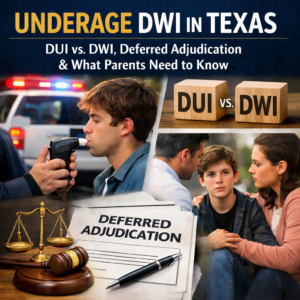
When a minor is stopped for alcohol and driving in Texas, two separate statutes may apply and which one applies determines the offense level, the available penalties, and whether deferred adjudication is even on the table. Most coverage of this topic treats them as the same charge. They are not and confusing them can lead families to make decisions based on incorrect information about what options exist.
Texas DUI vs. Texas DWI: Two Different Charges
DUI: Texas Alcoholic Beverage Code §106.041
Texas Alcoholic Beverage Code §106.041 creates a separate offense for minors: Driving Under the Influence of Alcohol by a Minor. The standard is any detectable amount of alcohol so it’s not 0.08%, not impairment, but any measurable trace. A minor does not have to be intoxicated or impaired in the legal sense to be charged under this statute. A single drink from hours earlier that produces a 0.02% reading on a breath test is sufficient.
A first-offense DUI under §106.041 is a Class C misdemeanor which is the same classification as a traffic ticket. It carries a fine up to $500, mandatory alcohol awareness classes, 20 to 40 hours of community service, and a 60-day license suspension. A second offense escalates to a fine up to $500, 40 to 60 hours of community service, and a 120-day suspension. A third or subsequent offense is a Class B misdemeanor.
Deferred adjudication is available for Class C misdemeanor DUI. Because §106.041 is a Class C offense on a first charge, it falls within the category of offenses for which deferred adjudication can be granted. A minor who successfully completes deferred adjudication and follows all conditions may be eligible to seek non-disclosure of the record after a waiting period, depending on the specific facts and the court.
DWI: Texas Penal Code §49.04
Texas Penal Code §49.04 defines the offense of Driving While Intoxicated and it applies to minors the same way it applies to adults. A minor can be charged with DWI (not DUI) when their BAC is 0.08% or higher, or when alcohol or drugs have impaired their normal use of mental or physical faculties regardless of BAC level. A first-offense DWI is a Class B misdemeanor, not a Class C.
How the Charge Is Determined: The Science of “Any Detectable Amount”
The “any detectable amount” standard of §106.041 creates an evidentiary question that most people don’t consider: what does it mean for a test to detect alcohol, and how reliable is that detection at very low concentrations?
Breath testing instruments like the Intoxilyzer 9000 are calibrated for evidential use across a range that includes very low BAC readings, but the margin of error becomes more significant as the measured value approaches zero. A reading of 0.02% (well above the detection threshold but far below the 0.08% standard) carries a coefficient of variation that may be larger, in relative terms, than at higher concentrations. The question of whether a reading near the lower boundary of detection is reliable is a legitimate forensic challenge.
Additionally, the partition ratio assumption built into breath testing (the 2100:1 blood-to-breath conversion factor) applies to the §106.041 context as well. Individual variation in partition ratio (which ranges from approximately 1,100:1 to 3,400:1 across the population) affects the accuracy of the breath-to-blood conversion at any concentration, including very low readings. A reading that would establish “any detectable amount” on one assumption may not hold up on another.
For blood tests in DUI and DWI cases involving minors, the same GC-FID methodology and chain of custody requirements that apply to adult DWI cases apply here. A blood draw must be performed by qualified personnel, the sample must be properly preserved and stored, and the laboratory analysis must follow validated protocols.
Field Sobriety Tests and Minors
The Standardized Field Sobriety Tests (the Horizontal Gaze Nystagmus, Walk-and-Turn, and One-Leg Stand) were developed and validated on adult subjects. The NHTSA validation studies that established the correlation between SFST performance and BAC did not include subjects under 21. The application of adult-validated scoring criteria to a 17-year-old or 18-year-old subject introduces a methodological gap that the defense can exploit.
Additionally, SFSTs are administered under conditions that affect performance regardless of intoxication: poor lighting, uneven pavement, anxiety, unfamiliarity with the instructions, and the physical characteristics of the subject all influence results. A teenager, likely experiencing their first encounter with law enforcement in a high-stakes setting, may perform differently than an adult even in the complete absence of alcohol. The SFST cross-examination in a minor’s case should address both the general limitations of the tests and the specific conditions under which they were administered.
ALR Consequences for Minors
The Administrative License Revocation process applies to minors who fail or refuse a breath or blood test. The consequences differ from adult ALR:
Failure: A minor who provides a specimen above 0.00% for a DUI stop (or above 0.08% for a DWI stop) faces a 60-day license suspension for a first offense under the DUI statute, or the standard adult suspension periods for a DWI charge.
Refusal: A minor who refuses testing faces a 180-day suspension for a first refusal under the DUI statute. For a DWI charge, adult refusal suspension periods apply.
The 15-day deadline applies. A minor who receives notice of suspension has 15 days from the date of service of that notice to request an ALR hearing. Missing this deadline results in automatic suspension. This is one of the most time-sensitive steps in any DWI or DUI case involving a minor, and it must be addressed immediately.
Deferred Adjudication: When It’s Available and What It Requires
To summarize the deferred adjudication landscape clearly:
Class C DUI (§106.041, first offense): Deferred adjudication is available. The minor enters a plea of guilty or no contest, the judge defers a finding of guilt, and the minor is placed on probation with conditions. Typical conditions include an alcohol awareness class, community service, no alcohol consumption, and regular reporting. If the minor completes all conditions without violation, the case is dismissed without a conviction.
Class B DWI (§49.04): Deferred adjudication is available under certain circumstances. A minor charged with DWI under the Penal Code faces the same plea and trial options as an adult. This makes the decision to fight the charge versus accept a negotiated disposition more consequential.
Even where deferred adjudication is obtained for a Class C DUI, the record of the arrest and the deferred adjudication proceeding does not automatically disappear. Texas law allows eligible individuals to petition for an Order of Non-Disclosure, which seals the record from most public access. Non-disclosure has waiting periods, eligibility requirements, and is not automatic. It requires a separate legal proceeding after the deferred adjudication is successfully completed.
What Parents and Families Should Do
The most important early steps when a minor is charged with DUI or DWI in Texas:
Request an ALR hearing within 15 days of notice of suspension. This is non-negotiable and time-critical. The ALR hearing also provides an opportunity to cross-examine the arresting officer under oath before the criminal case proceeds which is a significant strategic benefit.
Determine which statute governs the charge. The difference between a Class C DUI and a Class B DWI determines what options are available. That determination should be made at the outset, not after a disposition is negotiated.
Evaluate the evidence before any plea decision. The breath or blood test result, the field sobriety test administration, the legality of the initial stop, and the chain of custody for any specimens collected are all subject to challenge. A plea should not be entered until the evidence has been independently evaluated.
Understand the long-term record implications. A conviction (even for a Class C misdemeanor) on a minor’s record can affect college applications, professional licensing, and future employment. The difference between a conviction, a deferred adjudication, and a dismissal has lasting consequences that extend well beyond the court date.
Deandra Grant Law defends minors and their families against DUI and DWI charges across North and Central Texas. Managing Partner Deandra Grant is a trained SFST instructor who administers and grades the ACS-CHAL and DUIDLA Board Certification exams. She holds the ACS-CHAL Forensic Lawyer-Scientist designation, a Master’s Degree in Pharmaceutical Science and Graduate Certificate in Forensic Toxicology. If your child is facing a DUI or DWI charge in Texas, call (214) 225-7117 for a confidential consultation.