
At a February 2026 hearing, Luigi Mangione stood up in a Manhattan courtroom and told the judge: “It’s the same trial twice. One plus one is two. Double jeopardy by any commonsense definition.”
He is legally wrong. But he is not wrong that being tried twice for the same conduct is a serious burden. It’s one that the Constitution permits and that the legal system routinely imposes on defendants who happen to cross both state and federal jurisdictional lines. The scheduling chaos now surrounding his case illustrates exactly why.
Mangione is accused of fatally shooting UnitedHealthcare CEO Brian Thompson in Midtown Manhattan on December 4, 2024. He faces charges in both New York state court (second-degree murder) and federal court (stalking charges carrying a potential life sentence). As of early April 2026, his state trial is set for September 8, 2026. His federal trial (which has been rescheduled three times in two days) is now set to begin jury selection January 5, 2027. Both courthouses are two blocks apart in lower Manhattan.
The Mangione case is a high-profile illustration of a doctrine most defendants encounter in a far less publicized context. Understanding how it works (and why courts have consistently upheld it) matters for any defendant whose conduct touches both state and federal law.
What Double Jeopardy Actually Prohibits
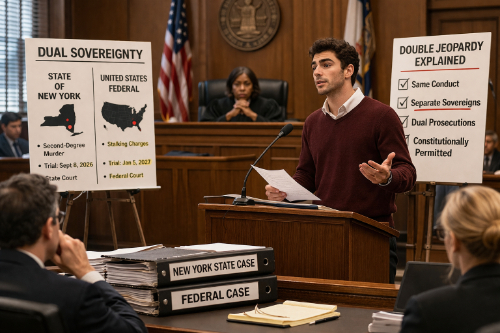 The Fifth Amendment provides that no person shall “be subject for the same offence to be twice put in jeopardy of life or limb.” Blockburger v. United States, 284 U.S. 299 (1932), established the test for what counts as the “same offence”: two charges are the same offense if each does not require proof of a fact that the other does not. Under this framework, prosecuting the same conduct under a state statute and a federal statute will almost always satisfy the Blockburger test because the two statutes, even if they address the same underlying act, typically have different elements.
But the more fundamental answer to Mangione’s “commonsense” double jeopardy argument is the dual sovereignty doctrine, which operates entirely separately from the Blockburger same-elements test.
The Dual Sovereignty Doctrine
The dual sovereignty doctrine holds that because state and federal governments are separate sovereigns (each deriving their authority from a different source) prosecution by one does not bar prosecution by the other for the same underlying conduct. The Supreme Court reaffirmed this principle in Gamble v. United States, 587 U.S. 678 (2019), which was decided by an 7-2 majority. The Court held that an offense defined by one sovereign is not the same offense as that defined by another, even if both arise from the identical act.
The logic runs as follows: a state and the federal government each have an independent interest in vindicating their own laws. When a defendant’s conduct violates both a Texas statute and a federal statute, the argument goes, each sovereign has suffered its own distinct harm and is entitled to seek its own remedy. Gamble rejected the argument (forcefully advocated by Justice Ginsburg in dissent and by Justice Gorsuch in a separate dissent) that this doctrine is a historical accident that has outlived its justification.
The doctrine has no practical exception that defendants can rely on in most federal courts. The Department of Justice does maintain a policy, the Petite Policy, under which federal prosecutors are instructed not to bring federal charges based on substantially the same act or transaction for which a defendant has already been prosecuted in state court, absent a compelling federal interest. But the Petite Policy is an internal DOJ guideline, not a constitutional right. It cannot be enforced by a defendant in court, and the government can decline to apply it whenever it determines a federal interest is substantial enough to warrant prosecution regardless.
How the Mangione Case Illustrates the Burden
The scheduling chaos in the Mangione case is not incidental to the dual sovereignty issue. Rather, it is the dual sovereignty issue made visible.
His defense team filed a three-page motion in March 2026 arguing that the then-current schedule (state trial June 8, federal trial September 8) was “not possible” to accommodate and violated his due process rights. The argument: preparing for two simultaneous serious felony trials is constitutionally different from preparing for one. Counsel cannot depose the same witnesses for two cases simultaneously, review hundreds of federal jury questionnaires while trying a state murder case or provide constitutionally adequate representation in both proceedings at the same time. “As a result of these competing schedules,” the defense wrote, “Mr. Mangione is now in the position of needing to prepare for two complicated and serious trials at the same time. This scenario violates several of Mr. Mangione’s constitutional rights.”
What followed was a scheduling sequence that illustrates the problem in real time. On April 1, 2026:
- U.S. District Judge Margaret Garnett initially declined to move the federal trial to 2027, instead pushing jury selection four weeks to October 5 and opening statements to October 26 or November 2. She said she was “skeptical of moving the trial wholesale into 2027” and did not want to be “held hostage” by the state prosecution.
- Later that same day, the state judge (with no stated reason) moved the state trial from June 8 to September 8, the same date as the newly scheduled federal jury selection.
- The next day, April 2, Judge Garnett moved the federal trial to January 2027 anyway, with jury selection January 5 and opening statements January 25.
The judge acknowledged the reality: “Whether we like it or not, we are somewhat at the mercy of events in the state case. There’s really no way around taking into account the events in the state case involving the same defendant.”
This is the dual sovereignty doctrine in practice. Two courts, two prosecutors, one defendant, no coordination obligation, and a scheduling problem that neither court alone controls.
An Additional Complication: Sequencing and Double Jeopardy Risk
The Mangione case has a wrinkle that most dual prosecution cases do not: the state prosecutors have argued that their interests could be prejudiced by double jeopardy concerns depending on how the federal case plays out first. If certain issues are fully litigated to a final judgment in the federal case, a subsequent state prosecution could face collateral estoppel arguments (the doctrine that facts necessarily determined in a prior proceeding cannot be relitigated).
This is why both the state and federal prosecutors, and both courts, have implicitly accepted that the state trial should go first. Running the federal trial first could complicate the state murder prosecution. The sequencing itself is a product of dual sovereignty. Two courts are trying to coordinate something the Constitution does not require them to coordinate.
A Note on What Mangione’s Case Is Actually Charged as Federally
One detail worth understanding: the federal charge Mangione faces is not murder. In January 2026, Judge Garnett dismissed the federal murder charge (murder through use of a firearm) finding it legally flawed as predicated on the stalking counts. A gun charge was also dismissed. What remains are stalking charges under 18 U.S.C. §2261A, which carry a maximum of life in prison when the conduct results in death.
The federal stalking charge and the state second-degree murder charge describe the same underlying act through different statutory frameworks. Under dual sovereignty, that is constitutionally permissible. Under Mangione’s commonsense definition, it is not. Courts have consistently sided with the constitutional framework, not the commonsense one.
How This Plays Out in Texas: The Northern District of Texas
Parallel state and federal prosecution is not a New York phenomenon. It is a routine feature of criminal practice in North Texas, and it arises in several recurring contexts:
Drug cases. A drug offense that occurs within 1,000 feet of a school can be charged under Texas Health and Safety Code §481.134 in state court. The same conduct (if it involved a sufficient quantity, interstate commerce, or a DEA investigation) can also be charged federally under 21 U.S.C. §841. Federal sentences under the drug guidelines are frequently far longer than what Texas state law produces for the same weight and conduct.
Firearms offenses. A felon in possession of a firearm can be charged under Texas Penal Code §46.04 (state jail felony to third-degree felony) and simultaneously under 18 U.S.C. §922(g) (federal offense carrying up to 10 years under the statute, and significantly more under the guidelines when combined with certain criminal histories or drug conduct).
Assault and family violence. Serious assaults, particularly those crossing state lines or occurring on federal property, can be charged in both venues. A family violence offense that also constitutes interstate domestic violence under 18 U.S.C. §2261 is a common dual-prosecution scenario.
Fraud and financial crimes. State-level fraud under Texas Penal Code Chapter 32 and federal wire fraud, mail fraud, or bank fraud under Title 18 are frequently charged in parallel when a single financial scheme touches both intrastate conduct and interstate electronic communications or banking.
White-collar and corporate cases. Plano and the Dallas-Fort Worth corridor’s concentration of corporate headquarters makes parallel SEC enforcement, DOJ prosecution, and state-level fraud charges a recurring combination in this district. Federal investigators frequently lead, and the Petite Policy’s application is negotiated through defense counsel before state charges are filed.
What Defendants Facing Parallel Prosecution Should Know
If you are facing charges that could give rise to both state and federal prosecution, several things follow from the dual sovereignty doctrine:
- A state acquittal does not bar federal prosecution. If you are acquitted in state court, the federal government may still prosecute you for the same underlying conduct under a different statute. The reverse is equally true. There is no constitutional protection against this, and the Petite Policy is not enforceable by the defendant.
- A state guilty plea does not end the federal exposure. Pleading guilty to a state charge with an agreement from the state prosecutor does not bind the federal government. A defendant who resolves state charges through a plea and then faces a federal indictment for the same conduct has no double jeopardy defense unless the same sovereign is prosecuting twice. Defense counsel in parallel prosecution cases must be aware of and manage federal exposure throughout the state proceeding.
- The sequencing of cases is strategically significant. Which case goes first affects the evidentiary record, the witnesses’ testimony, and what facts are established by the time the second case begins. Defense strategy in parallel prosecution cases involves managing that sequence, which requires coordination between defense counsel in both courts if the same attorney is not handling both.
- The burdens are compounding. Preparing for two serious felony trials simultaneously is constitutionally permissible but practically devastating. As Mangione’s defense team argued (and as Judge Garnett ultimately acknowledged) the scheduling problem is real even when the legal framework permits the dual prosecution. Defendants facing parallel prosecution should have counsel in place in both courts as early as possible.
If you are facing federal criminal charges in the Northern District of Texas, or if you are concerned about federal exposure arising from a state case, contact Deandra Grant Law for a free, confidential consultation. Of Counsel James Lee Bright handles federal criminal defense in all four Texas federal districts. Call (214) 225-7117 or schedule online at texasdwisite.com.