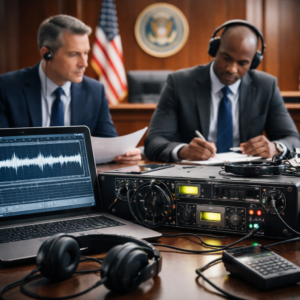
Federal money laundering investigations are complex, long-running operations that are often well underway before the target has any idea they are being investigated. The government uses financial surveillance tools, bank reporting requirements, and cooperating witnesses to build cases over months or years. By the time you learn you are under investigation, through a target letter, a subpoena, an interview request from federal agents, or the arrest of a business associate, the government may already have assembled significant evidence.
At Deandra Grant Law, Attorney James Lee Bright has more than 25 years of experience defending clients in complex federal financial crime cases. This article explains how federal money laundering investigations work, what you should and should not do if you learn you are a target, and how an experienced federal defense attorney can protect your rights.
What Is Federal Money Laundering?

Federal money laundering is prosecuted under two primary statutes:
- 18 U.S.C. §1956 — Laundering of Monetary Instruments. Criminalizes conducting financial transactions with proceeds of specified unlawful activity (SUA) with the intent to promote the SUA, conceal the nature or source of the proceeds, or avoid reporting requirements. Maximum penalty: 20 years per count.
- 18 U.S.C. §1957 — Engaging in Monetary Transactions in Property Derived from SUA. Criminalizes knowingly engaging in a monetary transaction exceeding $10,000 with criminally derived property. Does not require proof of intent to launder. Maximum penalty: 10 years per count.
The government also frequently charges 31 U.S.C. §5324 — Structuring, which criminalizes breaking up transactions to avoid the $10,000 Currency Transaction Report (CTR) threshold. Structuring carries a maximum of 5 years and does not require proof that the underlying funds were derived from criminal activity — only that the transactions were structured to evade reporting.
How Federal Money Laundering Investigations Work
Bank Secrecy Act Reporting
Financial institutions are required to file Currency Transaction Reports (CTRs) for cash transactions exceeding $10,000 and Suspicious Activity Reports (SARs) when they identify transactions that appear unusual, lack a business purpose, or involve patterns consistent with money laundering. These reports are filed with the Financial Crimes Enforcement Network (FinCEN) and are the starting point for many federal investigations.
Financial Pattern Analysis
Federal investigators analyze banking records, wire transfer patterns, real estate transactions, business formation records, and tax filings to identify patterns consistent with money laundering: rapid movement of funds through multiple accounts, transactions just below reporting thresholds, use of shell companies or nominee accounts, and unexplained wealth relative to reported income.
Cooperating Witnesses
Co-defendants in the underlying criminal activity (ex. drug trafficking, fraud, tax evasion) may cooperate with the government and provide testimony about how proceeds were laundered. Their testimony is often the link between the financial transactions and the underlying criminal activity.
Grand Jury Subpoenas and Search Warrants
The government uses grand jury subpoenas to obtain financial records from banks, businesses, accountants, and attorneys. Search warrants may be executed on residences and businesses to seize physical records, computers, and other evidence.
What to Do if You Learn You’re Under Investigation
- Contact a federal criminal defense attorney immediately. Do not wait for charges to be filed. Lee Bright’s 25+ years of federal experience include handling pre-indictment investigations where early intervention can shape the outcome.
- Do not speak to federal agents without an attorney present. Anything you say can and will be used against you. Even innocent explanations can be twisted into evidence of consciousness of guilt.
- Do not destroy, alter, or conceal any documents or records. Obstruction of justice and destruction of evidence are separate federal crimes that carry their own penalties and dramatically increase sentencing exposure.
- Do not discuss the investigation with anyone other than your attorney. Conversations with friends, family, or business associates are not privileged and can be compelled through subpoena or used by cooperating witnesses.
- Preserve all financial records, communications, and documents. These may be essential to your defense.
Defending Against Federal Money Laundering Charges
Lee challenges federal money laundering cases by examining:
- The specified unlawful activity (SUA). Money laundering requires proof that the funds were derived from a specified unlawful activity. If the government cannot prove the SUA, the laundering charges fail.
- Knowledge and intent. The government must prove that the defendant knew the funds were derived from criminal activity and acted with the required intent. Legitimate business transactions, even if later characterized as laundering, are not criminal without proof of knowledge and intent.
- Financial forensic analysis. Lee works with forensic accountants to independently trace funds, challenge the government’s financial analysis, and identify legitimate explanations for transaction patterns.
- Structuring defenses. In structuring cases, the government must prove that the defendant knew about the reporting requirements and intentionally structured transactions to evade them. Many people break up cash transactions for legitimate reasons without any knowledge of CTR thresholds.
Penalties and Sentencing
- 1956 carries a maximum of 20 years per count and fines up to $500,000 or twice the amount of the transaction. §1957 carries a maximum of 10 years per count. Sentencing under the Guidelines is driven by the amount of laundered funds.
Contact Deandra Grant Law
If you are under investigation or have been charged with a federal offense, contact Deandra Grant Law for a free, confidential consultation with Attorney James Lee Bright. Lee has more than 25 years of federal trial experience and is admitted to practice in all four federal districts in Texas, the District of Columbia, the Fifth Circuit Court of Appeals, and the United States Supreme Court.
Call us at (214) 225-7117 or schedule a free consultation at texasdwisite.com/schedule-consultation/. Se habla español: (972) 347-8833.
The defense is ready.
Firm Accolades

Better Business Bureaus

D Magazine