When you are under investigation for murder in Texas, the grand jury proceeding is often one of the first critical battleground and it is one that most people facing charges do not understand until it is too late to use it effectively.
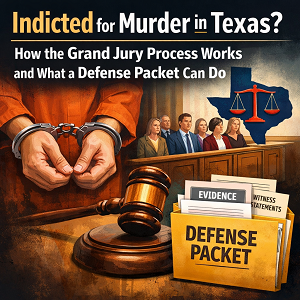
A grand jury decides whether the prosecution has probable cause to formally charge you. If it returns an indictment, the case proceeds court. If it returns a no-bill, the case does not proceed further (unless it is presented to another grand jury). The window between arrest and grand jury presentment is brief, and the most important thing a defense attorney can do during that window is prepare and submit a defense packet that gives the grand jury a reason to look harder at the prosecution’s evidence before voting.
This piece explains how the grand jury process works in Texas, what a defense packet is and what it can accomplish, and why the timing of your attorney’s involvement is critical.
How the Texas Grand Jury Works
Grand jury proceedings in Texas are governed by the Texas Code of Criminal Procedure, Chapter 20. A grand jury is a body of 12 citizens selected from the community whose function is not to determine guilt or innocence (that is the trial jury’s job) but to decide whether the evidence presented by the prosecution establishes probable cause to formally charge the defendant with a crime.
The probable cause standard is significantly lower than the beyond-a-reasonable-doubt standard required for conviction at trial. The grand jury is not deciding whether you are guilty. It is deciding whether there is enough evidence to require you to answer a formal charge.
Selection. Grand jurors are selected from a pool of eligible citizens in the county where the alleged offense occurred. Once seated, they serve for a fixed term and hear multiple cases during that period.
Presentation. The prosecutor presents the state’s evidence to the grand jury. This typically includes witness testimony, police reports, physical evidence summaries, and forensic findings. Grand jury proceedings are secret which means they are not open to the public or the defendant, and the records are sealed.
The defendant’s position. The defendant has no right to appear before the grand jury, no right to cross-examine witnesses, and no right to hear what evidence is presented. The grand jury hears only what the prosecution chooses to present unless the defense takes proactive steps.
The vote. After deliberation, the grand jury votes. In Texas, at least 9 of the 12 jurors must vote in favor of indictment for the case to proceed. If 9 or more vote to indict, a “true bill” is returned and formal charges are filed. If fewer than 9 vote to indict, a “no-bill” is returned and the charges are not filed, and the case is effectively dismissed, at least at that stage.
What a Defense Packet Is and What It Can Do
Because the defendant has no right to appear before the grand jury, the defense packet is the primary tool available to defense counsel during this stage. A defense packet is a written submission prepared by the defense attorney and submitted to the prosecutor before the grand jury presentment that provides the grand jury with information and evidence the prosecution may not present on its own.
The prosecutor is ethically required to present exculpatory evidence to the grand jury, but that obligation is imperfectly enforced and narrowly interpreted in practice. A defense packet ensures that the grand jury has the full picture, not just the prosecution’s version of events.
A well-prepared defense packet may include:
Alibi evidence. Documentation, witness statements, phone records, GPS data, or surveillance footage that places the defendant somewhere other than the scene at the relevant time. If the evidence supporting the alibi is strong, the grand jury may conclude that the prosecution cannot establish probable cause that the defendant committed the act.
Challenges to the prosecution’s physical or forensic evidence. If the forensic evidence has weaknesses (ex. contamination, chain of custody issues, or an alternative interpretation of the findings) the defense packet can identify those weaknesses and present them in a way the grand jury can evaluate.
Witness credibility issues. If the prosecution’s key witnesses have prior inconsistent statements, credibility problems, or motives to fabricate, documentation of those issues can cause the grand jury to question whether the evidence is as strong as the prosecution represents.
Self-defense evidence. If the evidence supports a self-defense or defense-of-others claim, the defense packet can present that narrative with supporting facts, creating a basis for the grand jury to question whether the conduct was criminally culpable at all.
Mitigating circumstances that bear on the degree of the charge. Even when an indictment is likely, the defense packet can influence what the grand jury charges. If the evidence supports manslaughter rather than murder because the act was committed in the heat of passion or under sudden provocation rather than with premeditation, presenting that distinction to the grand jury may result in a lesser charge, which has significant implications for everything that follows, including bail, trial strategy, and sentencing exposure.
What a Defense Packet Cannot Do
It is important to be precise about the limits of this tool. A defense attorney does not appear before the grand jury and does not argue to its members directly. The packet is submitted to the prosecutor, who then decides whether and how to present it to the grand jury. Some prosecutors will present the packet materials as part of their presentation; others will not. Some jurisdictions have more established practices around defense packet consideration than others.
The defense packet is not a guaranteed outcome. It is a legitimate and often effective advocacy tool within the constraints of a proceeding that structurally favors the prosecution. Its value depends on the strength of the materials included, the quality of the legal argument presented, and the specific grand jury and prosecutor involved.
Murder vs. Capital Murder in Texas: Why the Charge Level Matters
Not all murder charges in Texas are the same, and the grand jury’s charge determination has significant downstream consequences.
Murder under Penal Code §19.02 is a first-degree felony, carrying 5 to 99 years or life in prison. It applies when a person intentionally or knowingly causes the death of another, or intends to cause serious bodily injury and commits an act clearly dangerous to human life that causes death.
Capital murder under Penal Code §19.03 carries either life without parole or, when the state seeks it, the death penalty. Capital murder requires murder plus an additional aggravating factor, such as killing a peace officer, killing during the commission of another felony (robbery, kidnapping, sexual assault), killing for remuneration, killing more than one person, or killing a child under 10 years of age.
Manslaughter under Penal Code §19.04 is a second-degree felony, carrying 2 to 20 years. It applies when a person recklessly causes the death of another which is a lower culpable mental state than the intentional or knowing standard required for murder.
Criminally negligent homicide under Penal Code §19.05 is a state jail felony. It applies when a person causes death through criminal negligence which is a failure to perceive a substantial and unjustifiable risk.
The defense packet can be a vehicle for arguing that the evidence supports a lesser offense level. A grand jury that is presented with a coherent, evidence-based argument that the conduct was reckless rather than intentional may return a manslaughter indictment rather than a murder indictment which means a difference of many years in sentencing exposure and a significant change in the legal and strategic posture of the case.
Why Timing Is Everything
The grand jury proceeding is scheduled based on the prosecution’s timeline, not the defense’s. In many Texas counties, murder cases are presented to a grand jury within weeks of arrest. Once the grand jury votes and a true bill is returned, the formal indictment is filed and the window for influencing the charge level through a defense packet has closed.
This means that the first conversation with a defense attorney after an arrest or investigation notification is not too early to begin discussing grand jury strategy. In serious felony cases, particularly murder, the most valuable work defense counsel can do may happen before the grand jury votes, not after.
Speak With Deandra Grant Law
Murder and serious felony charges require defense counsel with the experience, the forensic knowledge, and the courtroom record to handle them effectively from the first moment. Douglas Huff serves as Lead Counsel on all murder cases at Deandra Grant Law. He has the qualifications that are directly relevant to evaluating the forensic and physical evidence that drives serious felony prosecutions.
If you or someone you care about is under investigation or has been arrested for murder in Texas, do not wait. Call (214) 225-7117 or visit texasdwisite.com to schedule a confidential consultation.