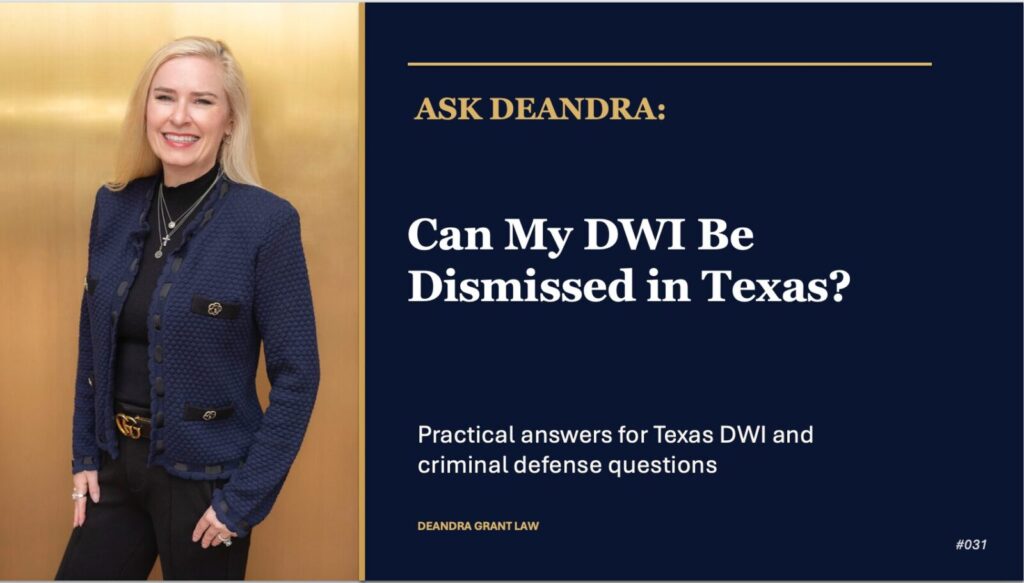
The question: Can my DWI be dismissed in Texas?
The short answer: Yes, but not in most cases and not without specific grounds. Most Texas DWI cases do not end in dismissal. They end in plea bargains, deferred adjudication where available, trials, or reductions to lesser or different offenses. But real dismissals do happen, and the categories of cases that produce them are identifiable. Dismissals generally come from one of five sources: a motion to suppress that defeats the State’s essential evidence, a fatal evidentiary problem the State cannot fix, witness unavailability, an ALR hearing victory that exposes a defective stop or arrest, or prosecutorial discretion in cases where the State concludes it cannot prove the case beyond a reasonable doubt. None of these is automatic. Each requires defense work to develop. “Will my DWI get dismissed” is the wrong question to ask. “What would have to be true for my DWI to be dismissable, and how do I get to that finding” is the right one.
Here is the longer answer: the five categories of DWI dismissals in Texas, what each requires, and how a real defense works to make dismissal possible.
Source One: A Successful Motion to Suppress
This is the most common path to a Texas DWI dismissal. A motion to suppress asks the court to exclude evidence obtained in violation of the Fourth, Fifth, or Sixth Amendment to the United States Constitution, or in violation of Article I, §9 of the Texas Constitution, or in violation of statutory requirements. When the court grants a motion to suppress on evidence the State needs to prove its case, the prosecution typically becomes impossible and a dismissal follows UNLESS the State opts to appeal the judge’s decision.
The most common suppression targets in DWI cases:
- The stop itself. Under the Fourth Amendment, an officer needs reasonable suspicion of a traffic violation or other criminal activity to make a traffic stop. If the stop was made without reasonable suspicion (ex. a pretext for fishing, a mistaken identification of conduct, a violation that did not actually occur) the stop violates the Constitution. Everything that follows from the stop becomes suppressible. The officer must state articulable facts to support reasonable suspicion. Without the stop, the State has no field sobriety evidence, no breath or blood test evidence, no observations of the driver, no statements, no driving evidence beyond what the dispatcher reported. The case collapses.
- The arrest. Under the Fourth Amendment, an officer needs probable cause to arrest. Probable cause requires more than reasonable suspicion. If the officer arrested without probable cause (ex. making the arrest based on hunches, on a refusal to perform voluntary field sobriety tests, on the bare odor of alcohol, on demeanor alone) the arrest violates the Constitution. Evidence obtained after the arrest, including chemical test results, becomes suppressible.
- The chemical test warrant. In cases where the blood specimen was obtained under a warrant, the warrant and the affidavit supporting it are fully reviewable. Defective affidavits (ex. missing required facts, including stale information, relying on conclusory officer assertions without underlying facts, failing to establish the affiant’s basis of knowledge) can support a Franks v. Delaware challenge or a more general challenge to probable cause. A defective warrant suppresses the blood evidence and often the entire case.
- The chemical test methodology. Texas Transportation Code Chapter 724 and related regulations set out specific procedural requirements for breath and blood testing such as observation periods, instrument certification, operator qualifications, blood draw procedures, sample handling or chain of custody. Violations of these requirements can support suppression of the test results.
- Miranda Statements obtained in custodial interrogation without proper Miranda warnings, or after invocation of the right to counsel, can be suppressed. While Miranda violations alone rarely defeat a DWI case (because the State can usually proceed on physical evidence), they can be part of a broader suppression strategy.
Motion to suppress practice is one of the most consequential areas of DWI defense. A well-prepared motion supported by careful body-camera review, certified records, and applicable case law has produced suppression orders in cases that looked, on first glance, like routine convictions.
Source Two: Fatal Evidentiary Problems
Some DWI cases have evidentiary problems that the State cannot cure even with everything admissible. Common examples:
- Operator identity issues. In single-vehicle accident cases where the defendant was not observed driving, in cases involving multiple potential drivers in the vehicle, or in cases where the defendant is found near rather than in the vehicle, the State must still prove the defendant was actually operating the vehicle at the relevant time. Operator identity defenses have produced dismissals in cases where the State could not establish operation.
- Public place defects. Texas Penal Code §49.04 requires operation of a motor vehicle in a public place. Conduct occurring on private property that does not qualify as a “public place” may not support DWI prosecution. The defense lawyer’s investigation of the location can defeat the public place element.
- Defective chain of custody. Blood evidence requires documented chain of custody from collection through analysis. Gaps in the chain can sometimes defeat admissibility.
- Laboratory problems. Laboratory accreditation issues, validated method failures, calibration documentation gaps, and analyst qualification issues have all defeated blood evidence in Texas DWI prosecutions. The defense lawyer who reviews the full laboratory record is the lawyer who finds these problems.
Fatal evidentiary problems do not announce themselves. They emerge from careful discovery review and forensic investigation. A defense lawyer who treats the case as a routine plea misses the problems entirely.
Source Three: Witness Unavailability
Texas DWI prosecutions depend on testimony from the arresting officer and, in many cases, additional officers, technical supervisors, forensic toxicologists, and lay witnesses. When the State’s necessary witnesses become unavailable, the prosecution can collapse:
- Officer separation from service. Officers retire, resign, are terminated, or move to other agencies. Officers who are no longer affiliated with the arresting agency can be subpoenaed but are sometimes difficult to produce.
- Officer credibility issues. Officers with documented credibility problems (ex. disciplinary records, Brady disclosures, prior false-statement findings) may be effectively unavailable as witnesses for the prosecution’s purposes.
- Death or disability. Tragic but real. An officer or other necessary witness who dies or becomes disabled before trial may not be replaceable in the State’s case.
- Forensic analyst issues. Forensic toxicologists and breath instrument technical supervisors who leave their employment, retire, or otherwise become unavailable can affect the State’s ability to present the chemical evidence.
Defense lawyers monitor witness status as part of trial preparation. In some cases, the right defense move is to push the case toward trial precisely because the State’s ability to produce its witnesses becomes weaker over time.
Source Four: ALR Hearing Results That Affect the Criminal Case
The ALR hearing is technically a civil administrative proceeding separate from the criminal case. But the testimony given at the ALR hearing is on the record, under oath, and admissible in the criminal case for impeachment and substantive purposes.
ALR hearings can affect criminal case dismissals in several ways:
- Officer testimony that contradicts the police report. Officers sometimes testify at ALR hearings in ways that conflict with the offense report or that omit critical facts. The contradiction can support a motion to suppress in the criminal case.
- Officer testimony that fails to establish probable cause. If the officer cannot articulate, on the stand and under oath, the specific facts that established probable cause to arrest, the testimony itself becomes the foundation for a successful suppression motion.
- Procedural admissions. Officer admissions of procedural failures (ex. deficient observation periods, improper warnings, missing documentation) obtained at the ALR hearing can make it more difficult for the State to prove the criminal case.
- ALR hearing win. If the administrative law judge finds against DPS at the ALR hearing after hearing testimony (not because the officer fails to show up) the underlying basis of the finding (typically a stop or arrest defect) may be valuable for the defense in the criminal case.
This is one of the most important reasons to request and run the ALR hearing in every DWI case, including cases where winning the hearing seems unlikely. The hearing is free discovery, and the discovery sometimes produces the foundation for criminal-case dismissal.
Source Five: Prosecutorial Discretion
Prosecutors are not required to prosecute every case. Texas prosecutors exercise discretion to dismiss cases that, in their judgment, cannot be proven beyond a reasonable doubt. The factors that produce prosecutorial dismissals include:
- Strength of the defense. A defense lawyer who develops the forensic, procedural, and substantive defenses early (and who communicates them effectively to the prosecutor) can produce dismissals in cases where the prosecutor concludes that proceeding is not viable. Quiet, well-prepared defense advocacy outside of court is some of the most valuable defense work in any DWI practice. Note: Some prosecutors are not going to dismiss a DWI no matter what the Defense produces prior to trial so “showing your hand” to them is a bad strategic move if you intend to try the case.
- Sympathetic defendants and difficult facts. Cases involving sympathetic defendants (long clean records, exceptional contributions, particularly compelling personal circumstances) paired with difficult prosecutorial facts sometimes produce dismissals in the interest of justice. These are uncommon.
- Cooperation in unrelated cases. In rare circumstances, prosecutorial dismissals are part of cooperation arrangements in unrelated investigations. This is a specialized area requiring careful navigation.
Prosecutorial discretion is exercised case by case and prosecutor by prosecutor. A defense lawyer with established credibility in a particular prosecutor’s office has more access to discretion than one without that credibility which is part of why local courthouse experience matters.
What Dismissal Actually Looks Like
When a Texas DWI case is dismissed, the dismissal is documented in the court record. The standard categories:
- Dismissal in the interest of justice. The most common dismissal language. Indicates that the prosecutor has determined the case should not proceed.
- Dismissal after motion to suppress granted. Following a successful suppression motion that gutted the State’s case.
- Dismissal for insufficient evidence. Used in cases where the State concludes evidence is inadequate.
- Dismissal as part of plea to other charges. In multi-charge cases, the DWI may be dismissed as part of a plea to a different offense. The plea may be to a reduced or different charge such as obstruction of a highway, reckless driving, or another reduced offense.
- Dismissal for speedy trial violation. In cases where the State fails to bring the case to trial within statutory limits, dismissal may be available.
- Dismissal after pre-trial diversion. In some counties, the State may dismiss the case after successful completion of a pre-trial diversion program. Note: This is available in very few counties in Texas.
After dismissal, the defendant generally becomes eligible for expunction of the arrest record under Texas Code of Criminal Procedure Chapter 55, subject to specific waiting periods and procedural requirements. A successful expunction removes the criminal record of the arrest as though the arrest never occurred which is the most favorable possible long-term outcome of a DWI case.
What “Dismissal” Is Sometimes Confused With
Several dispositions are sometimes mistakenly described as “dismissal” but are not:
- Deferred adjudication under HB 3582. Deferred adjudication is not a dismissal. It is a disposition under which the court defers entering a finding of guilt while the defendant completes probation. Successful completion results in an entry of a No Finding of Guilt order by the court, but the case is treated as a conviction for some purposes (including, importantly, enhancement if arrested for DWI again).
- Reduction or change to a lesser or different offense. A plea to obstruction of a highway or reckless driving will result in dismissal of the DWI in some counties if the new charge is filed as a separate charge. In others the DWI Information is amended to the obstruction or reckless driving language.
- Probation completion. Successful completion of DWI probation does not result in dismissal. It results in successful probation completion, with the underlying conviction remaining on the record.
- Acquittal at trial. Acquittal is a not-guilty verdict at trial, not a dismissal. The legal effect is similar (no conviction), but acquittal opens different post-disposition options including expunction eligibility.
Defendants who are told they got a “dismissal” should ask their defense lawyer to confirm exactly what the disposition was. The distinction matters for collateral consequences, non-disclosure eligibility, and expunction eligibility.
What to Do if You Want to Pursue Dismissal
Practical guidance for defendants who want to pursue dismissal as a realistic outcome:
- Hire a defense lawyer who handles dismissals as part of their regular practice. Not every DWI lawyer pursues dismissal as a realistic outcome. Some default to plea negotiation in nearly every case. The lawyers who win dismissals are the ones who plan for them from the first consultation.
- Develop the forensic record early. Dismissals from suppression motions and fatal evidentiary problems depend on the defense lawyer’s ability to identify the issues. Body camera review, certified records requests, laboratory record requests, and expert consultation are all early-stage work that produces later dismissals.
- Litigate the ALR hearing. As discussed above, the ALR hearing produces sworn testimony that can support criminal case dismissal. Even ALR hearings that do not produce no-suspension findings often produce critical evidence for the criminal case.
- Be patient. Dismissals rarely happen at the first court setting. They generally emerge from months of forensic investigation, motion practice, and negotiation. Defendants who push for quick resolution often miss the dismissal that would have come with patience.
- Be honest with your defense lawyer about the facts. Defense strategy depends on accurate facts. The defense lawyer who knows the full picture can pursue the right strategy. The lawyer who learns adverse facts at trial cannot.
- Address the ALR deadline first. Within 15 days of being served with the Notice of Suspension. This deadline matters even when dismissal is the strategic goal.
The Bottom Line
Texas DWI cases can be dismissed. Real dismissals happen with meaningful frequency, but they do not happen automatically or as a default outcome. Dismissals come from five identifiable sources: successful motions to suppress, fatal evidentiary problems, witness unavailability, ALR hearing results that affect the criminal case, and prosecutorial discretion. Each requires defense work to develop. Whether your specific case is a dismissable case depends on facts that have to be investigated, not assumed. The defense lawyer who treats your case as a likely plea misses the dismissal that the defense lawyer who treats it as a potential dismissal can sometimes produce. “Will my DWI be dismissed” is a less useful question than “what would have to be true for my DWI to be dismissable.” The answer to the second question is the first step toward making dismissal a real possibility.
DWI Dismissal Work at Deandra Grant Law
Deandra Grant Law defends DWI cases across North and Central Texas, including Dallas, Fort Worth, Plano, McKinney, Frisco, Allen, Lewisville, Denton, Rockwall, and Waco, with the forensic, procedural, and motion practice that produces dismissals where dismissal is achievable. We pursue every defense available, litigate the ALR hearing and prepare each case for trial from the first consultation.
If you have been charged with DWI in Texas and want to understand whether dismissal is a realistic outcome in your case, call Deandra Grant Law at (214) 225-7117 or visit texasdwisite.com to schedule a confidential consultation. And remember that the 15-day ALR deadline runs from the date of service of the notice of suspension.
Have a DWI question you want answered in this series? Submit it at texasdwisite.com — you might see it featured in a future Ask Deandra post.