Home »
Do You Need Legal Help?
ARVE error: <a href="https://nextgenthemes.com/plugins/arve/documentation/installation/">ARVE Pro</a> license not activated or valid

"Deandra Grant Law fights hard for their clients and is always willing to go above and beyond. They are the best firm for DWI cases in DFW and beyond. Definitely hire them to represent you in any pending cases."
- P. Williams
"Deandra Grant made a tough situation so much better. She listened to my concerns and helped me so much with my case. I would recommend her to anyone needing legal services."
- M. Haley
"Deandra Grant Law handled my case with diligence and professionalism. Deandra Grant's reputation is stellar and now I know why. She has a team of individuals who provide quality service."
- N. Coulter
As Seen On






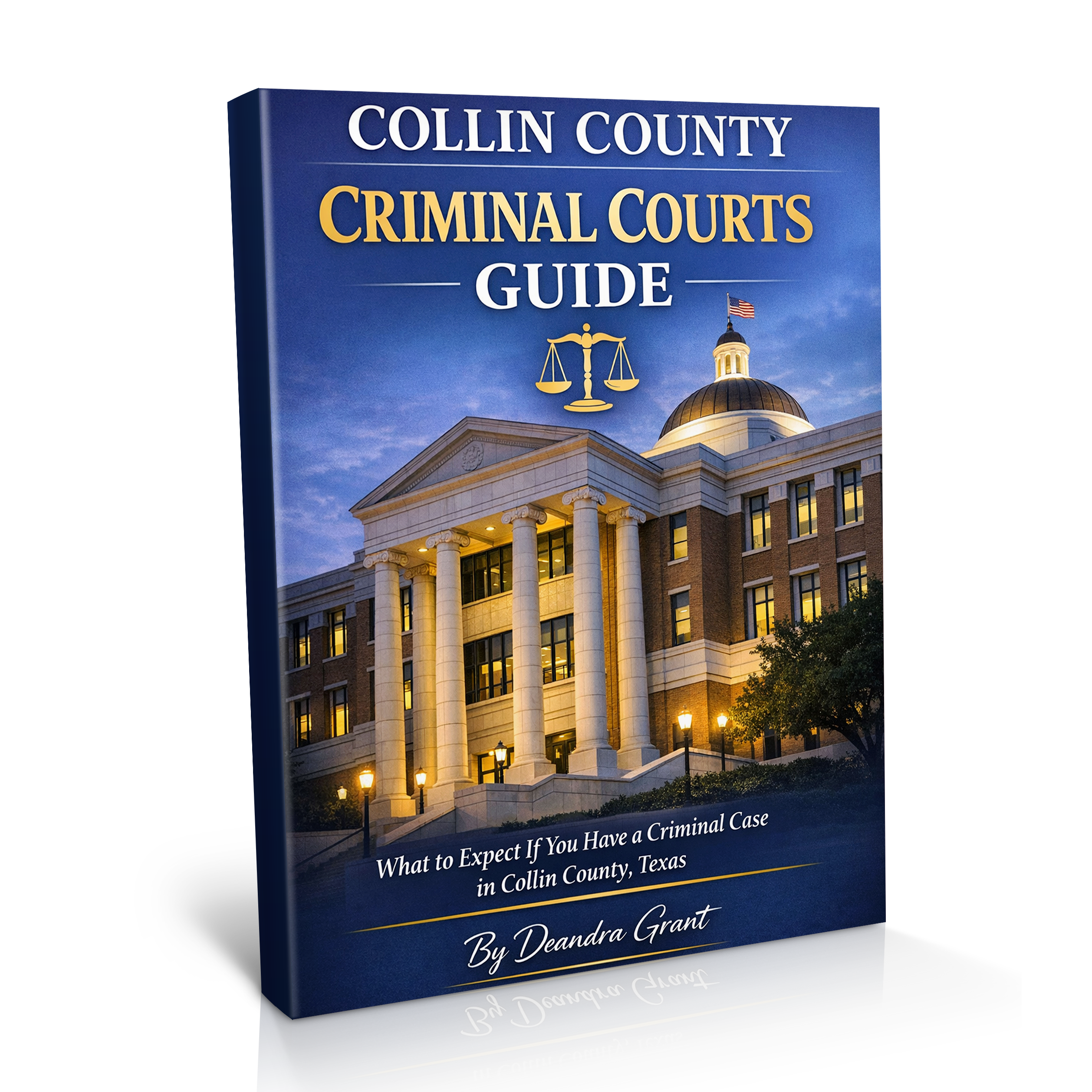
Collin County Criminal Courts Guide
By Attorney Deandra Grant
If you’re facing a criminal charge in Collin County, understanding how the local courts work can make the process far less confusing. This guide explains where cases are heard, what each court handles, and what you can expect as your case moves through the system.
Read NowFrisco Underage DWI Lawyers
A driver under 21 arrested for drinking and driving in Texas is not facing a single charge. Texas has two separate statutes that reach underage impaired driving — Alcoholic Beverage Code §106.041 (DUI by Minor, zero-tolerance) and Penal Code §49.04 (the adult DWI statute). The two have different elements, different penalty ranges, and different long-term consequences. Depending on the BAC and the circumstances, a minor can be charged with one, the other, or both.
The central distinction is simple. Under §106.041, any detectable amount of alcohol in a driver under 21 supports a Class C misdemeanor DUI. A breath test of 0.02 is enough. Under §49.04, the driver must be intoxicated which in practice means BAC of 0.08 or higher, or loss of normal mental or physical faculties. A minor at 0.02 can be charged with §106.041 but not §49.04. A minor at 0.10 can be charged with both.
Underage DWI charges in Frisco involve court routing that reflects the city’s dual-county geography. First- and second-offense §106.041 Class C misdemeanor cases (which constitute the majority of underage alcohol-driving charges) are handled by the Frisco Municipal Court, 7300 Public Safety Way, Frisco, TX 75034 regardless of which side of Frisco the arrest occurred on. This is the one area where Frisco’s dual-county structure does not produce a split: Class C cases from both Collin County and Denton County addresses are heard in the same municipal court. Third §106.041 offenses (Class B misdemeanor), §49.04 DWI cases, and any felony-level matters follow the county split. Arrests in eastern Frisco (Collin County) are prosecuted by the Collin County District Attorney’s Office at the Collin County Courthouse in McKinney. Arrests in western Frisco (Denton County) are prosecuted by the Denton County District Attorney’s Office at the Denton County Courthouse in Denton. Federal cases from either side of the city are prosecuted in the Eastern District of Texas (Sherman Division).
Deandra Grant Law has defended criminal charges in both Collin County and Denton County for more than 30 years. Our Allen office serves the Collin County side of Frisco, and our Denton office serves the Denton County side so we are positioned for cases on either side of the county line without the client having to adjust representation based on where the stop occurred. Managing Partner Deandra Grant is a trained SFST instructor and holds the ACS-CHAL Forensic Lawyer-Scientist designation along with a Master of Science in Pharmaceutical Science and a Graduate Certificate in Forensic Toxicology. Partner Douglas Huff holds the same ACS-CHAL designation.
Two Statutes, Two Different Cases
DUI by Minor — Texas Alcoholic Beverage Code § 106.041
The zero-tolerance statute. Under §106.041, a minor (person under 21) commits an offense by operating a motor vehicle in a public place, or a watercraft, while having any detectable amount of alcohol in the minor’s system. “Any detectable amount” is the operative phrase. The statute does not require proof of impairment, loss of faculties, or BAC 0.08. A breath or blood test showing 0.02 is sufficient.
- First offense: Class C misdemeanor. Fine up to $500, 20-40 hours community service, mandatory alcohol awareness class, 30-day driver’s license suspension.
- Second offense: Class C misdemeanor. Fine up to $500, 40-60 hours community service, mandatory alcohol awareness class, 60-day driver’s license suspension.
- Third offense (or minor is 17+ with two priors): Class B misdemeanor carries up to 180 days in county jail, fine up to $2,000, 180-day driver’s license suspension.
DWI — Texas Penal Code § 49.04
The standard DWI statute applies equally to minors. Where a driver under 21 has a BAC of 0.08 or higher, or has lost the normal use of mental or physical faculties, §49.04 applies and brings adult-DWI consequences:
- First offense DWI: Class B misdemeanor — 72 hours to 180 days in county jail, fine up to $2,000.
- First offense DWI with BAC 0.15+: Class A misdemeanor — up to 1 year in county jail, fine up to $4,000.
- Transportation Code §709.001 civil statutory fine: $3,000 first offense; $6,000 if BAC is 0.15+. This is on top of the criminal fine.
- Driver’s license suspension: 90 days to 1 year on conviction.
Can a Minor Be Charged with Both?
Yes. A minor driver with a BAC above 0.08, or who shows signs of intoxication, can be charged with DUI by Minor (for having detectable alcohol) and DWI (for being intoxicated). In practice, the state usually elects between the two based on the strength of the evidence, but both charges are legally available.
Texas Zero Tolerance — What It Really Means
“Zero tolerance” is not a slogan; it is an operative legal threshold. Under §106.041, the state does not need to prove impairment. A minor can be convicted based solely on a positive test, even at levels that would not produce visible impairment in an adult driver. Practical implications:
- A minor who had one drink hours earlier and is no longer impaired can still test above 0.00 and face §106.041 charges.
- Field sobriety test performance is largely irrelevant to §106.041 — the test result is what matters.
- Residual mouth alcohol from recent drinking, certain medical conditions, and interfering substances can produce false-positive breath readings even without impairment.
- A refusal to test triggers an automatic ALR suspension and does not prevent the §106.041 charge from proceeding on other evidence.
Because the zero-tolerance threshold is so low, the forensic analysis of the test itself (calibration, operator certification, chain of custody, interfering substances) is often where §106.041 cases are defended. A defective test can defeat a §106.041 charge the same way it defeats an adult DWI charge.
License Consequences for Minors — Separate from ALR
Underage DWI and DUI by Minor cases produce driver’s license consequences from multiple sources, all running against the same license:
- ALR for minors. §524.022 imposes an Administrative License Revocation on any minor who tests at 0.08 or refuses: 180-day suspension on refusal (2 years with prior ALR), 60-day suspension on failed test (120 days with prior ALR). The ALR deadline is 15 days from the date of notice of suspension.
- §106.041 conviction suspension. Separate from ALR, a §106.041 conviction carries its own 30/60/180-day suspension depending on offense number. This suspension runs on top of any ALR suspension.
- §49.04 criminal-court suspension. DWI conviction for a minor carries 90 days to 1 year suspension under Transportation Code Chapter 521. Also runs separately from ALR.
- Occupational license restrictions for minors. Minors under 18 generally cannot obtain an occupational license during suspension. Minors 18–20 may qualify but with enhanced restrictions.
Mandatory Alcohol Awareness Course
Under §106.041(e), a minor convicted of DUI by Minor must complete a Texas Department of Licensing and Regulation-approved Alcohol Awareness Program. The course requirement:
- Completion is mandatory. Failure to complete within 90 days of judgment results in an additional 180-day license suspension on top of any other suspension.
- The court may order the parents or guardian to attend the class as well, under §106.115.
- The program is separate from any community service requirement.
- On conviction for a second or subsequent §106.041 offense, the court may require a substance use treatment program in addition to the awareness class.
Defense Strategies in Frisco Underage DWI Cases
Forensic challenges on the test. Because §106.041 is a zero-tolerance statute triggered by “any detectable amount” of alcohol, the test result is the case. Breath test analysis turns on proper calibration, operator certification, and the 15-minute observation period before the test. Blood test analysis turns on chain of custody, preservative balance, and GC-FID methodology at the DPS Crime Lab in Garland, which serves both Collin and Denton Counties.
Residual mouth alcohol. Recent drinking, burping, dental work retaining alcohol, and mouthwash can produce elevated breath readings that do not reflect actual BAC. The 15-minute observation period is designed to prevent this, but operator deviations from protocol are common.
Medical conditions. Diabetic ketoacidosis, GERD, and certain dietary conditions can produce endogenous compounds that affect breath test readings. Individual minor cases sometimes involve medical evidence that supports a challenge to the result.
Article 38.23 — no good faith exception. Many Frisco-area underage DWI arrests originate from traffic stops on the Dallas North Tollway, US-380, SH-121, or Preston Road, or from calls to residential areas and to the restaurant and entertainment districts around The Star, Legacy West, Stonebriar Centre, and Frisco Station. Texas’s exclusionary rule carries no good faith exception so evidence from an unlawful stop, search, or seizure is suppressible regardless of what it shows.
SFST challenges on §49.04 cases. Where the minor is charged under §49.04 (BAC 0.08+), the full SFST challenge applies: administration protocol, scoring, environmental factors, and medical conditions that can affect performance. As a trained SFST instructor, Deandra Grant addresses these issues in every case.
Deferred adjudication and diversion. Deferred adjudication is available for §106.041 cases. For first-time minor offenders, deferred adjudication followed by successful completion can produce a dismissal that is eligible for sealing. The positioning of the case to qualify for the best available disposition is a central part of the representation.
Long-Term Consequences and Record Sealing
A §106.041 or §49.04 conviction on a minor’s record produces consequences that can follow for years (college admissions, financial aid, professional licensing, military enlistment, and insurance rates). Positioning the case for dismissal (through deferred adjudication or acquittal) and for record sealing is often the most important long-term objective.
Expunction and nondisclosure for minors. Alcoholic Beverage Code §106.12 provides a specific expunction pathway for minors whose §106.041 convictions are eligible. The statute allows expunction of a §106.041 conviction once the person reaches 21, subject to specific conditions (no more than one alcohol-related conviction, completion of all court-ordered conditions). This is different from the general expunction and nondisclosure framework and is a significant long-term advantage for a §106.041 conviction over a §49.04 conviction that does not qualify for §106.12 relief.
Why Deandra Grant Law for Frisco Underage DWI Defense
-
- Offices in Allen and Denton — both sides of Frisco covered. 30+ years in both Collin County and Denton County courts. 500+ trials to verdict. Wherever in Frisco the arrest occurred, the county courthouse is familiar ground.
- Trained SFST Instructor — Deandra Grant. Field sobriety test administration, scoring, and interpretation challenged in every case.
- ACS-CHAL Forensic Lawyer-Scientist — Deandra Grant and Douglas Huff. Breath and blood test methodology, interfering-substance analysis, and the State’s forensic evidence evaluated at the chemistry level.
- Master of Science in Pharmaceutical Science + Graduate Certificate in Forensic Toxicology. Blood alcohol analysis, retrograde extrapolation, and the pharmacology of alcohol impairment.
- Article 38.23 — no good faith exception. Every underage DWI case begins with the lawfulness of the stop, search, or seizure.
- Long-term-record focus. Cases positioned for §106.12 expunction, deferred adjudication, and the best available long-term disposition — not just the shortest path to plea.
- 17 published law books. Including The Texas DWI Manual
- Texas Super Lawyer since 2011.
- AV® Preeminent rated by Martindale-Hubbell®.
If you are facing underage DWI or DUI by Minor charges in Frisco — whether on the Collin County or Denton County side — call (214) 225-7117 for a free, confidential consultation. Or schedule online at texasdwisite.com.
Related Blogs

Ask Deandra: Can I Get a DWI for Marijuana or Edibles in Texas?
texasdwisite.com/blog/ — Prepared June 2026 By Deandra Grant, J.D., M.S. (Pharmaceutical Science), ACS-CHAL Forensic Lawyer-Scientist [...]
Ask Deandra: What’s the Difference Between a DWI and a DUI in Texas?
By Deandra Grant, J.D., M.S. (Pharmaceutical Science), ACS-CHAL Forensic Lawyer-Scientist The question: What’s the difference [...]
Ask Deandra: How Do Police Prove a Drug-Based DWI Without a Blood Test?
The question: How do police prove a drug-based DWI without a blood test? The short [...]

The Complete Guide to Court-Ordered Alcohol Monitoring Devices in Texas DWI Cases
SCRAM, Ignition Interlock, Soberlink, and the New Wave of Wearables — What They Are, Who [...]
Ask Deandra: Can I Be Arrested for DWI in Texas if I’m Under 0.08?
The question: Can I be arrested for DWI in Texas if my BAC is under [...]

Ask Deandra: Should I Answer the Officer’s Questions After a DWI Arrest?
The question: Should I answer the officer’s questions after a DWI arrest? The short answer: [...]

Ask Deandra: Do I Have to Take a Field Sobriety Test in Texas?
The question: Do I have to take a field sobriety test in Texas? The short [...]

Ask Deandra: What Should I Do If I’m Pulled Over and the Officer Thinks I’m Drunk?
The question: What should I do if I’m pulled over and the officer thinks I’m [...]
Client Reviews

“Deandra Grant Law – Criminal & DWI Defense handled my case with diligence and professionalism. Deandra Grant’s reputation is stellar and now I know why. She has a team of individuals who provide quality service.”