
Home »
Do You Need Legal Help?
ARVE error: <a href="https://nextgenthemes.com/plugins/arve/documentation/installation/">ARVE Pro</a> license not activated or valid

"Deandra Grant Law fights hard for their clients and is always willing to go above and beyond. They are the best firm for DWI cases in DFW and beyond. Definitely hire them to represent you in any pending cases."
- P. Williams
"Deandra Grant made a tough situation so much better. She listened to my concerns and helped me so much with my case. I would recommend her to anyone needing legal services."
- M. Haley
"Deandra Grant Law handled my case with diligence and professionalism. Deandra Grant's reputation is stellar and now I know why. She has a team of individuals who provide quality service."
- N. Coulter
As Seen On






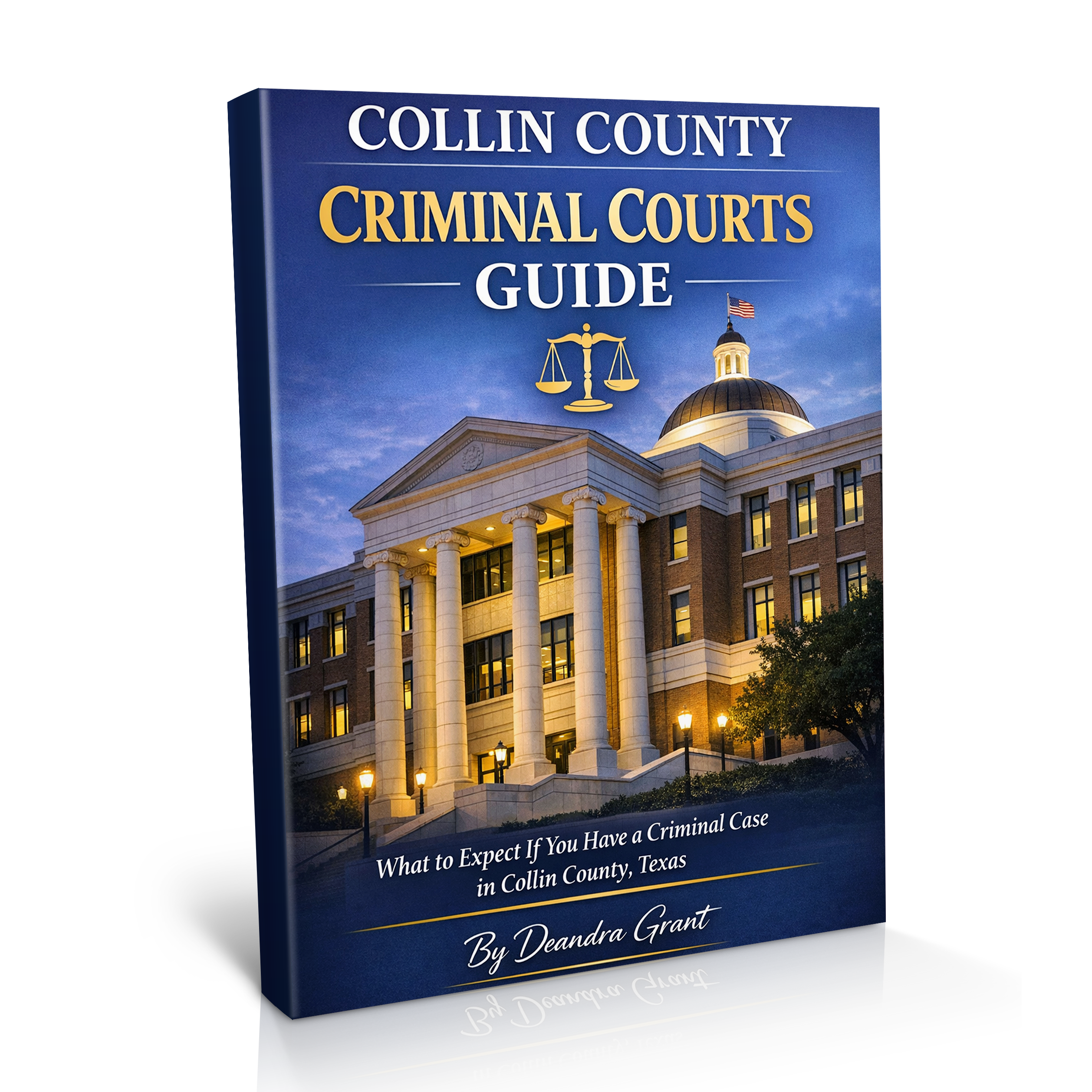
Collin County Criminal Courts Guide
By Attorney Deandra Grant
If you’re facing a criminal charge in Collin County, understanding how the local courts work can make the process far less confusing. This guide explains where cases are heard, what each court handles, and what you can expect as your case moves through the system.
Read NowFrisco Multiple DWI Lawyers
A second DWI in Texas carries consequences that catch most defendants by surprise. Under Penal Code §49.09(a), a second DWI is a Class A misdemeanor punishable by up to 1 year in county jail, a fine up to $4,000, and a license suspension of 180 days to 2 years. Even when a judge grants probation, §49.09(h) requires a mandatory 72 hours to 30 days in county jail as a condition of that probation. Ignition interlock becomes mandatory under CCP Article 17.441. And because Texas has no DWI lookback period, a prior conviction from any time in the defendant’s life counts (a DWI conviction from college two decades ago enhances today’s case the same as a recent one).
Second DWI charges arising in Frisco present an unusual procedural feature. Frisco straddles the Collin County / Denton County line roughly along the Dallas North Tollway, with eastern Frisco in Collin County and western Frisco in Denton County. Criminal jurisdiction follows the location of the arrest. A case arising in eastern Frisco is prosecuted by the Collin County District Attorney’s Office at the Collin County Courthouse in McKinney. A case arising in western Frisco is prosecuted by the Denton County District Attorney’s Office at the Denton County Courthouse in Denton. Class C misdemeanor cases from either side of the city go to the Frisco Municipal Court, 7300 Public Safety Way, Frisco, TX 75034. Federal cases from either county are prosecuted in the Eastern District of Texas (Sherman Division). Many Frisco-area arrests originate from traffic stops on the Dallas North Tollway, US-380 (University Drive), SH-121 (Sam Rayburn Tollway), and Preston Road.
Deandra Grant Law has defended criminal charges in both Collin County and Denton County for more than 30 years. Our Allen office serves the Collin County side of Frisco, and our Denton office serves the Denton County side so we are positioned for cases on either side of the county line without the client having to adjust representation based on where the stop occurred. Managing Partner Deandra Grant is a trained SFST instructor and holds the ACS-CHAL Forensic Lawyer-Scientist designation along with a Master of Science in Pharmaceutical Science and a Graduate Certificate in Forensic Toxicology. Partner Douglas Huff holds the same ACS-CHAL designation.
Second DWI Under Texas Law — Penal Code §49.09(a)
A second DWI is not a first offense with a bigger fine. It is a different statutory classification with materially different consequences:
- Class A misdemeanor. Up to 1 year in county jail, fine up to $4,000.
- §49.09(h) mandatory jail minimum on probation. Even when the court grants probation, the defendant must serve 72 hours to 30 days in county jail as a condition of probation. This is a statutory floor, not a judicial preference, and it is not waivable.
- Driver’s license suspension: 180 days to 2 years. Under Texas Transportation Code Chapter 521.
- Mandatory ignition interlock. CCP Article 17.441 requires interlock as a condition of bond on any DWI where the defendant has a prior DWI conviction.
- Transportation Code §709.001 statutory fine: $4,500 on second offense. §709.001 imposes a civil statutory fine on top of the criminal fine. The second-offense amount is $4,500 (the first-offense amount is $3,000).
No Lookback — Priors Never Expire in Texas
Texas repealed its DWI lookback statute in 2005. Before that, a prior conviction more than 10 years old generally did not enhance a current DWI. That rule is gone. The current framework under Penal Code §49.09 treats every prior conviction (regardless of age) as an enhancement. This surprises most defendants. Key points:
- A DWI conviction from 25 years ago counts the same as one from 2 years ago.
- Out-of-state DUI, OUI, and OWI convictions count under §49.09(c), which defines a prior “offense relating to the operating of a motor vehicle while intoxicated” to include substantially similar offenses from other states.
- Deferred adjudications generally do not count as convictions for §49.09 enhancement — but they do count for other purposes, and the deferred-vs-conviction analysis requires case-by-case review.
- Juvenile DWI adjudications and dismissed-charge outcomes require individual review; not all dispositions are enhancement-triggering priors.
Attacking the Prior Conviction
A prior that cannot be proved cannot enhance. Challenges to the predicate conviction (jurisdiction, defective plea waivers, inadequate admonishments, identity) can reduce a second DWI to first-offense treatment. On very old priors, defective judgment paperwork is a recurring issue. Key areas of inquiry:
- Certified copy of the prior judgment. The state must produce a properly certified copy. A missing, defective, or uncertified prior can defeat the enhancement even where the conviction occurred.
- Identity proof. The state must prove the defendant in the current case is the same person convicted in the prior case. Where the prior matter involved limited fingerprinting or identification records, this is contestable.
- Plea admonishments. If the plea in the prior case was not knowing and voluntary — missing admonishments, inadequate advice of counsel, or other defects — the prior may not be usable for enhancement.
- Out-of-state statute comparison. Out-of-state DUI/OUI/OWI convictions require a statute-by-statute comparison to Texas DWI elements. Some out-of-state convictions do not qualify as enhancement-triggering priors even though they involved intoxicated driving.
ALR and Driver’s License Consequences Stack on Repeats
The Administrative License Revocation process runs in parallel with the criminal case and the consequences stack on repeats:
- Failed test with prior ALR suspension: 1-year ALR suspension.
- Refusal with prior ALR suspension: 2-year ALR suspension.
- Criminal-court license suspension on second DWI conviction: 180 days to 2 years.
- ALR deadline: 15 days from the date of notice of suspension to request a hearing. Missing the deadline results in an automatic suspension.
When a Third DWI Becomes a Felony
A third or subsequent DWI under §49.09(b)(2) is a third-degree felony that carries 2 to 10 years in TDCJ. §49.09(h) imposes a 10-day mandatory jail minimum even on probated third DWIs. A fourth DWI with prior felony convictions can be enhanced under §12.42 to second-degree felony (2 to 20 years) or habitual offender (25 years to life). Felony DWI cases involve different procedural posture, different forensic focus, and different sentencing considerations than misdemeanor repeat cases. Those issues are addressed in detail on our Frisco Felony DWI Defense page.
Defense Strategies in Frisco Second DWI Cases
Forensic challenges on the current case. Ethanol analysis in Texas is performed by headspace gas chromatography with flame ionization detection (GC-FID). Drug analysis is performed by LC-MS/MS. Frisco-area DWI blood specimens are typically submitted to the DPS Crime Lab in Garland, which serves both Collin and Denton Counties. Chain of custody, preservative balance, calibration, column chemistry, and measurement uncertainty are all contestable at the chemistry level.
SFST administration. Field sobriety tests (HGN, walk-and-turn, one-leg-stand) have strict NHTSA administration protocols. Deviations affect validity. As a trained SFST instructor, Deandra Grant challenges the administration, scoring, and interpretation of SFST evidence in every case.
Article 38.23 — no good faith exception. Many Frisco-area DWI arrests originate from stops on the Dallas North Tollway, US-380, SH-121, or Preston Road. Texas’s exclusionary rule carries no good faith exception so evidence from an unlawful stop, search, or seizure is suppressible regardless of what it shows. The legality of the stop, the field investigation, the arrest, and any blood warrant are examined before any other defense strategy is built.
ALR as discovery. Requesting the ALR hearing and taking the arresting officer’s testimony under oath months before the criminal case reaches its first setting produces discovery that shapes the criminal defense strategy. The ALR deadline is 15 days from the date of notice of suspension.
Sentencing mitigation. Where conviction is likely, the defense shifts to mitigation such as treatment compliance, employment, family responsibilities, and evidence that addresses the pattern rather than just the current incident. The §49.09(h) 72-hour-to-30-day minimum is not waivable, but where it falls within that range is influenced by mitigation evidence.
Why Deandra Grant Law for Frisco Multiple DWI Defense
-
- Offices in Allen and Denton — both sides of Frisco covered. 30+ years in both Collin County and Denton County courts. 500+ trials to verdict. Wherever in Frisco the arrest occurred, the county courthouse is familiar ground.
- Trained SFST Instructor — Deandra Grant. Field sobriety test administration, scoring, and interpretation challenged in every case.
- ACS-CHAL Forensic Lawyer-Scientist — Deandra Grant and Douglas Huff. Chemical testing, breath and blood analysis, and the forensic evidence underlying the State’s case evaluated at the scientific level.
- Master of Science in Pharmaceutical Science + Graduate Certificate in Forensic Toxicology. Blood alcohol analysis, retrograde extrapolation, and the pharmacology of alcohol impairment.
- Article 38.23 — no good faith exception. Every second DWI case begins with the lawfulness of the stop, search, or seizure.
- Prior conviction analysis. Every enhancement-triggering prior is examined for defects such as judgment certification, identity proof, plea admonishments, and out-of-state statutory comparison.
- 17 published law books. Including The Texas DWI Manual
- Texas Super Lawyer since 2011.
- AV® Preeminent rated by Martindale-Hubbell®.
If you are facing second or subsequent DWI charges in Frisco — whether on the Collin County or Denton County side — call (214) 225-7117 for a free, confidential consultation. Or schedule online at texasdwisite.com.
Related Blogs

Ask Deandra: Can I Get a DWI for Marijuana or Edibles in Texas?
texasdwisite.com/blog/ — Prepared June 2026 By Deandra Grant, J.D., M.S. (Pharmaceutical Science), ACS-CHAL Forensic Lawyer-Scientist [...]
Ask Deandra: What’s the Difference Between a DWI and a DUI in Texas?
By Deandra Grant, J.D., M.S. (Pharmaceutical Science), ACS-CHAL Forensic Lawyer-Scientist The question: What’s the difference [...]
Ask Deandra: How Do Police Prove a Drug-Based DWI Without a Blood Test?
The question: How do police prove a drug-based DWI without a blood test? The short [...]

The Complete Guide to Court-Ordered Alcohol Monitoring Devices in Texas DWI Cases
SCRAM, Ignition Interlock, Soberlink, and the New Wave of Wearables — What They Are, Who [...]
Ask Deandra: Can I Be Arrested for DWI in Texas if I’m Under 0.08?
The question: Can I be arrested for DWI in Texas if my BAC is under [...]

Ask Deandra: Should I Answer the Officer’s Questions After a DWI Arrest?
The question: Should I answer the officer’s questions after a DWI arrest? The short answer: [...]

Ask Deandra: Do I Have to Take a Field Sobriety Test in Texas?
The question: Do I have to take a field sobriety test in Texas? The short [...]

Ask Deandra: What Should I Do If I’m Pulled Over and the Officer Thinks I’m Drunk?
The question: What should I do if I’m pulled over and the officer thinks I’m [...]
Client Reviews

“Deandra Grant Law – Criminal & DWI Defense handled my case with diligence and professionalism. Deandra Grant’s reputation is stellar and now I know why. She has a team of individuals who provide quality service.”