By Deandra Grant, J.D., M.S., ACS-CHAL
NATIONAL EDITION — AND A WORD ON THE PRESUMPTION OF INNOCENCE
The Gavel of Shame usually reads the public discipline files of the Texas State Commission on Judicial Conduct. Now and then a case from another state is instructive enough to be worth opening here. This is one of those.
It also carries a caveat we take seriously as defense lawyers: the criminal half of this story has not been tried. Edward Harold King has been arrested and charged and nothing more. He is presumed innocent, and every statement below about the criminal case is an allegation the government still has to prove beyond a reasonable doubt.
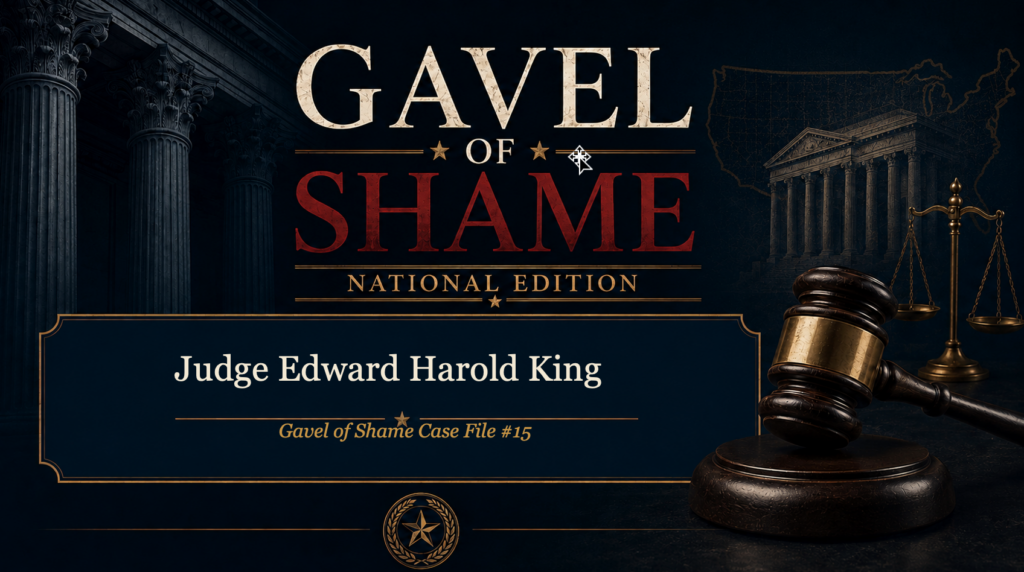
On May 13, 2026, a man who had spent more than three decades in and around the law walked into a federal courthouse in Brooklyn not as a judge, but as a defendant. Edward Harold King, a former Kings County Supreme Court Justice, was arrested and charged with one count of wire fraud conspiracy. Five months earlier he had given up his robe under a different kind of pressure entirely: a state commission that investigates how judges behave. Same man, same underlying conduct, two completely separate proceedings running on two completely separate tracks.
That split is worth understanding, because most people (and a surprising number of lawyers) blur the two together. A judge who gets in trouble can face a conduct commission, a criminal prosecutor, or both. They are not the same thing, they answer different questions, and they hand out very different consequences. King’s case is a clean illustration of how each track works and where they meet.
Track One — The Conduct Commission: Taking the Robe
Every state has a body whose job is to police judicial conduct. In Texas it is the State Commission on Judicial Conduct; in New York it is the Commission on Judicial Conduct. The names differ, but the mission is the same: protect public confidence in the judiciary by investigating allegations that a judge has broken the rules that govern judges. These commissions are not courts of appeal. They cannot reverse a ruling, free anyone from jail, or send anyone to prison. Their currency is the robe: they can warn, admonish, reprimand, and, in the most serious cases, push a judge off the bench.
That is the track that caught up with King first. According to the New York commission, King resigned effective December 31, 2025, after it informed him it was investigating multiple complaints. Rather than fight the case, he signed a stipulation agreeing never to serve as a judge again, which ended the investigation. He denied the allegations.
What was he accused of? The commission described complaints that King had taken part in a scheme to defraud real estate investors by improperly receiving and transferring escrow funds, that he served as a fiduciary while a sitting full-time judge, and that he kept holding himself out as a practicing lawyer including by accepting money into his own attorney escrow accounts. New York, like Texas, bars full-time judges from practicing law, acting as fiduciaries, or running outside businesses. The commission’s administrator, Robert Tembeckjian, called the allegations “so egregious as to warrant his permanent departure from the bench.”
Notice what the commission did and did not do. It secured the one thing within its power which is King will never sit as a judge again. It did not, and could not, decide whether he committed a crime or owes anyone money. Notice, too, what resignation accomplished for King: by leaving voluntarily and accepting a lifetime bar, he ended the conduct proceeding before it produced formal findings. That is a common move, and it is exactly why the conduct track so often closes quietly while the criminal track is just getting started.
Track Two — The Criminal Case: The Liberty Question
A conduct commission can take your title. Only a criminal court can take your freedom and a conduct commission has nothing to do with whether that happens. A separate set of players runs the second track: investigators, a grand jury or a charging prosecutor, and ultimately a judge and jury. The question is not “Is this person fit to be a judge?” It is “Did this person commit a crime, and can the government prove it beyond a reasonable doubt?”
On the criminal track, federal prosecutors in the Eastern District of New York charged King and a co-defendant, Brooklyn real estate developer Yechiel “Sam” Sprei, with wire fraud conspiracy. Prosecutors allege that in 2024 two investors were induced to wire $6.5 million as “proof of liquidity” into an account in King’s name in connection with a New Jersey property bid; that when the investors asked for their money back, they received only about $1.5 million; and that the rest was never returned. U.S. Attorney Joseph Nocella announced the charges. King was released on a $250,000 bond after his initial appearance.
Wire fraud conspiracy carries a statutory maximum of up to 20 years which is the ceiling Congress set for the underlying wire fraud offense. A statutory maximum is not a prediction; it is the outer boundary of what the law allows, and the actual outcome of any federal case depends on conviction first and the sentencing guidelines second. Right now there has been neither a trial nor a plea. King is presumed innocent, and the burden of proving every element rests entirely on the government.
Why Escrow Is the Recurring Flashpoint
If you read enough of these cases, you notice the same word over and over: escrow. There is a reason. An escrow or trust account is money that belongs to someone else, held by a lawyer who is supposed to keep it untouched until a deal closes or a condition is met. It is the single most heavily policed account a lawyer controls, because the temptation (and the damage) are both enormous.
For a judge, escrow is doubly dangerous. A full-time judge is not supposed to be practicing law at all, which means a sitting judge has no business holding an attorney escrow account in the first place. So the same set of facts (a judge sitting on other people’s money) can light up both tracks at once: it violates the conduct rules that keep judges out of private law practice, and, if the money is taken or misdirected, it can support a fraud or theft charge. That overlap is exactly what the King allegations describe, and it is why escrow shows up again and again when a judge ends up in this kind of trouble.
How It Works in Texas
Texas runs the same two tracks. The State Commission on Judicial Conduct investigates judicial misconduct and can issue private or public sanctions, suspend a judge, or recommend removal which is the discipline this series breaks down case by case. It is a conduct body, not a criminal court. A Texas judge accused of stealing client or investor money would face the Commission on one track and a district attorney or federal prosecutor on the other, with neither proceeding controlling the outcome of the other.
The practice-of-law line is just as firm here. Under Canon 4G of the Texas Code of Judicial Conduct, a judge shall not practice law except as narrowly permitted so a full-time Texas judge cannot moonlight as a practicing attorney or sit on an attorney trust account any more than a New York judge can. And the trust-account rules that govern every Texas lawyer (the safekeeping-of-property duties under the Texas Disciplinary Rules of Professional Conduct) mean the escrow flashpoint exists here too. The names and citations change at the state line; the structure does not.
From the Bench to the Defense Table
There is something genuinely sobering about a judge becoming a defendant. The person who once ruled on bail now posts it. The person who once read others their rights now exercises his own. And the presumption of innocence (the principle a judge is sworn to protect for everyone who stands in front of the bench) now protects him, exactly as it would protect anyone else.
That is not a footnote to us. It is the whole job. We spend our careers on the defense side of that table, insisting that an accusation is not a conviction and that the government has to prove its case. The fact that the accused here once wore a robe does not change the standard one inch. Whatever the New York commission concluded about his fitness to be a judge, the criminal charges against Edward Harold King remain allegations and they will stay allegations unless and until the government proves them in court or a plea of guilty is entered.
| FACING A FEDERAL OR STATE INVESTIGATION?
Wire fraud, theft, and white-collar charges move fast and hit hard and a criminal case can run alongside professional-licensing or other proceedings, just as it does here. The defense team at Deandra Grant Law handles serious state and federal matters, including federal practice through Of Counsel James Lee Bright, whose work spans all four Texas federal districts, the Fifth Circuit, and the United States Supreme Court. Call (214) 225-7117 |
Sources & Further Reading
ABA Journal (Shirley Henderson, May 14, 2026) — Former Brooklyn judge arrested: abajournal.com
Associated Press via NBC New York — charges and Dec. 31, 2025 resignation: nbcnewyork.com
amNewYork — Commission on Judicial Conduct announcement of resignation: amny.com
Gothamist — complaint details, escrow timeline: gothamist.com