Home »

Do You Need Legal Help?

"Deandra Grant Law fights hard for their clients and is always willing to go above and beyond. They are the best firm for DWI cases in DFW and beyond. Definitely hire them to represent you in any pending cases."
- P. Williams
"Deandra Grant made a tough situation so much better. She listened to my concerns and helped me so much with my case. I would recommend her to anyone needing legal services."
- M. Haley
"Deandra Grant Law handled my case with diligence and professionalism. Deandra Grant's reputation is stellar and now I know why. She has a team of individuals who provide quality service."
- N. Coulter
As Seen On






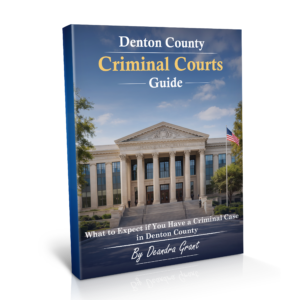
Denton County Criminal Courts Guide
By Attorney Deandra Grant
If you’re facing a criminal charge in Denton County, understanding how the local courts work can make the process far less confusing. This guide explains where cases are heard, what each court handles, and what you can expect as your case moves through the system.
Read NowLewisville DWI with CDL Attorneys
A DWI arrest for a Commercial Driver’s License holder is not a standard DWI with extra consequences. It is two parallel cases: a state criminal prosecution under Texas law, and a federal disqualification proceeding under the Federal Motor Carrier Safety Regulations. The two cases run on different tracks with different rules, different standards of proof, and different windows for action. Both must be defended at once.
The central facts a CDL holder needs to understand at the outset:
- The commercial threshold is 0.04 BAC — half the 0.08 standard for non-commercial drivers. This applies when operating a commercial motor vehicle.
- A first CDL DWI disqualification is 1 year, with no occupational option. Three years if the DWI occurred while transporting hazardous materials.
- A second CDL DWI disqualification is lifetime — permanent. This is a career-ending consequence under federal law, not a Texas statute.
- A DWI in a personal vehicle disqualifies a CDL. The disqualification is not limited to commercial vehicle operation. A Saturday-night DWI in a family car produces the same federal consequences as a DWI in a tractor-trailer.
- The federal masking prohibition defeats deferred adjudication as a CDL workaround. Deferred adjudication does not protect the CDL from disqualification.
DWI cases involving CDL holders in Lewisville are prosecuted by the Denton County District Attorney’s Office at the Denton County Courthouse, 1450 E. McKinney Street, Denton, TX 76209. I-35E through Lewisville is one of the busiest commercial trucking corridors in North Texas, carrying heavy interstate freight traffic between Dallas-Fort Worth and Oklahoma. SH-121, FM-3040, and the western terminus of the President George Bush Turnpike also carry substantial commercial traffic, which means Denton County produces a steady volume of CDL-DWI cases. CDL disqualifications are administered separately by DPS at the state level and reported to the federal Commercial Driver’s License Information System (CDLIS).
Deandra Grant Law has defended DWI charges for CDL holders in Denton County for more than 30 years. Managing Partner Deandra Grant is a trained SFST instructor and holds the ACS-CHAL Forensic Lawyer-Scientist designation along with a Master of Science in Pharmaceutical Science and a Graduate Certificate in Forensic Toxicology. Partner Douglas Huff holds the same ACS-CHAL designation. Every CDL-DWI case begins with the understanding that the federal disqualification framework (not just the criminal case) shapes the outcome that matters to the client’s livelihood.
The Two-Track Reality — Criminal Case + CDL Disqualification
The criminal case and the CDL disqualification case are legally separate and procedurally independent:
- Criminal case. Prosecuted under Texas Penal Code §49.04 (or §49.09 on enhancement) with standard DWI penalty ranges — Class B misdemeanor on first offense, Class A with BAC 0.15+ or on second offense, third-degree felony on third or subsequent.
- CDL disqualification. Administered under federal regulation (49 CFR Part 383) and implemented in Texas through Transportation Code §522.081. The disqualification is independent of any state-court license suspension and cannot be modified by occupational-license orders.
- ALR. Administrative License Revocation still applies to the underlying Class C driver’s license. A non-commercial occupational license during ALR does not authorize CMV operation.
- Employer action. Most trucking companies and employer-based CDL operators have independent disciplinary policies for DWI arrests that produce termination regardless of the criminal or administrative outcome. The employment consequence often arrives before the court consequence.
The 0.04 BAC Threshold for Commercial Motor Vehicles
Under 49 CFR §383.51, it is a “major offense” for a CDL holder to operate a commercial motor vehicle with a BAC of 0.04 or higher. Practical implications:
- A BAC of 0.04 in a CMV triggers the federal “major offense” framework even where no state DWI charge is filed.
- A BAC of 0.02 to 0.039 triggers an out-of-service order for 24 hours under 49 CFR §392.5 but does not trigger disqualification on a first occurrence.
- The 0.04 threshold applies only to operation of a CMV. A DWI in a personal vehicle uses the Texas §49.01 0.08 threshold but still triggers CDL disqualification if charged as DWI.
- “Operating a CMV” includes being behind the wheel with the engine running, including in a loading area or truck stop. It does not require driving on a public road.
Lewisville DWI & Criminal Defense
Criminal Defense DWI Assault BWI Cocaine Defense Drug Crime Defense DUID DWI with CDL Felony DWI Gun Crime Defense Hit & Run DWI Intoxication Assault Multiple DWIs Theft Defense Underage DWI WarrantsRelated Blogs
Ask Deandra: How Accurate Is the Breathalyzer in Texas?
By Deandra Grant, J.D., M.S. (Pharmaceutical Science), ACS-CHAL Forensic Lawyer-Scientist The question: How accurate is [...]
Ask Deandra: What Is a SCRAM Device?
The question: What is a SCRAM device? The short answer: A SCRAM device is a [...]

What Counts as ‘Reasonable Suspicion’? A Plain-English Guide to the Supreme Court’s Latest Fourth Amendment Ruling
On April 20, 2026, the United States Supreme Court issued its decision in District of [...]
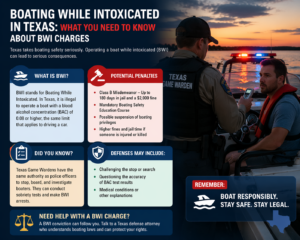
Boating While Intoxicated in Texas: What You Need to Know About BWI Charges
Texas has more than 800,000 registered recreational watercraft and some of the most active boating [...]

Before You Launch: BWI Enforcement on North and Central Texas Lakes
Texas has more than 560,000 registered boats and an estimated 359,000 additional unregistered watercraft operating [...]
Can You Get Life in Prison for a DWI in Texas? The Peace Officer Enhancement Explained
A Tarrant County jury recently sentenced DeAujalae Evans, 26, to life in prison after she [...]
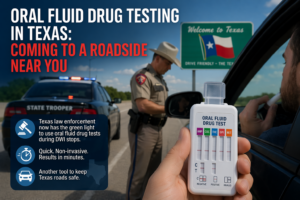
Oral Fluid Drug Testing in Texas: Coming to a Roadside Near You
Oral fluid drug testing (collecting saliva and testing it for the presence of drugs) is [...]
How Texas Uses Out-of-State DWI Convictions for Enhancement and How the Defense Challenges Them
Texas Penal Code §49.09 contains two facts that surprise most people who come to us [...]
Federal CDL Disqualification Framework — 49 CFR §383.51
First conviction. Under 49 CFR §383.51(b), a first conviction for driving a CMV (or any motor vehicle) while under the influence of alcohol carries a 1-year disqualification. The same 1-year disqualification applies to a first refusal to submit to alcohol testing and to a first conviction for leaving the scene, using a vehicle in the commission of a felony, driving a CMV while the CDL is revoked or suspended, causing a fatality through negligent or criminal operation of a CMV, and several other enumerated offenses.
HAZMAT enhancement — 3-year disqualification. If the first offense occurs while the driver is operating a CMV transporting hazardous materials requiring placards, the disqualification is 3 years rather than 1 year.
Second conviction — lifetime disqualification. Under 49 CFR §383.51(b)(2), a second conviction for any of the enumerated major offenses produces a lifetime CDL disqualification. The regulation permits the driver to petition for reinstatement after 10 years, but reinstatement requires completion of an approved rehabilitation program and is not guaranteed.
Personal-vehicle DWI still counts. 49 CFR §383.51(b) expressly covers a CDL holder’s operation of any motor vehicle — not just a CMV. A CDL holder’s DWI in a personal pickup on a Saturday night triggers the same disqualification as a DWI in a tractor-trailer on a weekday run. This is the single most commonly misunderstood feature of the CDL framework.
Drug offenses are major offenses. A CDL holder’s conviction for using a motor vehicle in the commission of a felony involving the manufacture, distribution, or dispensing of a controlled substance results in lifetime disqualification with no reinstatement eligibility at 10 years.
The Masking Prohibition — Why Deferred Adjudication Does Not Protect the CDL
Under 49 CFR §384.226, the state cannot “mask, defer, or take any other action that prevents a CDL conviction from being reported to CDLIS” or from being used to trigger disqualification. Texas Transportation Code §522.102 implements this prohibition in Texas law. The practical effects:
- Deferred adjudication is treated as a conviction for CDL disqualification purposes, even though it does not result in a final criminal conviction under Texas law.
- Pretrial diversion that results in case dismissal is generally not reportable as a conviction, but specific program details determine CDL treatment.
- Expunction and nondisclosure do not erase the federal record of the conviction for CDL purposes.
- This fundamentally changes the plea calculus. A deferred adjudication disposition that would be beneficial for a non-CDL defendant can be devastating for a CDL holder. The case must be resolved through acquittal, dismissal, or reduction to a non-disqualifying offense and not through standard deferred adjudication.
Out-of-Service Orders Under Texas Transportation Code §522.101
A separate framework applies at the roadside during a CMV enforcement contact. Under Transportation Code §522.101 and 49 CFR §392.5, a driver with any detectable alcohol (BAC above 0.00 but below 0.04) is placed out-of-service for 24 hours. The out-of-service order is not a disqualification, but it is reportable and can affect the driver’s carrier safety rating.
- A first out-of-service order does not trigger CDL disqualification.
- A second out-of-service order within 10 years triggers a 2-year disqualification.
- A third out-of-service order within 10 years triggers a 3-year disqualification.
- Out-of-service orders issued during transport of hazardous materials carry 6-year disqualifications on second occurrence.
Employment Consequences — Independent of the Criminal Case
Beyond the disqualification itself, most CDL employers impose their own consequences based on the arrest alone. Common employer responses:
- Immediate administrative leave pending case resolution.
- Termination upon any reportable incident regardless of case outcome.
- FMCSA-mandated substance abuse professional (SAP) evaluation and return-to-duty process before any reinstatement.
- Insurance-driven disqualification from operator pools even after the federal disqualification period ends.
- Difficulty obtaining new CDL employment after any DWI conviction or disqualification, often for 3–5 years beyond the legal disqualification period.
The employment reality means that even a successful criminal defense may not restore the driver to their prior job. The defense has to take employment considerations into account from the outset while still focusing on the criminal and administrative outcome that determines the legal baseline.
Defense Strategies in Denton County CDL-DWI Cases
Charge-outcome focus. Because deferred adjudication does not protect the CDL, the defense strategy differs from a standard DWI. Acquittal, dismissal, or reduction to a non-disqualifying offense (such as reckless driving or obstruction of a highway) are the outcomes that matter. Plea negotiation is fundamentally different when the standard “probation with dismissal” pathway is not CDL-protective.
Forensic challenges. Breath and blood test analysis at the 0.04 threshold is particularly contestable. Measurement uncertainty at lower BAC levels can be material, and calibration, operator certification, and the 15-minute observation period before breath testing are critical. Lewisville-area DWI blood specimens are typically submitted to the DPS Crime Lab in Garland.
SFST challenges. Field sobriety tests (HGN, walk-and-turn, one-leg-stand) have strict NHTSA administration protocols. CDL-DWI stops often involve fatigue, elevated stress from the commercial-enforcement context, and the physical reality of stepping down from a truck cab onto uneven ground all of which can affect performance independent of alcohol. As a trained SFST instructor, Deandra Grant addresses these issues in every case.
Article 38.23 — no good faith exception. Texas’s exclusionary rule carries no good faith exception. Stops, field sobriety testing, arrests, and blood warrants are all subject to constitutional review. Many CDL-DWI stops occur at commercial enforcement zones or weigh stations where the reasonable-suspicion framework differs from standard traffic stops and is often contestable.
ALR as discovery. Requesting the ALR hearing produces sworn officer testimony and early discovery that shapes the criminal defense strategy. The ALR deadline is 15 days from the date of notice of suspension.
CDL reinstatement planning. Where conviction or disqualification is unavoidable, planning the path back to CDL eligibility starts at sentencing (substance abuse evaluation, rehabilitation program completion, and documentation of remedial steps that support reinstatement at the earliest possible date).
Why Deandra Grant Law for Lewisville CDL-DWI Defense
-
- Office in Denton. 30+ years in Denton County courts. 500+ trials to verdict. The Denton County Courthouse and the Denton County DA’s office are familiar ground.
- Trained SFST Instructor — Deandra Grant. Field sobriety test administration, scoring, and interpretation challenged in every case.
- ACS-CHAL Forensic Lawyer-Scientist — Deandra Grant and Douglas Huff. Chemical testing at the 0.04 threshold evaluated at the chemistry level, where measurement uncertainty is often material.
- Master of Science in Pharmaceutical Science + Graduate Certificate in Forensic Toxicology. Blood alcohol analysis, retrograde extrapolation, and the pharmacology of alcohol impairment.
- CDL-specific resolution strategy. Cases positioned for acquittal, dismissal, or reduction to non-disqualifying offenses — not standard deferred adjudication that would not protect the CDL.
- Article 38.23 — no good faith exception. Every CDL-DWI case begins with the lawfulness of the stop, search, or seizure.
- 17 published law books. Including The Texas DWI Manual
- Texas Super Lawyer since 2011.
- AV® Preeminent rated by Martindale-Hubbell®.
If you are facing DWI charges as a CDL holder in Denton County, call (214) 225-7117 for a free, confidential consultation. Or schedule online at texasdwisite.com.
Client Reviews

“Deandra Grant Law – Criminal & DWI Defense handled my case with diligence and professionalism. Deandra Grant’s reputation is stellar and now I know why. She has a team of individuals who provide quality service.”