
Home »
Do You Need Legal Help?
ARVE error: <a href="https://nextgenthemes.com/plugins/arve/documentation/installation/">ARVE Pro</a> license not activated or valid

"Deandra Grant Law fights hard for their clients and is always willing to go above and beyond. They are the best firm for DWI cases in DFW and beyond. Definitely hire them to represent you in any pending cases."
- P. Williams
"Deandra Grant made a tough situation so much better. She listened to my concerns and helped me so much with my case. I would recommend her to anyone needing legal services."
- M. Haley
"Deandra Grant Law handled my case with diligence and professionalism. Deandra Grant's reputation is stellar and now I know why. She has a team of individuals who provide quality service."
- N. Coulter
As Seen On






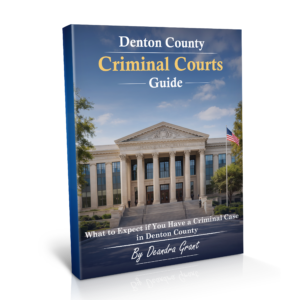
Denton County Criminal Courts Guide
By Attorney Deandra Grant
If you’re facing a criminal charge in Denton County, understanding how the local courts work can make the process far less confusing. This guide explains where cases are heard, what each court handles, and what you can expect as your case moves through the system.
Read NowLewisville Cocaine Defense Lawyers
Cocaine charges arising in Lewisville are prosecuted by the Denton County District Attorney’s Office and heard in the District Courts at the Denton County Courthouse, 1450 E. McKinney Street, Denton, TX 76209. Cocaine is a Penalty Group 1 controlled substance under Texas Health and Safety Code §481.102. Possession of as little as 1 gram is a second-degree felony. Possession of 4 grams or more is a first-degree felony with a potential life sentence.
I-35E runs through Lewisville and is one of the most actively enforced drug trafficking corridors in North Texas. A significant proportion of cocaine arrests in the Lewisville area arise from traffic stops on I-35E, where interdiction units target vehicles traveling both northbound and southbound along the corridor. The legality of the stop and the basis for any subsequent search are the first issues examined in every I-35E cocaine case.
Deandra Grant Law has defended cocaine charges in Denton County for more than 30 years. Managing Partner Deandra Grant holds the ACS-CHAL Forensic Lawyer-Scientist designation, a Master of Science in Pharmaceutical Science, and a Graduate Certificate in Forensic Toxicology. Partner Douglas Huff holds the same ACS-CHAL designation. Every cocaine case at Deandra Grant Law begins with an independent review of the forensic evidence at the chemistry level.
How Denton County Cocaine Cases Are Processed
Drug specimens seized in Lewisville cocaine cases are typically submitted to the DPS Crime Lab in Garland for identification and quantification. The analytical methodology used and the chain of custody from seizure through laboratory analysis are both subject to independent examination.
Denton County has drug court programs for qualifying defendants, and diversion options may be available in some first-offense cases. Whether diversion is appropriate requires evaluating the specific charge, the defendant’s history, and the strength of the forensic evidence.
Denton County Cocaine Penalty Structure
Possession (§481.115)
- Less than 1 gram: State jail felony — 180 days to 2 years in state jail, fine up to $10,000.
- 1 gram to less than 4 grams: Third-degree felony — 2 to 10 years in TDCJ, fine up to $10,000.
- 4 grams to less than 200 grams: Second-degree felony — 2 to 20 years in TDCJ, fine up to $10,000.
- 200 grams to less than 400 grams: First-degree felony, enhanced minimum — 10 to 99 years, fine up to $100,000.
- 400 grams or more: Enhanced first-degree felony — 15 to 99 years, fine up to $100,000.
Delivery and Manufacturing (§481.112)
- Less than 1 gram: State jail felony — 180 days to 2 years, fine up to $10,000.
- 1 to less than 4 grams: Second-degree felony — 2 to 20 years, fine up to $10,000.
- 4 to less than 200 grams: First-degree felony — 5 to 99 years or life, fine up to $10,000.
- 200 to less than 400 grams: First-degree felony, enhanced minimum — 10 to 99 years or life, fine up to $100,000.
- 400 grams or more: First-degree felony, enhanced minimum — 15 to 99 years or life, fine up to $250,000.
Lewisville DWI & Criminal Defense
Criminal Defense DWI Assault BWI Cocaine Defense Drug Crime Defense DUID DWI with CDL Felony DWI Gun Crime Defense Hit & Run DWI Intoxication Assault Multiple DWIs Murder Defense Theft Defense Underage DWI WarrantsRelated Blogs
Can Police Get Into Your iPhone? How Apple’s New Security Is Reshaping Digital Evidence
By Douglas E. Huff | Partner, Deandra Grant Law | Dallas, Texas In March 2026, [...]
The Michael Morton Act, the Richard Miles Act and the Heath Opinion Now Under Fire
Most people who are not lawyers do not think much about criminal discovery. It sounds [...]
Pitchford v. Cain: What a Batson Challenge Is, and Why the Jury Is Often Decided Before the First Witness
By Deandra Grant | Deandra Grant Law | Dallas, Texas On May 28, 2026, the [...]
Probabilistic DNA Software in the Courtroom: What Defense Lawyers Need to Watch For
This month Cybergenetics (the company behind the TrueAllele probabilistic genotyping system) announced the launch of [...]
Texas SB 4 Goes Live May 15: What Defense Lawyers and Their Clients Need to Know Right Now
On April 24, 2026, the en banc Fifth Circuit vacated the preliminary injunction that had [...]
How Forensic Misconduct Can Unravel a Conviction: The Missy Woods Case and What It Means for Texas
For 29 years, Yvonne “Missy” Woods was a star analyst at the Colorado Bureau of [...]
Can the Algorithm Convict You? TrueAllele and a Defendant’s Right to Cross-Examine the Code
In March 2026, the U.S. Court of Appeals for the Third Circuit handed prosecutors a [...]
Can a Texas Warrant Expire or Does It Follow You Forever?
One of the most common misconceptions about warrants in Texas is that they eventually expire [...]
The Forensic Science Defense in Lewisville Cocaine Cases
Article 38.23 and the I-35E stop. Texas’s exclusionary rule carries no good faith exception. Many Lewisville cocaine arrests arise from traffic stops on I-35E, where officers use equipment violations, lane change infractions, and other pretextual bases to conduct stops on vehicles targeted for drug interdiction. The specific basis for the stop, whether any consent to search was truly voluntary, and whether a drug dog alert constituted valid probable cause are examined before any other defense strategy is built.
Field test reliability. Presumptive field tests are not definitive and are known to produce false positives for cocaine on a range of legal substances. A positive field test is not a conviction. It is the starting point for a laboratory analysis that is itself subject to challenge.
Weight determinations at threshold values. The penalty tier is driven entirely by weight. Cocaine is commonly sold in mixtures containing adulterants and cutting agents. Whether the DPS lab correctly weighed only the controlled substance mixture (and whether the measurement falls above or below a penalty threshold) is a legitimate forensic challenge, particularly at the 1-gram and 4-gram cutoffs where the margin of instrument error is material.
Laboratory accreditation and protocol. Deviations in sample handling, instrument calibration, analyst qualifications, or chain of custody can render results inadmissible or subject to effective challenge at trial.
Chain of custody. Every transfer of the seized substance (from the arresting officer to the evidence locker to the laboratory) must be documented without interruption. Breaks in the chain of custody create grounds to question whether the substance tested is the same one seized from the defendant.
Related Videos
Important Criminal Videos
Choosing a criminal defense attorney
Why shouldn’t I use a court ordered attorney
Your rights after a drug crime arrest
Steps to take after a drug crime arrest
How can an attorney help me with a warrant?
Consequences of marijuana possession
How long does a criminal defense case take?
Why Deandra Grant Law for Lewisville Cocaine Defense
- Denton County office. 30+ years in Denton County courts. 500+ trials to verdict statewide. The Denton County Courthouse and the Denton County DA’s office are familiar ground.
- ACS-CHAL Forensic Lawyer-Scientist — Deandra Grant and Douglas Huff. Laboratory methodology, mixture-weight calculation, and chain of custody challenged at the chemistry level.
- Master of Science in Pharmaceutical Science + Graduate Certificate in Forensic Toxicology. Cocaine chemistry, adulterant analysis, and the forensic science underlying every stage of the State’s evidence.
- I-35E interdiction defense. Pretextual traffic stops on the I-35E corridor are examined for the lawfulness of the stop, the voluntariness of any consent, and the validity of any probable cause determination.
- Federal defense capability. James Lee Bright handles federal cocaine cases in the Eastern District of Texas (Sherman Division).
- 17 published law books. Including Arrested for Drug Charges in Texas
- Texas Super Lawyer since 2011. AV® Preeminent rated by Martindale-Hubbell®.
If you are facing cocaine charges in Denton County, call (214) 225-7117 for a free, confidential consultation. Or schedule online at texasdwisite.com.
Client Reviews

“Deandra Grant Law – Criminal & DWI Defense handled my case with diligence and professionalism. Deandra Grant’s reputation is stellar and now I know why. She has a team of individuals who provide quality service.”