
Manslaughter vs. Murder in Texas: The Mental State That Changes Everything

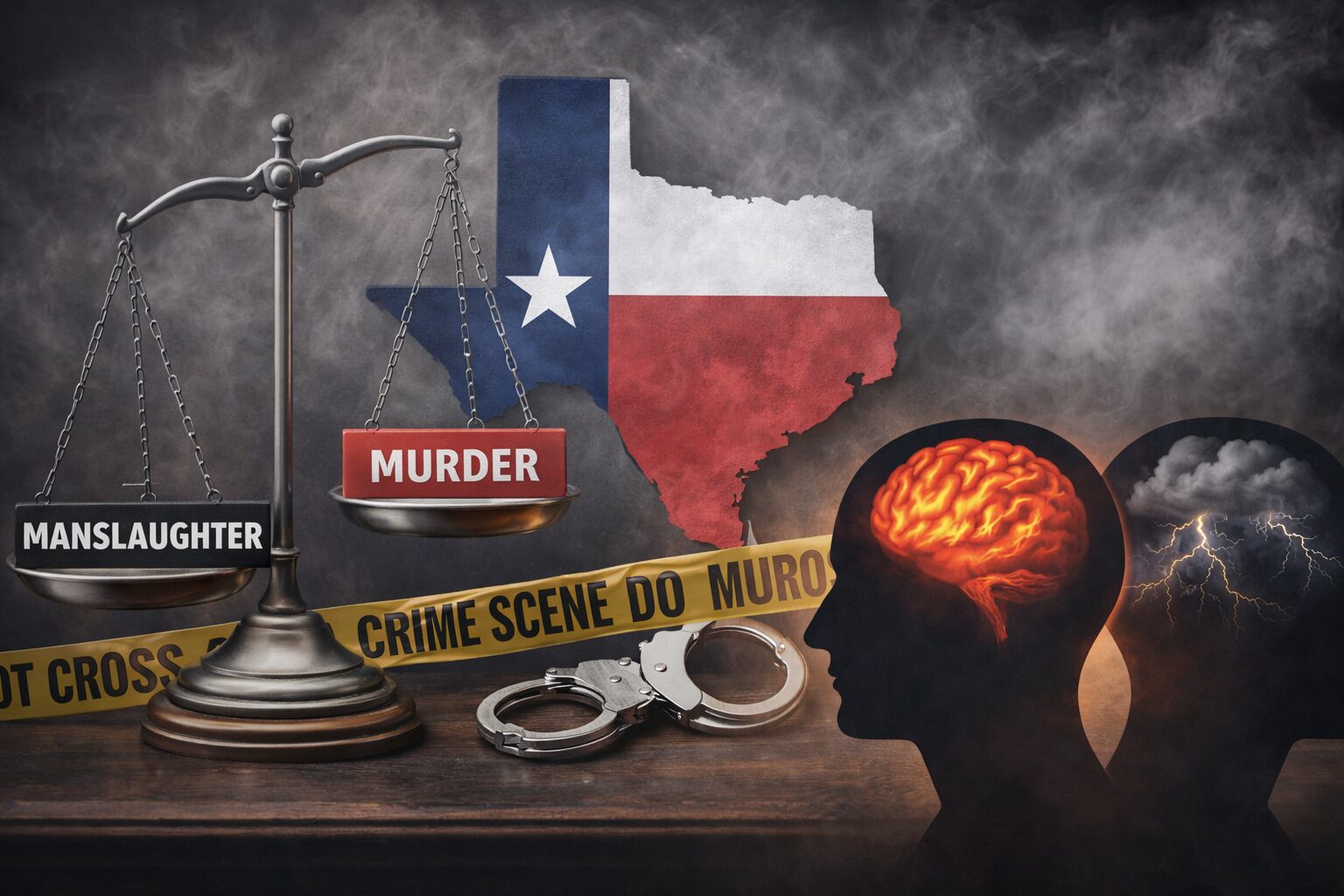
The difference between murder and manslaughter in Texas comes down to one word: the mental state. Murder requires that the defendant acted intentionally or knowingly. Manslaughter requires only recklessness. That single distinction determines whether a defendant faces a first-degree felony (5–99 years or life) or a second-degree felony (2–20 years). It determines parole eligibility, probation eligibility, and the trajectory of the defendant’s life. Understanding the line between reckless and intentional is essential for anyone facing a homicide charge in Texas.
Murder: Penal Code §19.02

Under §19.02(b)(1), a person commits murder if they intentionally or knowingly cause the death of an individual. Under Penal Code §6.03:
- Intentionally: The person’s conscious objective or desire was to cause the death.
- Knowingly: The person was aware that their conduct was reasonably certain to cause the death.
Murder is a first-degree felony: 5 to 99 years or life in prison, and a fine of up to $10,000. Murder is a 3g offense under CCP Article 42A.054, which means the judge cannot grant community supervision (probation). Only a jury can recommend probation for murder, and only if the sentence assessed does not exceed 10 years (which is rare in practice). Parole eligibility requires service of one-half of the sentence or 30 years, whichever is less, without consideration of good conduct time.
Manslaughter: Penal Code §19.04
Under §19.04(a), a person commits manslaughter if they recklessly cause the death of an individual. Under §6.03:
- Recklessly: The person was aware of but consciously disregarded a substantial and unjustifiable risk that the death would occur. The risk must be of such a nature and degree that its disregard constitutes a gross deviation from the standard of care that an ordinary person would exercise under all the circumstances.
Manslaughter is a second-degree felony: 2 to 20 years in prison and a fine of up to $10,000. Manslaughter is not a 3g offense, which means probation is available (both judge-ordered and jury-recommended). Parole eligibility follows the standard calculation: the defendant becomes parole-eligible after serving the lesser of one-quarter of the sentence or 15 years, with good conduct time applied. The practical difference in parole eligibility between murder and manslaughter is enormous.
Criminally Negligent Homicide: Penal Code §19.05
Below manslaughter on the culpability spectrum is criminally negligent homicide under §19.05. A person commits this offense if they cause the death of another by criminal negligence. Under §6.03, criminal negligence exists when a person ought to be aware of a substantial and unjustifiable risk that the death would occur. That is, the person fails to perceive the risk, as opposed to recklessness where the person perceives and disregards it.
Criminally negligent homicide is a state jail felony: 180 days to 2 years in a state jail facility and a fine of up to $10,000. This is the lowest homicide offense in Texas and carries the most favorable sentencing range.
The Mental State Spectrum: From Accident to Intent
Texas homicide law creates a spectrum of culpability based on the defendant’s mental state:
- No culpable mental state (accident): The death was truly accidental. No crime was committed.
- Criminal negligence (§19.05): The defendant should have been aware of the risk but wasn’t. State jail felony.
- Recklessness (§19.04): The defendant was aware of the risk and consciously disregarded it. Second-degree felony.
- Knowing (§19.02): The defendant was aware their conduct was reasonably certain to cause death. First-degree felony.
- Intentional (§19.02): The defendant’s conscious objective was to cause death. First-degree felony.
In every homicide case, the defense must evaluate where on this spectrum the defendant’s conduct falls and fight to push the case down the spectrum toward the lowest culpable mental state the evidence supports. Each step down the spectrum reduces the punishment range, improves probation eligibility, and reduces parole restrictions.
When DWI Deaths Are Charged as Murder
One of the most consequential applications of the murder/manslaughter distinction in Texas involves DWI-related deaths. Texas has a specific offense for intoxicated driving that causes death: intoxication manslaughter under §49.08 (second-degree felony, 2–20 years). But in certain circumstances, prosecutors charge DWI-related deaths as murder under §19.02 which then carries a punishment range of 5 to 99 years or life.
The prosecution’s theory is typically based on §19.02(b)(1) (knowingly causing death) or §19.02(b)(2) (intent to cause serious bodily injury with an act clearly dangerous to human life that causes death). The argument is that a person who drives while extremely intoxicated, who has prior DWI convictions, or who was warned by a court about the dangers of intoxicated driving, knows that their conduct is reasonably certain to cause death which elevates the mental state from recklessness (manslaughter) to knowing (murder).
These cases are sometimes called “DWI murder” cases, and they have become more common in Texas as prosecutors take a harder line on repeat DWI offenders who cause fatal crashes. The stakes are dramatically higher than intoxication manslaughter: murder carries a 5-year minimum, 3g parole restrictions, and no judge-ordered probation, while intoxication manslaughter carries a 2-year minimum with standard parole eligibility.
The defense in DWI murder cases attacks the mental state element. Did the defendant truly know that driving while intoxicated was reasonably certain to cause death? Or was the defendant aware of a risk (recklessness) without being aware that death was reasonably certain (knowledge)? The distinction is subtle but consequential, and it is fought over the defendant’s level of intoxication, their driving behavior, their prior DWI history, and any prior warnings from courts or treatment programs.
This is where Deandra Grant’s DWI defense expertise and forensic science credentials intersect with homicide defense. Her ACS-CHAL Forensic Lawyer-Scientist designation, SFST Instructor certification, and Master’s Degree in Pharmaceutical Science give her the ability to challenge the prosecution’s toxicology evidence, blood alcohol analysis, and retrograde extrapolation calculations with scientific precision. In a DWI murder case, the BAC evidence and the driving behavior evidence are the prosecution’s primary tools for establishing the “knowing” mental state and they are exactly the evidence Deandra has spent 30+ years challenging.
Manslaughter as a Lesser Included Offense in Murder Cases
In every murder trial, the defense must evaluate whether to request a jury instruction on manslaughter as a lesser included offense. Under the Hall v. State two-step analysis, the defendant is entitled to the instruction if (1) manslaughter is included within the proof necessary to establish murder, and (2) there is some evidence that, if believed, would permit a rational jury to find that the defendant was reckless but not intentional or knowing.
Manslaughter is always a lesser included offense of murder because every intentional or knowing killing also involves recklessness (a person who intentionally causes death necessarily consciously disregarded the risk of death). The question is whether there is evidence supporting the second step: evidence that the defendant’s mental state was reckless rather than intentional or knowing.
Requesting a manslaughter instruction is a strategic decision with significant consequences. On one hand, it gives the jury a compromise option in that they can convict of a second-degree felony rather than a first-degree felony, which dramatically reduces the defendant’s exposure. On the other hand, it gives the jury an alternative to acquittal, which may reduce the chance of a not-guilty verdict. The right decision depends on the strength of the evidence, the composition of the jury, and the overall defense theory.
Defense Strategies Across the Homicide Spectrum
Challenging the Mental State
The most common defense strategy in cases where a death has occurred but intent is disputed is to challenge the prosecution’s proof of the mental state. What evidence does the prosecution have that the defendant intended to kill, as opposed to acting recklessly? Did the defendant make statements showing intent? Was there a plan? Was there a motive? Or does the evidence show an impulsive, reckless act that resulted in an unintended death? The difference between these two narratives is the difference between murder and manslaughter.
Accident Defense
If the death was truly accidental (no culpable mental state at all) the defendant has committed no homicide offense. A gun that discharges accidentally during a struggle, a fall that occurs during a physical altercation that neither party intended to be deadly, or a death caused by a medical condition triggered by a non-criminal physical interaction may all support an accident defense. The defendant must present evidence establishing that their conduct did not involve intent, knowledge, recklessness, or even criminal negligence.
Self-Defense Leading to Manslaughter
In some cases, the jury may find that the defendant was partially justified in using force but that their response was disproportionate meaning the threat was real but the degree of force was excessive. While self-defense is a complete defense to murder, a jury that is not fully convinced of the proportionality of the response may reject self-defense at the guilt-innocence phase but find the circumstances mitigating at the punishment phase. In these situations, a manslaughter conviction (2–20 years) is a significantly better outcome than a murder conviction (5–99 years or life), and the sudden passion defense may further reduce the punishment range.
Homicide Defense at Deandra Grant Law
Every homicide case exists somewhere on the mental state spectrum. Where the case lands on that spectrum determines the charge, the punishment range, and the defendant’s future. Our job is to identify the lowest defensible position on the spectrum and build the case that puts the defendant there whether that means acquittal, manslaughter instead of murder, criminally negligent homicide instead of manslaughter, or no criminal liability at all.
With offices in Dallas, Fort Worth, Allen, Denton, Waco, and Rockwall, we defend homicide cases across North Texas. Call (214) 225-7117 or visit texasdwisite.com for a confidential consultation.
Which county your case is filed in changes how it is charged, who prosecutes it, and which court hears it.
Deandra M. Grant, JD, GC, MS, ACS-CHAL Forensic Lawyer-Scientist
She holds a Master of Science in Pharmaceutical Science and a Graduate Certificate in Forensic Toxicology, both from the University of Florida. She is the author of The Texas DWI Manual and has defended Texas DWI cases since 1994.
Facing Criminal Charges in Texas?
The sooner a defense lawyer is involved, the more can be done to protect your record and your freedom. Talk to us today.
Request a Free Case Evaluation
Tell us what happened. We'll respond as soon as possible.