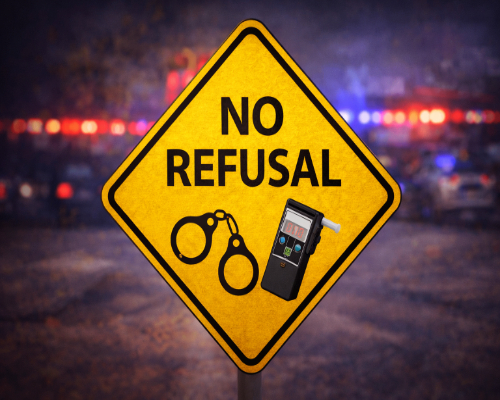
“No Refusal Weekend” is a press release, not a law. There is no Texas statute that creates a special enforcement period called a No Refusal Weekend. There is no provision that grants law enforcement additional powers on Memorial Day that they do not have on a Tuesday in February. What changes on a No Refusal Weekend is staffing and logistics but not the law.
Understanding what actually happens during these enforcement periods, and what the real consequences of refusing a breath test are year-round, is more useful than the version law enforcement publicizes.
What “No Refusal” Actually Means
Texas officers have always had the authority to seek a blood draw warrant when a driver refuses a breath test. That authority exists 365 days a year. A magistrate is always available to review a warrant application. The law does not change on a holiday weekend.
What changes during an announced No Refusal Weekend is this: prosecutors and judges volunteer to be on standby specifically to process blood warrant applications faster. Instead of an officer spending time locating an on-call magistrate, the magistrate is already waiting. The warrant paperwork may be pre-drafted. The turnaround from refusal to signed warrant is shorter.
That is the entirety of what a No Refusal Weekend is. A staffing arrangement. A commitment by the DA’s office and the judiciary to make the warrant process faster on nights when DWI arrests are expected to be high. The underlying legal authority (to seek a warrant, to draw blood pursuant to that warrant) is identical to any other night.
Law enforcement announces these programs publicly because the announcement itself is the point. The goal is deterrence. If drivers believe that refusing a breath test is futile on a holiday weekend, some will not refuse. The press release is the enforcement tool. The law is unchanged.
Why This Matters for Your Decision at the Side of the Road
The widespread belief that refusing a breath test is only futile on No Refusal Weekends creates a dangerous misunderstanding: that refusing is a viable strategy the rest of the year. It is not, for several reasons.
Officers Can Seek a Warrant Any Night
In Dallas County, Collin County, Denton County, and Tarrant County, prosecutors and law enforcement have the infrastructure to obtain blood draw warrants routinely and not just on announced No Refusal Weekends. The warrant process has become faster and more routine across North Texas over the past decade. Whether it is a long weekend in July or a Wednesday night in November, a DWI arrest that results in a refusal can result in a blood draw by warrant.
Refusal Triggers a Longer License Suspension
Under Texas’s Administrative License Revocation (ALR) system, the consequences for refusing a breath or blood test are worse than the consequences for failing one. A first-offense failed breath or blood test triggers a 90-day ALR suspension. A first-offense refusal triggers a 180-day suspension. For a second or subsequent offense, the suspension for refusal is two years. The ALR consequences attach regardless of whether a blood draw warrant was subsequently obtained and regardless of the outcome of the criminal case.
Your Refusal Is Admissible at Trial
Under Texas Transportation Code §724.061, evidence that a defendant refused to submit to a breath or blood test is admissible at trial. The prosecutor will tell the jury you refused. The jury is permitted to draw reasonable inferences from that refusal. For many jurors, refusal reads as consciousness of guilt. A defendant who refused and whose blood was then drawn by warrant faces a jury that knows about the refusal and sees the blood test result. The refusal did not prevent the evidence. It only added a piece of evidence the prosecution can use.
Warrant Blood Results Are Harder to Challenge
There is an irony in the conventional refusal strategy that is underappreciated: breath test results are generally more vulnerable to defense challenge than properly collected blood test results. The Intoxilyzer 9000 has documented vulnerabilities (partition ratio variability, mouth alcohol, calibration and observation period requirements) that experienced DWI defense counsel can exploit. A blood draw pursuant to a warrant, performed by a qualified phlebotomist, with documented chain of custody, submitted to a forensic laboratory for GC-MS analysis, produces a result that is harder to attack. Refusing the breath test and forcing a blood draw by warrant often results in stronger prosecution evidence, not weaker.
What No Refusal Weekends Do Not Change
The following are the same on a No Refusal Weekend as on any other night:
The legal standard for a blood draw warrant. The warrant affidavit must establish probable cause to believe the person was operating a motor vehicle while intoxicated. The magistrate must find that showing sufficient. A pre-drafted form does not lower the legal standard and a warrant signed on a holiday weekend without adequate probable cause is subject to the same Fourth Amendment challenge as any other defective warrant.
Your right to refuse. You can refuse a breath test on a No Refusal Weekend. The consequence is a longer ALR suspension and an admissible refusal at trial. It’s not a criminal penalty specific to the refusal itself. No law prohibits the refusal.
The warrant’s vulnerability to challenge. A blood draw warrant obtained on a No Refusal Weekend is a warrant. If the affidavit supporting it misstates the facts of the stop, omits information that would have defeated probable cause, or is otherwise legally deficient, the blood draw and its results may be suppressible. Texas’ Article 38.23 exclusionary rule carries no good faith exception. A defective warrant produces suppressible evidence regardless of whether it was signed on a holiday weekend or a Tuesday in March.
The reliability requirements for the blood analysis. A blood specimen drawn pursuant to a warrant must still be collected by a qualified person using proper procedures, stored appropriately, and analyzed by an accredited laboratory using validated methodology. The warrant authorizes the draw. It does not guarantee the reliability of the result. Chain of custody, collection procedure, storage conditions, and laboratory methodology are all subject to independent examination regardless of when the draw occurred.
The Breath Test vs. Blood Test Decision
Because the no-refusal framing has distorted the public understanding of this decision, it is worth stating the analysis plainly.
If you are stopped for a suspected DWI in North Texas, the relevant questions are not whether it is a No Refusal Weekend. The relevant questions are:
Will a blood draw warrant issue if I refuse? In most cases in Dallas, Collin, Denton, and Tarrant counties, the honest answer is: possibly, and with increasing frequency. The infrastructure exists. The staffing to support it has expanded well beyond announced holiday weekends.
Which result is more defensible — a breath test result or a blood test result? This depends on the facts. Breath test results have well-documented vulnerabilities that can be exploited by attorneys with forensic chemistry training. A warrant blood draw, properly conducted, produces a more reliable result that is harder to challenge. In no-refusal counties, refusing often produces the prosecution’s stronger evidence.
What are the ALR consequences of each choice? A failed test triggers a 90-day first-offense suspension. A refusal triggers 180 days. These consequences run independently of the criminal case.
There is no universal answer to the breath test question. There is, however, a universal answer to the No Refusal Weekend question: it does not change the legal analysis. The decision is the same question every night of the year.
Block "blog-awards" not found
Field Sobriety Tests: A Separate Question
No Refusal Weekend announcements sometimes create confusion about field sobriety tests as well. The answer there is clearer: there is no Texas statute requiring you to perform Standardized Field Sobriety Tests, and there is no ALR consequence for declining them. SFST refusal does not trigger implied consent penalties. You can decline field sobriety tests without statutory consequence, on a No Refusal Weekend or any other night.
If You Were Arrested During a No Refusal Weekend
A DWI arrest during a No Refusal Weekend is not meaningfully different from one on any other night. The same defenses apply. The same forensic challenges apply to the evidence. The 15-day ALR hearing deadline applies from the date of arrest regardless of when the arrest occurred.
If blood was drawn by warrant, the warrant affidavit, the blood collection procedure, the chain of custody, and the laboratory analysis are all subject to independent examination. Deandra Grant Law holds the ACS-CHAL Forensic Lawyer-Scientist designation — both Managing Partner Deandra Grant and Partner Douglas Huff — allowing evaluation of blood test evidence at the analytical chemistry level, not just the procedural level. Deandra Grant is also a trained SFST instructor and challenges field sobriety test administration in every case.
If you were arrested for DWI in North Texas, call (214) 225-7117 for a free, confidential consultation. The 15-day ALR deadline runs from the date of arrest. Do not wait.
Block "blog-testimonial-video" not found