By Deandra Grant, J.D., M.S. (Pharmaceutical Science), ACS-CHAL Forensic Lawyer-Scientist
After a DWI arrest in Texas, one of the first things you will lose is your driver’s license. Whether you failed the breath test or refused it, the Texas Department of Public Safety will initiate an Administrative License Revocation (ALR) that suspends your driving privileges. If you do nothing, the suspension takes effect on the 40th day after your arrest.
For most people, losing the ability to drive is the most immediate and disruptive consequence of a DWI arrest. It is more immediate than the criminal case which may take months to resolve. You need to get to work. You need to take your children to school. You need to get to medical appointments. You need to buy groceries. And your license is about to be suspended.
Texas law provides two separate pathways to restore restricted driving privileges during a DWI-related license suspension: the Occupational Driver’s License (ODL) and the Ignition Interlock Restricted License. These are not the same thing. They have different requirements, different restrictions, different costs, and different advantages. Understanding both options, and choosing the right one for your situation, is one of the first strategic decisions your defense attorney should help you make.
The Timeline: What Happens to Your License After a DWI Arrest
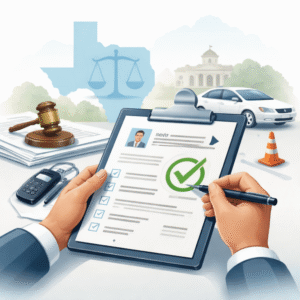
The moment you are arrested for DWI and either fail or refuse the breath or blood test, the officer will confiscate your driver’s license and issue a temporary driving permit. This permit is valid for 40 days. After 40 days, the ALR suspension takes effect automatically unless you take action.
The 15-Day ALR Hearing Deadline
You have 15 days from the date you are served notice of suspension to request an ALR hearing to challenge the suspension. This hearing is a separate proceeding from the criminal case, conducted before an administrative law judge at the State Office of Administrative Hearings (SOAH). At the ALR hearing, the issues are narrow: was there reasonable suspicion for the stop, was there probable cause for the arrest, was the defendant offered the opportunity to provide a specimen, and was the test result 0.08 or higher (or did the defendant refuse)?
If you prevail at the ALR hearing, your license is not suspended. If you do not prevail the suspension goes into effect immediately.
ALR Suspension Periods
- First offense, failed test (BAC ≥ 0.08): 90-day suspension
- First offense, refused test: 180-day suspension
- Repeat offense or prior ALR suspension, failed test: 1-year suspension
- Repeat offense or prior ALR suspension, refused test: 2-year suspension
These suspension periods are significant. A 2-year suspension for a repeat offender who refused the test means two years without a full driver’s license. Without a restricted license, the defendant cannot legally drive at all during this period. This is why the choice between the ODL and the ignition interlock license matters so much.
Two Pathways to Restricted Driving Privileges
Texas law provides two distinct mechanisms for restoring limited driving privileges during a DWI-related suspension. They are not interchangeable, and the right choice depends on the defendant’s specific circumstances.
Pathway 1: The Occupational Driver’s License (ODL)
The Occupational Driver’s License is governed by Transportation Code Chapter 521, Subchapter L (§§521.242–521.248). It is a court-issued restricted license that allows the defendant to drive for essential purposes only during specified hours.
How to Obtain an ODL
The ODL requires a court petition. Your attorney files a verified petition in the court that has jurisdiction over the suspension (typically the county court in the county where you reside or where the DWI occurred). The petition must include:
- A statement of the reason for the suspension
- Evidence of the essential need to drive (employment verification, school enrollment, medical documentation, or household necessity)
- A proposed driving schedule identifying the hours and days during which the defendant needs to drive
- Proof of financial responsibility which will be an SR-22 certificate from an insurance company that issues them (usually separate from your car insurance)
The court will hold a hearing on the petition. If the judge is satisfied that the defendant has an essential need and that the restrictions are appropriate, the judge will sign an order granting the ODL and specifying the conditions.
ODL Restrictions
The ODL comes with significant limitations:
- 12-hour daily maximum: Under 521.248, the court order must specify the hours during which the defendant is permitted to drive, and the total driving time cannot exceed 12 hours in any 24-hour period. This means the defendant must plan their driving around a fixed window (or example, 6 AM to 6 PM, or 7 AM to 7 PM) and cannot drive outside that window for any reason.
- Essential purposes only: The ODL permits driving for work, school, medical appointments, and essential household duties (such as grocery shopping). Driving for recreational purposes, social events, or any non-essential activity is not permitted.
- Must carry the court order: The defendant must carry a certified copy of the court order at all times while driving on the ODL. If stopped by law enforcement, the defendant must present the court order as proof of their restricted driving privileges. Driving without the court order is a violation that can result in additional criminal charges.
- Geographic restrictions may apply: Depending on the judge, the court order may specify geographic limitations restricting driving to certain counties or routes.
When the ODL Is the Better Option
The ODL may be the better choice for defendants who:
- Cannot afford the monthly cost of an ignition interlock device ($70–$100+ per month)
- Drive a vehicle that cannot accommodate an IID (certain older vehicles, diesel engines, or motorcycles)
- Share a vehicle with other drivers who do not want an IID installed
- Have a straightforward driving schedule that fits within a 12-hour window
Pathway 2: The Ignition Interlock Restricted License
The Ignition Interlock Restricted License is a fundamentally different pathway from the ODL, and for many DWI defendants, it is the better option.
How to Obtain an Ignition Interlock License
Like the ODL, the ignition interlock license requires a court petition and a hearing. The process requires:
- Installation of a certified ignition interlock device (IID) on every vehicle the defendant operates
- Proof of IID installation from a certified provider
- Proof of financial responsibility (SR-22 certificate)
- Payment of applicable DPS fees
Once the IID is installed and the order is submitted, DPS issues the restricted license.
Ignition Interlock License Advantages
The ignition interlock license has two critical advantages over the ODL:
- No hourly restrictions. Unlike the ODL’s 12-hour daily maximum, the ignition interlock license allows the defendant to drive at any time of day or night. There is no fixed driving window. The defendant can drive to work at 5 AM, pick up children at 3 PM, attend an evening appointment, and drive home at 10 PM legally, as long as the IID is functioning.
- No purpose restrictions. The ignition interlock license does not limit driving to essential purposes. The defendant can drive for any lawful reason, including social activities, recreation, and travel within Texas. The restriction is the device, not the schedule.
How the IID Works
An ignition interlock device is a breathalyzer unit wired into the vehicle’s ignition system. Before starting the vehicle, the driver must provide a breath sample. If the sample registers above a preset threshold (typically 0.02–0.025% BAC), the vehicle will not start. The device also requires periodic rolling retests while the vehicle is in operation which means the driver must provide additional breath samples at random intervals while driving. If the driver fails a rolling retest or does not provide a sample, the device logs the event and may trigger an alarm (horn honking, lights flashing) but will not shut off the engine while the vehicle is in motion.
The IID records every test result, every failed attempt, every missed retest, and every instance of tampering or circumvention. These records are downloaded at regular service appointments (typically every 30–60 days) and reported to DPS and, in some cases, to the court. Violations (failed tests, missed retests, tampering attempts) can result in extension of the IID requirement or revocation of the restricted license.
IID Costs
The defendant bears all costs associated with the IID:
- Installation: $75–$150, depending on the provider and vehicle
- Monthly monitoring and maintenance: $70–$100 per month
- Removal: $50–$100 at the end of the restriction period
- Calibration and service appointments: Typically included in the monthly fee, but missed appointments may incur additional charges
Over a 12-month restriction period, the total cost of the IID can range from $1,000 to $1,500 or more. This is a significant expense, but for many defendants, the freedom to drive without hourly restrictions is worth the cost.
When the Ignition Interlock License Is the Better Option
The ignition interlock license is typically the better choice for defendants who:
- Have unpredictable or non-standard work schedules (shift work, on-call employment, gig economy)
- Need to drive outside a 12-hour window regularly
- Want the flexibility to drive for non-essential purposes (social, recreational, travel)
- Want a faster, simpler process (no court petition or hearing required)
- Can afford the monthly IID costs
SR-22 Insurance: Required for Both Pathways
Regardless of whether the defendant pursues an ODL or an ignition interlock license, Texas requires proof of financial responsibility in the form of an SR-22 certificate. An SR-22 is not a separate insurance policy. It is a certification filed by the SR-22 insurance company with DPS confirming that the defendant maintains at least the minimum liability coverage required by Texas law.
The practical impact is that the defendant’s auto insurance premiums may increase. Insurance companies view DWI-related SR-22 filings as a high-risk indicator, and premiums may double or triple. The SR-22 must be maintained for two years from the date of filing. If the defendant’s insurance lapses at any point during the two-year period, the insurance company is required to notify DPS, and the defendant’s license will be suspended again.
Shopping for SR-22 insurance before the suspension takes effect is important. Not all insurance companies offer SR-22 filings, and rates vary significantly. We recommend Concept SR-22 for our clients
Timing: Don’t Wait Until the Suspension Takes Effect
The most common mistake defendants make with their license is waiting too long to act. Here is the critical timeline:
- Day 0: DWI arrest. Officer confiscates license. Temporary driving permit issued (valid 40 days).
- Day 15: Deadline to request an ALR hearing. If you miss this, the suspension will take effect automatically on Day 40 with no opportunity to challenge it.
- Day 40: ALR suspension takes effect unless the defendant prevailed at the ALR hearing or an ODL/ignition interlock license is already in place.
If the ALR hearing is requested within 15 days, the hearing itself may not occur until after the 40th day. In that case, the temporary driving permit is in effect until the hearing takes place.
How the Restricted License Interacts with the Criminal Case
The ODL and the ignition interlock license address the administrative license suspension (ALR) triggered by the arrest. This is a separate proceeding from the criminal DWI case. If the defendant is subsequently convicted of DWI, the criminal court may impose an additional license suspension as part of the sentence which is separate from and in addition to the ALR suspension.
Under Transportation Code §521.344, a DWI conviction results in:
- First offense: Suspension of up to 1 year
- Second offense: Suspension of up to 2 years
- Third or subsequent offense: Suspension of up to 2 years
If the defendant already has an ODL or ignition interlock license in place from the ALR suspension, and a conviction-based suspension is subsequently imposed, the defendant may need to file a new or modified ODL petition or update their ignition interlock license application to cover the new suspension period. The two suspension periods may overlap or run consecutively depending on the timing.
This is one of the reasons the criminal case strategy and the license strategy must be coordinated. A plea negotiation that results in a conviction may carry license consequences that extend beyond the ALR suspension. The defense attorney must advise the client on the full picture and not just the criminal penalties, but the administrative consequences for their driving privileges.
What Happens If You Violate the Restrictions
Driving outside the terms of an ODL or ignition interlock license is a criminal offense. Under §521.461, operating a motor vehicle in violation of a restriction imposed on an occupational license is a Class B misdemeanor which is the same classification as a first-offense DWI. This means a defendant who is caught driving outside their 12-hour ODL window or driving a vehicle without an installed IID faces additional criminal charges on top of the original DWI.
For IID violations (failed breath tests, missed rolling retests, tampering), the consequences depend on the specific violation and the supervising authority. DPS may extend the IID requirement period. The court (if the IID was ordered as a condition of bond or probation) may revoke bond or file a motion to revoke community supervision. Repeated violations can result in revocation of the restricted license entirely, leaving the defendant with no legal ability to drive.
The bottom line: once you have a restricted license, comply with every condition meticulously. The consequences of a violation can be worse than the consequences of the original DWI.
License Defense at Deandra Grant Law
Protecting your ability to drive is one of the most urgent priorities after a DWI arrest and it requires action within days, not weeks. The 15-day ALR hearing deadline and the 40-day suspension date create a window that closes quickly. Choosing between the ODL and the ignition interlock license, obtaining SR-22 insurance and filing the petition are all time-sensitive tasks that should begin the day you retain counsel.
At Deandra Grant Law, the license defense strategy is part of the DWI defense strategy from the first consultation. We request an ALR hearing for every client who retains us within their ALR request window. If the license is suspended we advise on which restricted license pathway is right for the client’s situation.
If you have been arrested for DWI in North Texas, call (214) 225-7117 or visit texasdwisite.com. The clock is already running.