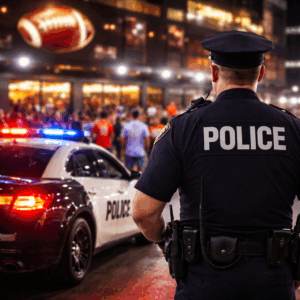
Super Bowl Sunday is one of the most heavily enforced DWI days in Texas. Law enforcement agencies across the state (municipal police, county sheriffs, and DPS troopers) deploy additional patrols specifically because they know traffic volume will be high, alcohol consumption will be elevated, and the number of impaired drivers on the road will spike in the hours after the game ends. If you are driving in Texas on Super Bowl Sunday or in the early hours of the following morning, the probability of encountering a DWI enforcement officer is significantly higher than on an ordinary evening.
This blog explains what that enforcement environment actually looks like, what Texas DWI law requires the prosecution to prove, what you should and should not do if you are stopped, and what the consequences are if you are arrested.

"Deandra Grant Law – Criminal & DWI Defense handled my case with diligence and professionalism. Deandra Grant's reputation is stellar and now I know why. She has a team of individuals who provide quality service."
- N. Coulter
"Deandra Grant Law – Criminal & DWI Defense fights hard for their clients and is always willing to go above and beyond. They are the best firm for DWI cases in DFW and beyond. Definitely hire them to represent you in any pending cases."
- P. Williams
"Deandra Grant made a tough situation so much better. She listened to my concerns and helped me so much with my case. I would recommend her to anyone needing legal services."
- M. Haley
Why Super Bowl Sunday Produces More DWI Arrests
The enforcement spike is not random. It is a predictable response to a predictable pattern. Several factors combine to make Super Bowl Sunday one of the highest-risk DWI enforcement nights of the year:
Extended drinking window. Pre-game gatherings often begin hours before kickoff. By the time the game ends (typically around 10 p.m. in Texas) many people have been drinking for five to seven hours. This extended consumption window produces higher blood alcohol concentrations than a typical evening out and, critically, produces drivers who have been in the elimination phase of alcohol metabolism for varying periods. Someone who stopped drinking at halftime may feel sober by the end of the game but still be above 0.08% depending on how much they consumed.
Late-night driving window. The game ends late on a Sunday night. The post-game driving window (roughly 10 p.m. to 2 a.m.) is when law enforcement is most actively looking for impaired drivers. Unlike a Friday or Saturday night, this is a work and school night, which means many drivers who might otherwise get a ride are concerned about getting home.
Heightened patrol presence. Texas law enforcement agencies increase patrol staffing on Super Bowl Sunday. Unlike some states, Texas does not conduct sobriety checkpoints. Instead, officers increase roving patrols on arterials, near bar and restaurant districts, and on highway corridors. The number of officers looking for DWI indicators is significantly higher than on a typical Sunday night.
What Texas DWI Law Actually Requires
Texas Penal Code §49.04 defines DWI as operating a motor vehicle in a public place while intoxicated. “Intoxicated” has two definitions, either of which is sufficient for a conviction:
- Per se intoxication: A blood alcohol concentration of 0.08% or greater at the time of driving.
- Impairment intoxication: Not having the normal use of mental or physical faculties by reason of the introduction of alcohol, a controlled substance, a drug, or a combination of substances.
The second definition is important because it does not require a breath or blood test result above 0.08%. A driver with a BAC of 0.06% can still be convicted of DWI if the prosecution proves impairment of normal faculties. This is the theory under which many Super Bowl Sunday DWI cases are prosecuted: the officer observed driving behavior and personal characteristics that the prosecution argues establish impairment, regardless of the chemical test result.
Texas DWI Penalties: What You Are Actually Facing
First DWI Offense — Class B Misdemeanor
The mandatory minimum is 72 hours in county jail. The range is 72 hours to 180 days. If an open container of alcohol was in the passenger area of the vehicle at the time of the arrest, the mandatory minimum increases to 6 days. Fine up to $2,000. License suspension 90 days to 1 year.
First offense deferred adjudication (HB 3582, 2023): A first-offense DWI defendant with no prior DWI convictions and a recorded BAC below 0.15% may be eligible for deferred adjudication. An ignition interlock device is required. Successful completion results in dismissal and potential non-disclosure of the record. This option is unavailable if the BAC was 0.15% or higher.
Second DWI Offense — Class A Misdemeanor
Mandatory minimum of 30 days in county jail. Range: 30 days to 1 year. Fine up to $4,000. License suspension 180 days to 2 years. No deferred adjudication available.
Third DWI Offense — Third-Degree Felony
2 to 10 years in TDCJ. Fine up to $10,000. A permanent felony conviction on the record.
Intoxication Assault — Third-Degree Felony
When a DWI causes serious bodily injury to another person, the charge escalates to intoxication assault under §49.07. Serious bodily injury means injury that creates a substantial risk of death, causes permanent disfigurement, or causes protracted loss or impairment of a bodily organ. Punishment range: 2 to 10 years in TDCJ, fine up to $10,000.
Intoxication Manslaughter — Second-Degree Felony
When a DWI causes the death of another person, the charge is intoxication manslaughter under §49.08 which is a second-degree felony carrying 2 to 20 years in TDCJ and a fine up to $10,000. This is a distinct offense from intoxication assault; the death of the victim is the element that triggers it. Texas’ Bentley’s Law also requires the defendant to pay monthly child support to the deceased victim’s minor children until each child turns 18.
If You Are Stopped on Super Bowl Sunday: What to Do — and What Not to Do
You Do Not Have to Answer Questions About Drinking
When an officer stops your vehicle, you are required to provide your driver’s license, registration, and proof of insurance. You are not required to answer questions about whether you have been drinking, where you are coming from, or how much you have had to drink. Politely decline to answer: “I’d prefer not to answer questions without speaking to an attorney.” This is not suspicious. It is a constitutional right.
Field Sobriety Tests: You Can Decline
You are not legally required to perform field sobriety tests in Texas. This is worth understanding at a scientific level, not just a legal one.
The three standardized field sobriety tests (HGN, Walk and Turn, and One Leg Stand) were validated by NHTSA under controlled conditions, on stable flat surfaces, in adequate lighting, administered by trained officers following the protocol exactly. The accuracy figures the prosecution cites in court apply under those conditions. They do not apply when:
- The test is administered on a sloped or uneven shoulder after the driver has been sitting for hours
- The officer deviates from the NHTSA administration protocol
- The driver has a medical condition, inner ear issue, or physical injury affecting balance
- The driver is over 65 or significantly overweight — populations outside the original validation studies
- Environmental conditions (cold, wind, passing headlights) differ from the validation environment
HGN alone has more than 47 documented causes other than alcohol, including inner ear disorders, certain medications, and naturally occurring nystagmus. A positive SFST result is not proof of intoxication. It is the starting point for a legal challenge.
Deandra Grant is a certified SFST instructor who administers and grades these tests for professional certification examinations. If you are arrested after performing SFSTs, that administration will be scrutinized at the protocol level by someone who teaches these tests for a living.
Case Results
Breath and Blood Tests: Understand the Consequences of Refusal
Texas’s implied consent law means that by driving in the state, you have agreed to submit to chemical testing if lawfully requested. Refusing a breath or blood test after a DWI arrest triggers an automatic Administrative License Revocation which is a license suspension that is separate from and in addition to any criminal consequences. The refusal itself can also be used as evidence against you at trial.
This is a genuine strategic decision that should be made with awareness of the consequences, not reflexively. In some cases, refusing a test may be the right call. In others, submitting and challenging the result forensically is the better approach. There is no universal answer.
The ALR Deadline: 15 Days
If you are arrested for DWI and fail or refuse a breath or blood test, DPS will initiate an Administrative License Revocation proceeding. You have 15 days from the date you receive the notice of suspension to request an ALR hearing. If you miss this deadline, the suspension takes effect automatically and the hearing opportunity is gone. Contact a DWI attorney immediately after an arrest and not after the 15-day window has closed.
If You Were Arrested After the Super Bowl
A Super Bowl Sunday DWI arrest is not an automatic conviction. The forensic evidence (the breath test, the blood draw, the field sobriety tests) can be challenged. The legality of the stop can be challenged. The chain of custody for blood specimens can be challenged. The retrograde extrapolation the prosecution uses to project your BAC backward to the time of driving can be challenged.
Deandra Grant Law defends DWI charges across North and Central Texas. Managing Partner Deandra Grant holds the ACS-CHAL Forensic Lawyer-Scientist designation, a Master’s Degree in Pharmaceutical Science, a Graduate Certificate in Forensic Toxicology, and is a trained SFST instructor. Partner Douglas Huff holds the same ACS-CHAL designation. These credentials exist precisely for cases where the forensic evidence is the entire prosecution (which is most DWI cases).
Call (214) 225-7117 for a free, confidential consultation. Or schedule online at texasdwisite.com. If you received a notice of suspension after your arrest, the 15-day ALR deadline is already running.
Firm Accolades

Better Business Bureaus

D Magazine